Tag: Ratha Jatra

  • Adhara Pana

    Published on 30 June 2023 in Indian Express

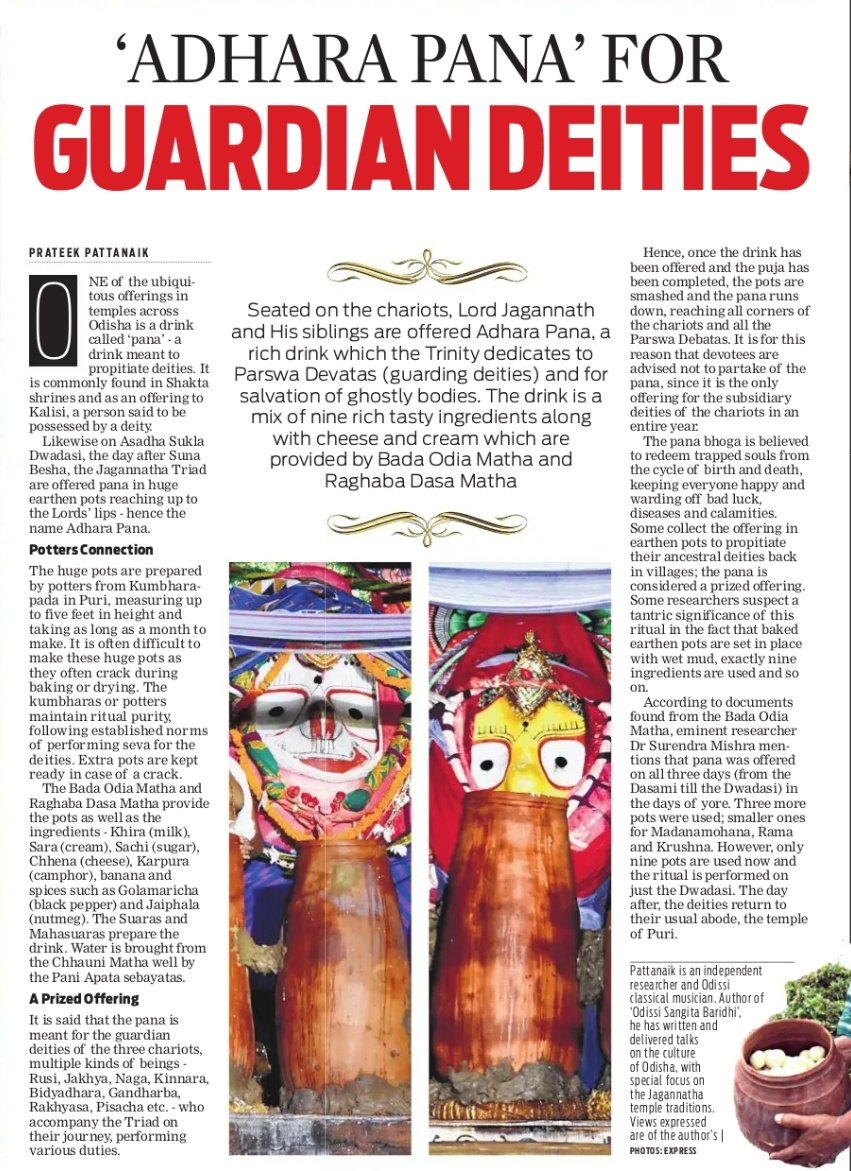
    One of the ubiquitous offerings in temples across Odisha is a drink called Pana ; a cool drink meant to propitiate deities. It is commonly found in shakta shrines and as an offering to Kalisi, a person said to be possessed by a deity. Likewise, on Asadha Sukla Dwadasi, the day after Suna Besa, the Jagannatha triad are offered Pana in huge earthen pots reaching up to the Lords’ lips – hence the name Adhara Pana. The huge pots are prepared by potters from Kumbharapada, measuring up to five feet in height and taking as long as a month to make. It is often difficult to make these huge pots as they often crack during baking or drying. The kumbharas or potters maintain ritual purity, following established norms of performing seva for the deities. Extra pots are kept ready in case of a crack. The Bada Odia Matha and Raghaba Dasa Matha provide the pots as well as the ingredients – Khira (milk), Sara (cream), Sachi (sugar), Chhena (cheese), Karpura (camphor), banana and a spices such as Golamaricha (black pepper) and Jaiphala (nutmeg). The Suaras and Mahasuaras prepare the drink. Water is brought from the Chhauni Matha well by the Pani Apata sebayatas.

    It is said that the Pana is meant for the guardian deities of the three Rathas, multiple kinds of beings : rusi, jakhya, naga, kinnara, bidyadhara, gandharba, rakhyasa, pisacha etc. who accompany the triad on their journey, performing various duties. Hence, once the drink has been offered and the  puja has been completed, the pots are smashed and the Pana runs down, reaching all corners of the rathas and all the parswa debatas. It is for this reason that devotees are advised not to partake of the Pana, since it is the only offering for the subsidiary deities of the ratha in an entire year. The Pana bhoga is believed to redeem trapped souls from the cycle of birth and death, keeping everyone happt and warding off bad luck, diseases and calamities. Some collect the offering in earthen pots to propitiate their ancestral deities back in villages ; the Pana is considered a prized offering. Some researchers suspect a Tantric significance of this ritual in the fact that baked earthen pots are set in place with wet mud, exactly 9 ingredients are used and so on. 

    According to documents found from the Bada Odia Matha, eminent researcher Dr. Surendra Mishra mentions that Pana was offered on all three days (from the Dasami till the Dwadasi) in the days of yore. Three more pots were used ; smaller ones for Madanamohana, Rama and Krusna. However now, only nine pots are used and the ritual is performed on just the Dwadasi. The day after, the deities return to their usual abode, the temple of Puri.
  • The Ashoka flower and Lingaraja’s ratha

    Published on 18 April 2021 in OdishaTV

    One festival that has been the very identity of Odisha is the Ratha Jatra of Puri. However, the concept of a festival built around a Ratha or chariot is not limited to Puri. Three other significant Ratha Jatras exist – those of Goddess Biraja (Jajpur), Surya or Mahabhaskara (Konarka) and Shiva or Lingaraja (Bhubaneswar). This quartet of chariot festivals spans the deities Vishnu, Shiva, Shakti and Surya; important deities with significant following in ancient and medieval Odisha. It is no coincidence that the festivals are centered at what are known as the four great ‘kshetra’s of Odisha.

    Bhubaneswar, known variously as Ekamra Kshetra and Chakra Kshetra, has been a seat of Shaivism for centuries. The grandest of Bhubaneswar’s temples is the Lingaraja temple, viewed as the culmination of harmony in Odia sculpture by many scholars, who date back the worship of Lingaraja to at least 1500 years ago. The Ratha Jatra of Lingaraja is hence a very ancient ritual in its own right— with its fair share of curiosities.

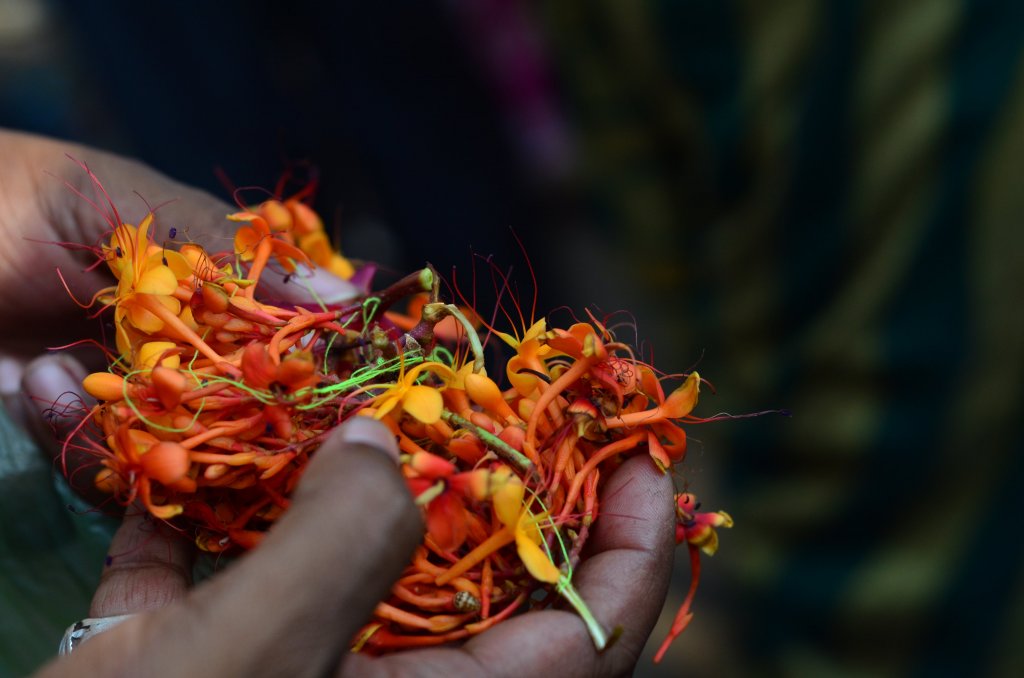
    On the day of Ashokastami every year, Shiva is worshipped with flowers of the Ashoka tree, also the state flower of Odisha. The tale goes that Hanuman was captured by Ravana’s son Indrajita, who employed the naga-pasha (snake-coil) weapon. Trapped in the Ashoka Vatika, Sita worshipped Shiva with eight buds of the Ashoka flower. In remembrance, Odia womenfolk celebrate the ritual Ashokastami Brata. The word ‘a-shoka’ means ‘without shoka (grief)’— for it is believed that consuming the Ashoka flower robs one of all grief, perhaps a reference to the medicinal properties of the flower. The Ashoka tree is also one of the five flower-arrows of Kamadeva, a symbol of love and life. The connection with the ruler Ashoka is compelling of course, but somewhat conjectural.

    Shiva’s Ratha is rather curiously known as Rukuna Ratha. ‘Rukuna’ is a colloquialism of ‘Rukmini’, Krishna’s wife. Lingaraja travels along with Ananta Basudeba and Rukmini — neatly forming a triad of deities. This triad of Shiva-Lingaraja, Shakti-Rukmini, Vishnu-Basudeba can be likened to Balabhadra-Subhadra-Jagannatha. Just like at Puri, the Ratha Jatra of Lingaraja also ends with a divine tussle between Parvati and Shiva, where Parvati rebukes her beloved for forsaking her in his grand journey.

    Even more curious is that the Ratha’s destination is the Rameswara temple, locally called ‘Mausi Maa’ temple. It is said that Rama has to atone for the sin of killing Ravana, a brahmin, by worshipping Lingaraja. The site of his worship comes to be known as Rameswara. And so Lingaraja returns to his friend every year and is received by the four brothers Rama, Lakshmana, Bharata & Shatrughna – in the four temples named after them, one of the oldest temple clusters in Bhubaneswar.

    Another interesting fact is that the Rukuna Ratha is never turned around. The Rathas at Puri are turned around for the return journey, a massive exercise considering their size and weight. However, the Rukuna Ratha is ritually never turned around. Rather the front and back are interchanged. This is the source for the Odia proverb ‘Rukuna Ratha Analeuta’, ‘the Rukuna Ratha never turns around’ — likening the chariot to someone who never breaks his word, or to something that never changes.

  • The four rathas of Odisha

    Published on 18 July 2019 in OrissaPOST

    The spectacular Ratha Jatra is perhaps the most iconic celebration of Odisha. Unsurprisingly, its influence is far-reaching. The chariot is a recurring motif in Odisha’s traditional art. The most remarkable example one can think of is the Sun Temple of Konarka, with its 24 wheels for the 12 months and majestic horses pulling the temple conceived as Surya’s ratha. While everyone knows Puri, Odisha actually has four elaborate chariot festivals each year.

    Four places of our state are shaped like the four attributes of Vishnu : sankha (conch), chakra (wheel), gada (mace) and padma (lotus). Puri is called sankha khetra, Bhubaneswar is chakra khetra, Jajpur is gada khetra and Konarka is padma khetra. These shrines have nurtured four different sects from time immemorial : followers of Vishnu, Shiva, Shakti and Surya respectively.

    Lingaraja
    The chariot of Lingaraja at Bhubaneswar is known as the Rukuna Ratha. Some scholars believe this festival predates even the Puri one. ‘Rukuna’ is a colloquial variant of the word Rukmini; but why is Shiva’s chariot named after Vishnu’s consort? Nobody knows for sure. Today, Lingaraja, Rukmini and Ananta Basudeba are taken in the chariot; a striking resemblance with the Puri triad. Is this an anthropomorphic recreation of the same? We can only guess.

    A popular saying in Odia goes ‘rukuna ratha analeuta’. This is because the Rukuna chariot is never turned for the return journey, rather the seat is simply reversed. It is used as a metaphor for something one cannot go back on, or undo.

    Biraja

    Jajpur’s goddess shrine is one of the most ancient shrines of Odisha. Biraja’s chariot is called Singhadhwaja ‘lion-bannered’. The event lasts nine days. The chariot here has no destination, a sharp contrast to the other chariots (notably this is the only feminine deity with a chariot) ; instead it circumambulates the temple itself. The path is circular, looping back into itself; not linear. Given the Tantric background of this place and geometrical symbolism so commonly employed therein, it is probably a metaphor for the goddess, symbolising feminine power, grace and nature itself. 

    Konarka

    Most of the history behind the grand sun temple of Konarka (originally called Padmakesara Deula) is an enigma. However, the discovery and subsequent publication of four manuscripts on the shrine by Pt Sadasiva Rathasarma of Puri along with Alice Boner in the 1970s revealed fascinating details. From these, we find details of how the Sun Temple had its own chariot festival. On the day of magha sukla saptami (considered to be the birthday of the deity) a ratha was made. The book of chronicles mentions that artisans from Puri would come over for this purpose. On the chariot a small bronze image of the deity was placed. The god was thus taken from a chariot-like temple to a temple-like chariot, reiterating that the ratha is meant to be nothing but a movable temple. Servitors would wait with twenty one lamps in their hands and when the sun rose out of the ocean the chariot would start its journey. Even today lakhs of people assemble to take a dip in the Chandrabhaga, as if in unknowing reveration of a long-gone festival of yore.

    Puri

    The grandest of all, Puri’s Ratha Jatra was and still is the most famous chariot festival. Perhaps the earliest representation in sculpture comes from a frieze originally in a temple in Dhanmandal, Odisha. It shows three chariots with deities being pulled by devotees. However, these rathas are pyramidal— modelled after the pyramidal pidha deula of Kalinga architecture. They have solid wheels. We know that now the rathas have curvilinear spires, resembling the towering rekha deula instead. The wheels have spokes like those at Konarka. We now have three rathas instead of six, which was the norm when the Malini river ran across badadanda. Thus many details have evolved in the course of time, but the ritual continues as always, untarnished.

  • Seven makers of the Ratha

    Seven makers of the Ratha

    Published on 2 Jul 2019 in OrissaPOST

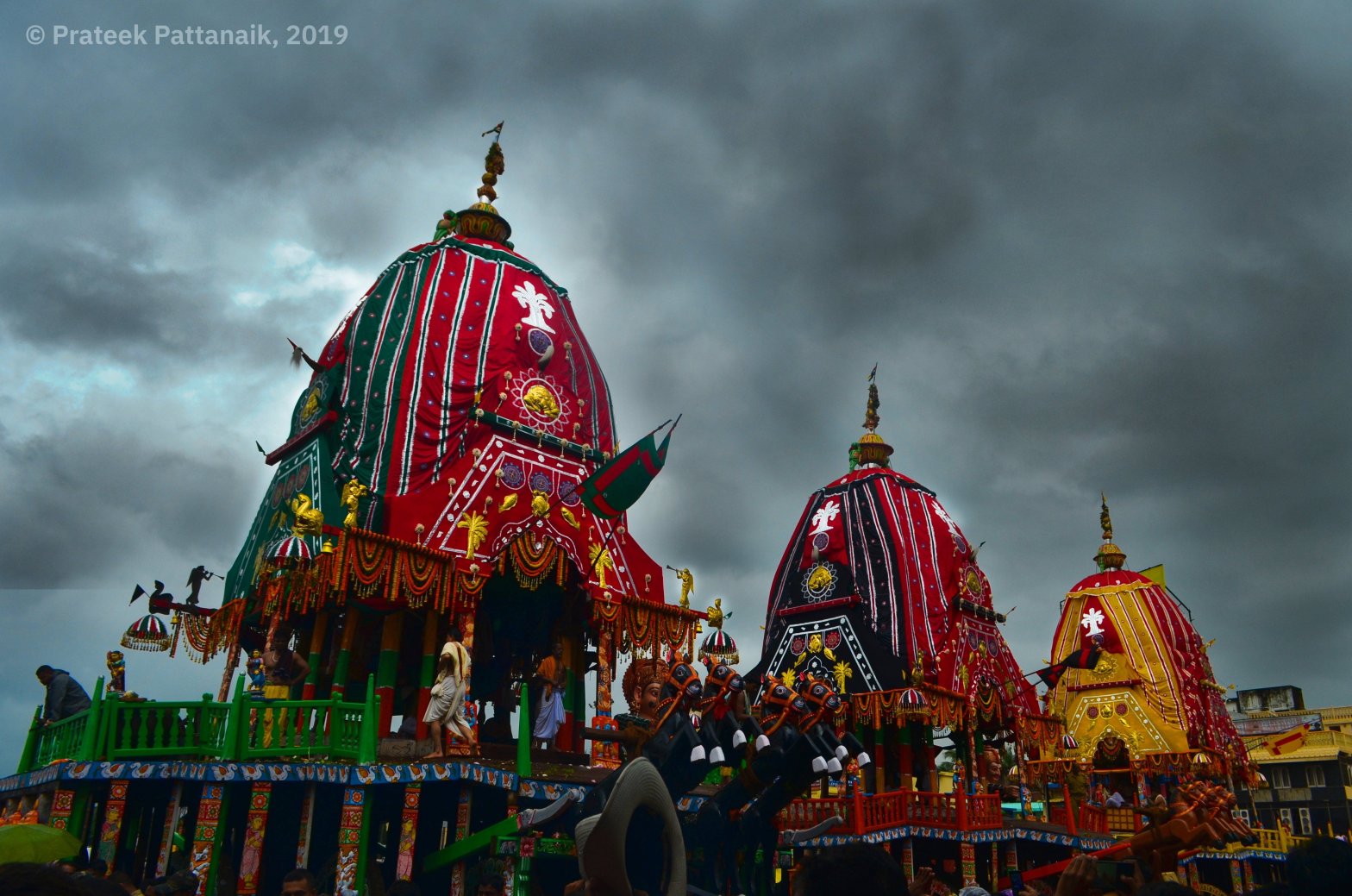
    Every year for the Ratha Jatra, three huge rathas or chariots are made by artisans in Puri. While being huge structures that must be capable of supporting several people at once, the rathas are also spectacular pieces of traditional art, combining multiple branches of craftsmanship into a harmonious whole. 

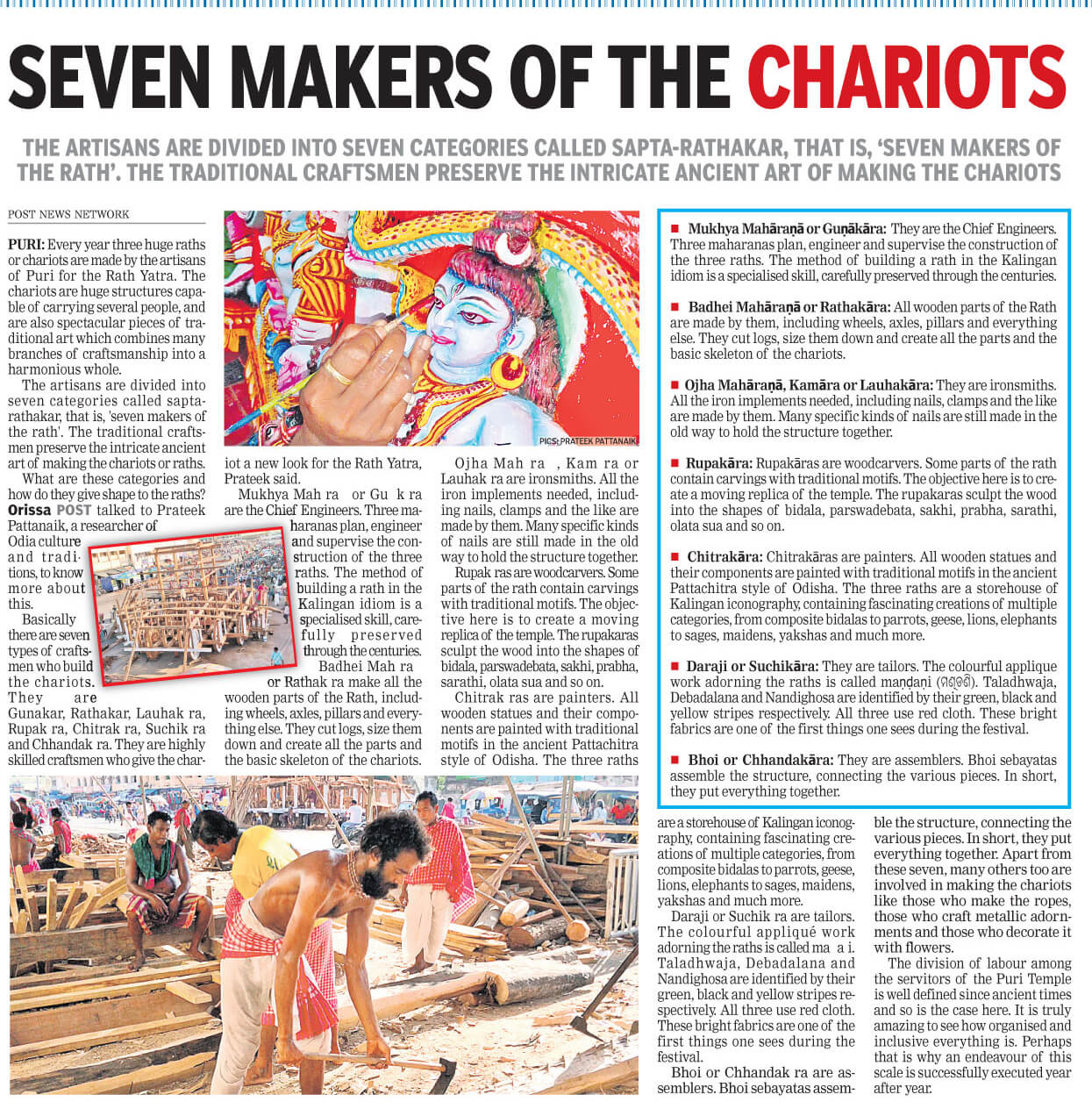
    Traditionally the artisans are divided into seven categories called sapta-rathakāras, ‘seven makers of the ratha’. These traditional craftsmen hence preserve the intricate ancient art of making rathas. What are these categories and how do they work separately yet together to build the rathas?

    1. Mukhya Mahāraṇā or Guṇākāra (ମୁଖ୍ୟ ମହାରଣା ବା ଗୁଣାକାର) : Chief engineers, so to say. Three maharanas plan, engineer and supervise the construction of the three rathas respectively. The method of building a ratha in the Kalingan idiom is a very specialised skill, carefully preserved for centuries.

    2. Badhei Mahāraṇā or Rathakāra (ବଢ଼େଇ ମହାରଣା ବା ରଥକାର) : All the wooden parts of the Ratha are made by them, including the wheels, axles, pillars and everything else. They cut up logs, size them down and form all parts, creating the basic skeleton.

    3. Ojha Mahāraṇā, Kamāra or Lauhakāra (ଓଝା ମହାରଣା, କମାର ବା ଲୌହକାର) : Ironsmiths. Iron implements needed, including nails, clamps and the like are all made by them. Several specific kinds of nails are still made in the old way to hold the structure together.

    4. Rupakāra (ରୂପକାର) : Woodcarvers. Various parts of the ratha contain carvings of traditional motifs, the aim being to create a moving replica of the temple. The rupakaras sculpt the wood in the shape of bidala, parswadebata, sakhi, prabha, sarathi, olata sua and so on.

    5. Chitrakāra (ଚିତ୍ରକାର) : Painters. All wooden statues and components are painted with traditional motifs in the ancient Pattachitra style of Odisha. The three rathas are a storehouse of Kalingan iconography, containing fascinating creatures of multiple categories, from composite bidalas to parrots, geese, lions, elephants to sages, maidens, yakshas and much more.

    6. Daraji or Suchikāra (ଦରଜୀ ବା ସୂଚୀକାର) : Tailors. The colourful applique work adorning the rathas is known by the name maṇḍaṇi (ମଣ୍ଡଣି). Taladhwaja, Debadalana and Nandighosa are identified by their green, black and yellow stripes respectively. All three use the red cloth. These bright fabrics are one of the first things one sees during the festival.

    7. Bhoi or Chhandakāra (ଭୋଇ ବା ଛନ୍ଦକାର) : Assemblers. The group of bhoi sebayatas assemble the structure, connecting pieces and putting it all together.

    Besides these seven, many others are also engaged : including those who make the ropes, those who craft metallic adornments and those who decorate it with flowers. The division of labour among the servitors of the Puri temple is very well-defined since ancient times and so also is the case here. It is truly amazing to see how organised and inclusive the activity is— perhaps that is why an endeavour of this scale can be successfully accomplished, year after year.

    The writer researches and documents vulnerable aspects of Odisha’s culture using technology. e-Mail: pattaprateek@gmail.com