Published on 8 May 2021 in OdishaTV
The Veena is one of the oldest instruments known in India for millennia. It is considered the mother of the stringed instrument family.
In ancient times the term ‘Veena’ was used in a generic sense for any plucked stringed instrument. Hence ekatantri was a Veena with a single string; in other words, one could liken it to what is known in Odisha and in many other parts of the country as the ektara. This ektara is used by the Jogis of Odisha to sing songs about yogic philosophies, sarira-bheda bhajana. Similarly we have the dotara with two strings.
The Veena as an instrument at its core is a string stretched to the desired pitch. Other elements such as a fretboard or gourd-amplifiers were obvious evolutions of the skeletal design. In Odisha’s ancient temples, we find hundreds of depictions of the Veena being played by divinities, celestial musicians (gandharvas), alluring maidens (nayikas) and mysterious creatures including yakshas. The traditional dances of Odisha all have a pose for the Veena.
The 6th-century Asanapat inscription from Keonjhar depicts a dancing Shiva playing on a Veena. This is one of the earliest depictions of Nataraja Shiva in India. Goddess Sarada of Jhankada, one of the most important Shakta shrines of Odisha holds a Veena prominently. Her pitha is easily around two thousand years old. Palm leaf manuscripts and Pattachitra murals across the state mention fabulous designs. A study of these designs reveals a huge variety. Elaborate descriptions are found in Odissi musical treatises such as Sangita Narayana.
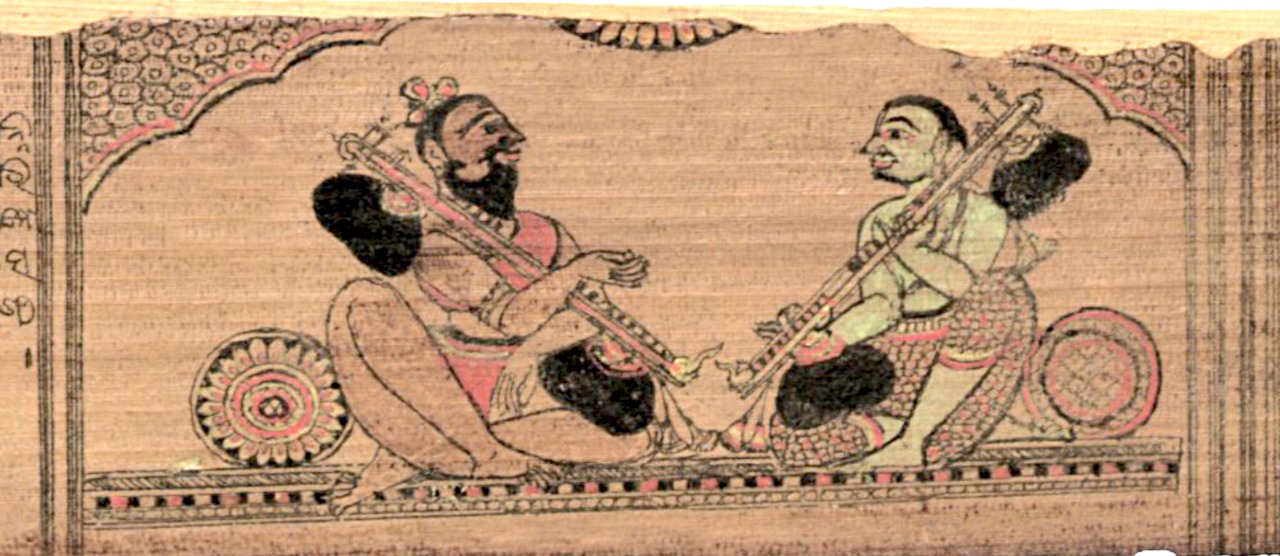
The Veena was one of the mandatory sevas at the Jagannatha Temple of Puri. Musicians used to be appointed in the temple to sing and play traditional Odissi classical songs. Odissi music being a separate stream of classical music with its own history and stylistic features, the technique of Veena playing has also been markedly different, emphasising the contours of Odissi singing nuances. The instrumental repertoire included the Mardala, the traditional percussion instrument of Odisha, the Veena, the Venu or flute among others. The Madala Panji mentions the ‘Binākāra Seva’ quite prominently. Unfortunately, these sevas went extinct during the 1940s in Puri, and it is not easy to restart an extinct seva in the Jagannatha temple due to some beliefs. In the latter half of the 20th century the Veena was frequently used in Odissi dances, mostly due to the insistence of Adiguru Pankaj Charan Das, however, over time that has receded as well. It would not be out of place to mention that the term Binākāra is unique to Odia and Odisha, and is found in traditional performing arts such as Danda Nata.
The Veena in the Odissi music tradition however survived in South Odisha. In the mathas of South Odisha iconic Odissi musicians of the time would sing every evening in honour of their chosen deity. Many of the mahantas were themselves reputed Odissi musicians— singers and instrumentalists. For example, in Paralakhemundi there was the great Sangitacharya Mahanta Adwaita Guru, who lived in the last part of the nineteenth century. Royal courts often had court musicians. Again in the court of Paralakhemundi the raja-sangitagya was Apanna Panigrahi, possibly the greatest Odissi Binakara of his time. Apanna was a favourite of Maharaja Krushna Chandra Gajapati Narayana Deva, and it is on the latter’s insistence that he agreed to record his voice on gramophone. Hailed as ‘Utkala Ra Suradasa’ as he was blind, his records were an instant hit all over Odisha. He had several worthy disciples.
In the twentieth century, the Odissi Veena was kept alive thanks to the efforts of Acharya Tarini Charan Patra of Boirani, Ganjam. An ardent devotee of Kabisurjya Baladeba Ratha, writer of the iconic Champu, Tarini Charan Patra established a musical university of sorts in the 1940s, one of the earliest such efforts in Odisha. He trained students in Odissi vocal music with special focus on the Veena. His Veena playing was broadcast almost every other morning over All India Radio Cuttack. Now, it is his disciples who carry forward the instrument, keeping it alive against all odds. Pt. Ramarao Patra, now in his 70s, was one of the Acharya’s favourite students, and is perhaps the last upholder of this critically endangered tradition. It is a miracle indeed that the Odissi Veena has survived despite all odds.
Today, the mention of the word ‘Veena’ makes most people think about either Saraswati Veena in the South or the Rudra Veena of the North. Odisha, as usual, is overlooked without thought. It is about time that we learn to appreciate the sheer variety of traditions in the country, abstaining from simplistic binaries.