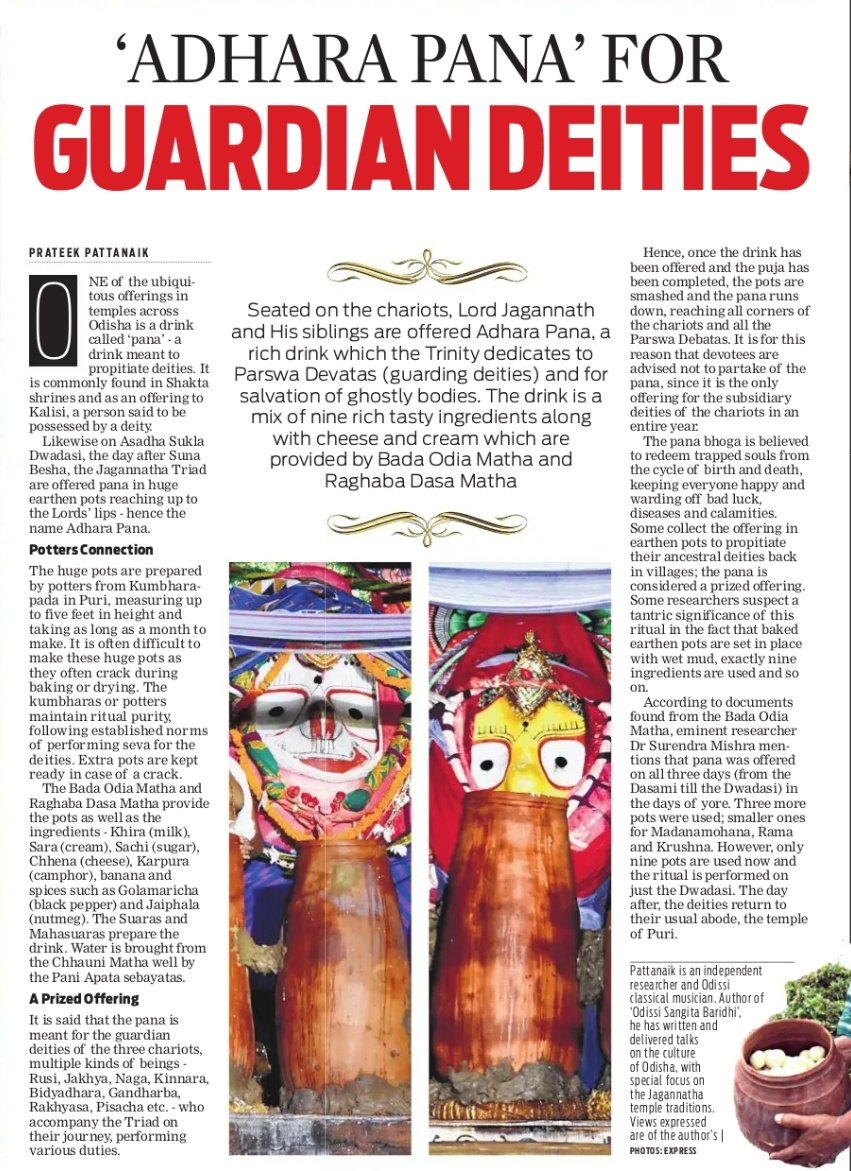
One of the ubiquitous offerings in temples across Odisha is a drink called Pana ; a cool drink meant to propitiate deities. It is commonly found in shakta shrines and as an offering to Kalisi, a person said to be possessed by a deity. Likewise, on Asadha Sukla Dwadasi, the day after Suna Besa, the Jagannatha triad are offered Pana in huge earthen pots reaching up to the Lords’ lips – hence the name Adhara Pana. The huge pots are prepared by potters from Kumbharapada, measuring up to five feet in height and taking as long as a month to make. It is often difficult to make these huge pots as they often crack during baking or drying. The kumbharas or potters maintain ritual purity, following established norms of performing seva for the deities. Extra pots are kept ready in case of a crack. The Bada Odia Matha and Raghaba Dasa Matha provide the pots as well as the ingredients – Khira (milk), Sara (cream),Sachi (sugar), Chhena (cheese), Karpura (camphor), banana and a spices such as Golamaricha (black pepper) and Jaiphala (nutmeg). The Suaras and Mahasuaras prepare the drink. Water is brought from the Chhauni Matha well by the Pani Apata sebayatas.
It is said that the Pana is meant for the guardian deities of the three Rathas, multiple kinds of beings : rusi, jakhya, naga, kinnara, bidyadhara, gandharba, rakhyasa, pisacha etc. who accompany the triad on their journey, performing various duties. Hence, once the drink has been offered and the puja has been completed, the pots are smashed and the Pana runs down, reaching all corners of the rathas and all the parswa debatas. It is for this reason that devotees are advised not to partake of the Pana, since it is the only offering for the subsidiary deities of the ratha in an entire year. The Pana bhoga is believed to redeem trapped souls from the cycle of birth and death, keeping everyone happt and warding off bad luck, diseases and calamities. Some collect the offering in earthen pots to propitiate their ancestral deities back in villages ; the Pana is considered a prized offering. Some researchers suspect a Tantric significance of this ritual in the fact that baked earthen pots are set in place with wet mud, exactly 9 ingredients are used and so on.
According to documents found from the Bada Odia Matha, eminent researcher Dr. Surendra Mishra mentions that Pana was offered on all three days (from the Dasami till the Dwadasi) in the days of yore. Three more pots were used ; smaller ones for Madanamohana, Rama and Krusna. However now, only nine pots are used and the ritual is performed on just the Dwadasi. The day after, the deities return to their usual abode, the temple of Puri.
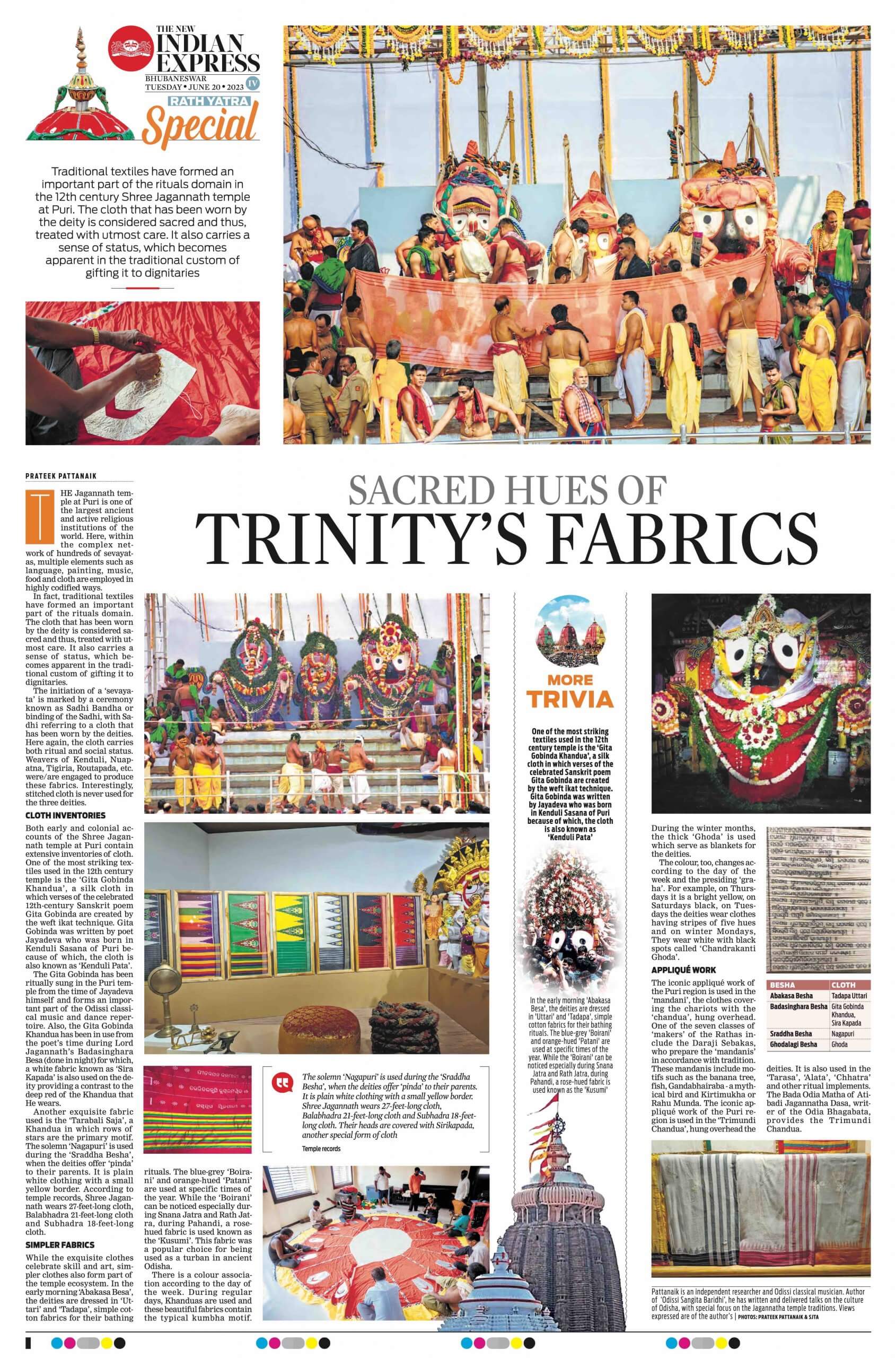
The Jagannatha Temple of Puri is one of the largest ancient institutions of the world, still active. Within the complex network of hundreds of sebayatas, multiple elements such as language, painting, music, food and cloth are employed in highly codified ways. As such, traditional textile forms an important part of the ritual domain ; a cloth that has been worn by the deity ‘maharda’ is sacred and thus treated with utmost care. It also carries a sense of status, which becomes apparent in the traditional custom of gifting it to dignitaries. The initiation of a sebayata is marked by a ceremony known as sadhi-bandha ‘binding of the sadhi’, sadhi here referring to a cloth that has been worn by the deities. Here again the cloth carries both ritual and social status. Weavers of Kenduli, Nuapatana, Tigiria, Routapada, etc. were/are engaged to produce these fabrics. Stitched cloth is never used.
Both early and colonial accounts of the Puri temple contain extensive inventories of cloth. One of the most striking textiles used in the temple is the ‘Gitagobinda Khandua’, a silk cloth in which verses of the celebrated 12th-century Sanskrit poem Gitagobinda (written by Jayadeva, born in Kenduli Sasana, Puri – because of which the cloth is also known as ‘Kenduli Pata’) are created by the weft ikat technique. The Odia script is traditionally used, for Sanskrit has no standard script and used to be written in a variety of regional scripts in ancient India. The Gitagobinda has been ritually sung in the Puri temple from the time of Jayadeva himself and forms an important part of the Odissi classical music & dance repertoire ; the Gitagobinda Khandua has also been in use from the poet’s time, in the nighttime Badasinghara Besa, in which a white fabric known as the Sira Kapada provides contrast to the deep red of the Khandua. Another exquisite fabric used is the Tarabali Saja, a Khandua in which ‘rows of stars’ are the primary motif. The solemn Nagapuri is used during the Sraddha Besa, when the deities offer pinda to their parents.
While the exquisite clothes celebrate skill and art, simpler clothes also form part of the temple ecosystem. In the early morning Abakasa Besa, the deities are dressed in Uttari and Tadapa, simple cotton fabrics for their bathing rituals. The blue-grey Boirani and orange-hued Patani are used at specific times of the year. The Boirani can be noticed especially during Snana Jatra and Ratha Jatra. During Pahandi, a rose-hued fabric is prominent, known as the Kusumi. This fabric was a popular choice for a turban in ancient Odisha.
There is a colour association according to the day of the week. During regular days, Khanduas are used. These beautiful fabrics contain the typical kumbha motif. During the winter months, the thick Ghoda is used; these serve as blankets. The colour changes according to the day of the week and the presiding graha. For example, on Thursdays it is a bright yellow ; on Saturdays black ; on Tuesdays consisting of stripes of five hues ; on winter Mondays white with black spots, called Chandrakanti Ghoda.
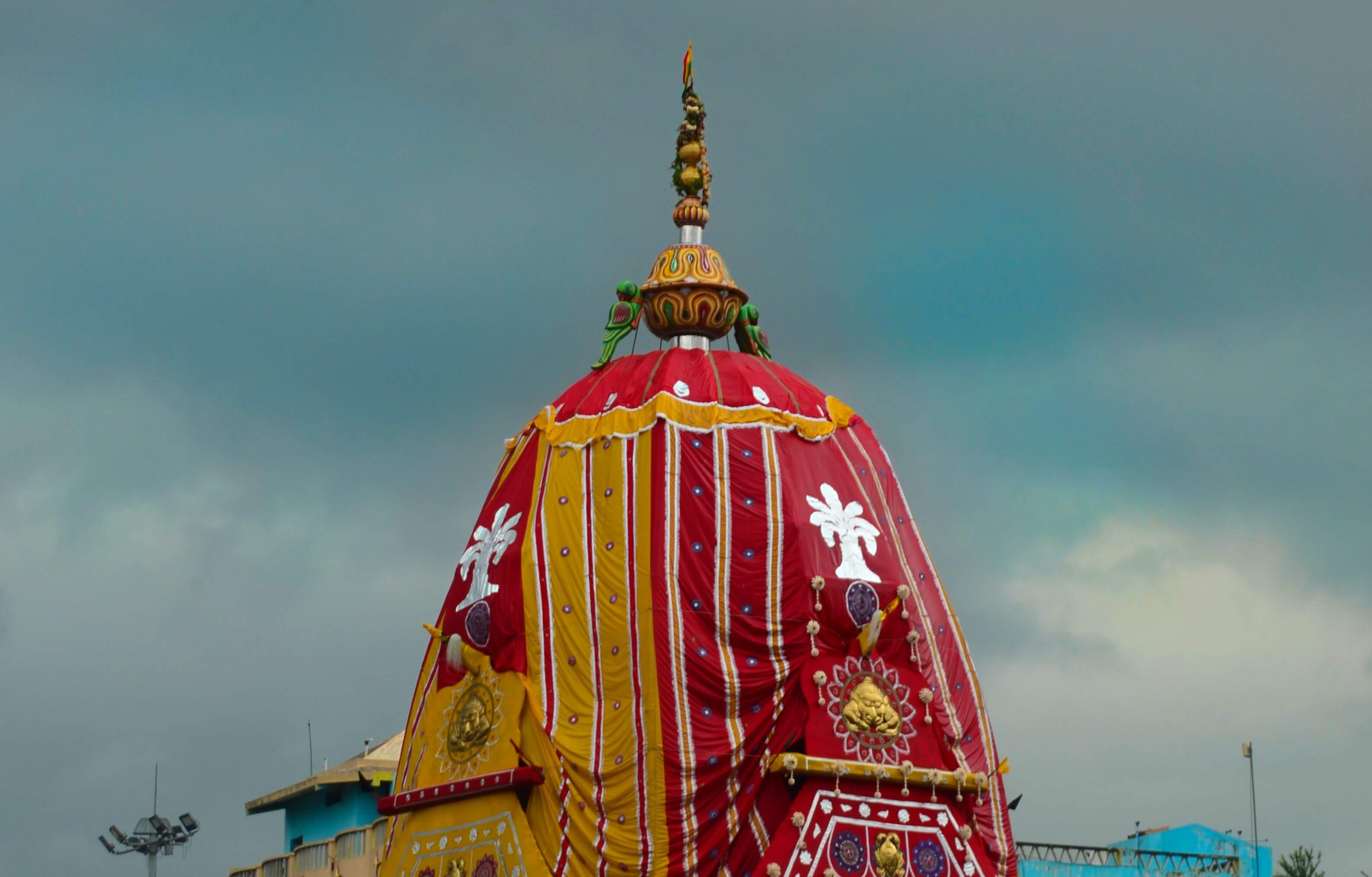
The iconic applique work of the Puri region is used in the ‘mandani’ the clothes covering the Rathas and the chandua, hung overhead. One of the seven classes of ‘makers’ of the Rathas include the daraji sebakas, who prepare the mandanis in accordance with tradition.
The Veena is one of the oldest instruments known in India for millennia. It is considered the mother of the stringed instrument family.
In ancient times the term ‘Veena’ was used in a generic sense for any plucked stringed instrument. Hence ekatantri was a Veena with a single string; in other words, one could liken it to what is known in Odisha and in many other parts of the country as the ektara. This ektara is used by the Jogis of Odisha to sing songs about yogic philosophies, sarira-bheda bhajana. Similarly we have the dotara with two strings.
The Veena as an instrument at its core is a string stretched to the desired pitch. Other elements such as a fretboard or gourd-amplifiers were obvious evolutions of the skeletal design. In Odisha’s ancient temples, we find hundreds of depictions of the Veena being played by divinities, celestial musicians (gandharvas), alluring maidens (nayikas) and mysterious creatures including yakshas. The traditional dances of Odisha all have a pose for the Veena.
The 6th-century Asanapat inscription from Keonjhar depicts a dancing Shiva playing on a Veena. This is one of the earliest depictions of Nataraja Shiva in India. Goddess Sarada of Jhankada, one of the most important Shakta shrines of Odisha holds a Veena prominently. Her pitha is easily around two thousand years old. Palm leaf manuscripts and Pattachitra murals across the state mention fabulous designs. A study of these designs reveals a huge variety. Elaborate descriptions are found in Odissi musical treatises such as Sangita Narayana.
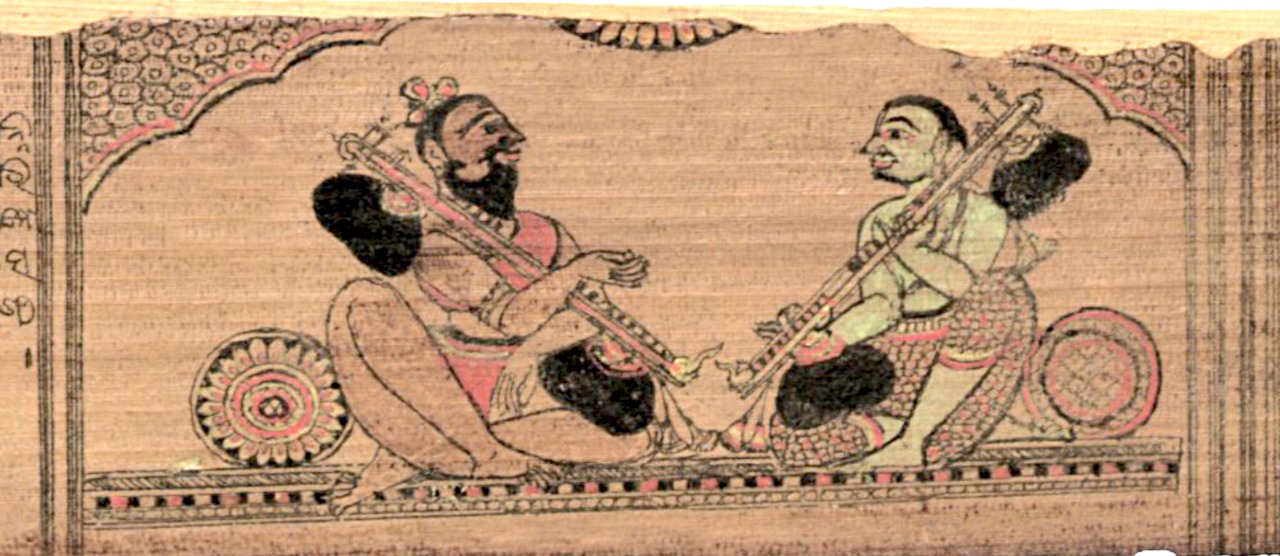
Chitrapothi or palm leaf illustration of Binākāras or Veena players, Odisha, 17th century.
The Veena was one of the mandatory sevas at the Jagannatha Temple of Puri. Musicians used to be appointed in the temple to sing and play traditional Odissi classical songs. Odissi music being a separate stream of classical music with its own history and stylistic features, the technique of Veena playing has also been markedly different, emphasising the contours of Odissi singing nuances. The instrumental repertoire included the Mardala, the traditional percussion instrument of Odisha, the Veena, the Venu or flute among others. The Madala Panji mentions the ‘Binākāra Seva’ quite prominently. Unfortunately, these sevas went extinct during the 1940s in Puri, and it is not easy to restart an extinct seva in the Jagannatha temple due to some beliefs. In the latter half of the 20th century the Veena was frequently used in Odissi dances, mostly due to the insistence of Adiguru Pankaj Charan Das, however, over time that has receded as well. It would not be out of place to mention that the term Binākāra is unique to Odia and Odisha, and is found in traditional performing arts such as Danda Nata.
The Veena in the Odissi music tradition however survived in South Odisha. In the mathas of South Odisha iconic Odissi musicians of the time would sing every evening in honour of their chosen deity. Many of the mahantas were themselves reputed Odissi musicians— singers and instrumentalists. For example, in Paralakhemundi there was the great Sangitacharya Mahanta Adwaita Guru, who lived in the last part of the nineteenth century. Royal courts often had court musicians. Again in the court of Paralakhemundi the raja-sangitagya was Apanna Panigrahi, possibly the greatest Odissi Binakara of his time. Apanna was a favourite of Maharaja Krushna Chandra Gajapati Narayana Deva, and it is on the latter’s insistence that he agreed to record his voice on gramophone. Hailed as ‘Utkala Ra Suradasa’ as he was blind, his records were an instant hit all over Odisha. He had several worthy disciples.
In the twentieth century, the Odissi Veena was kept alive thanks to the efforts of Acharya Tarini Charan Patra of Boirani, Ganjam. An ardent devotee of Kabisurjya Baladeba Ratha, writer of the iconic Champu, Tarini Charan Patra established a musical university of sorts in the 1940s, one of the earliest such efforts in Odisha. He trained students in Odissi vocal music with special focus on the Veena. His Veena playing was broadcast almost every other morning over All India Radio Cuttack. Now, it is his disciples who carry forward the instrument, keeping it alive against all odds. Pt. Ramarao Patra, now in his 70s, was one of the Acharya’s favourite students, and is perhaps the last upholder of this critically endangered tradition. It is a miracle indeed that the Odissi Veena has survived despite all odds.
Today, the mention of the word ‘Veena’ makes most people think about either Saraswati Veena in the South or the Rudra Veena of the North. Odisha, as usual, is overlooked without thought. It is about time that we learn to appreciate the sheer variety of traditions in the country, abstaining from simplistic binaries.
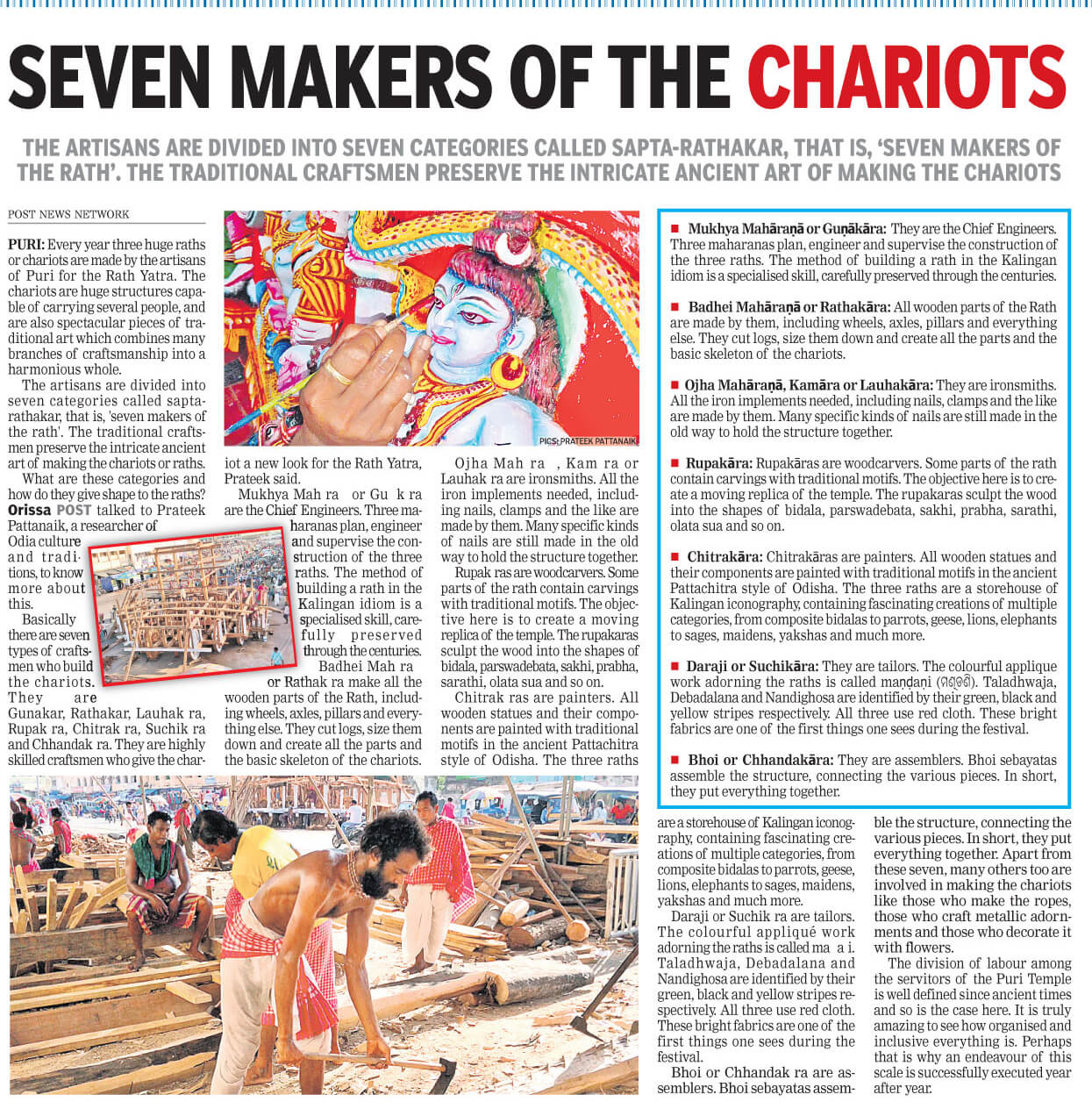
Every year for the Ratha Jatra, three huge rathas or chariots are made by artisans in Puri. While being huge structures that must be capable of supporting several people at once, the rathas are also spectacular pieces of traditional art, combining multiple branches of craftsmanship into a harmonious whole.
Traditionally the artisans are divided into seven categories called sapta-rathakāras, ‘seven makers of the ratha’. These traditional craftsmen hence preserve the intricate ancient art of making rathas. What are these categories and how do they work separately yet together to build the rathas?
1. Mukhya Mahāraṇā or Guṇākāra (ମୁଖ୍ୟ ମହାରଣା ବା ଗୁଣାକାର) : Chief engineers, so to say. Three maharanas plan, engineer and supervise the construction of the three rathas respectively. The method of building a ratha in the Kalingan idiom is a very specialised skill, carefully preserved for centuries.
2. Badhei Mahāraṇā or Rathakāra (ବଢ଼େଇ ମହାରଣା ବା ରଥକାର) : All the wooden parts of the Ratha are made by them, including the wheels, axles, pillars and everything else. They cut up logs, size them down and form all parts, creating the basic skeleton.
3. Ojha Mahāraṇā, Kamāra or Lauhakāra (ଓଝା ମହାରଣା, କମାର ବା ଲୌହକାର) : Ironsmiths. Iron implements needed, including nails, clamps and the like are all made by them. Several specific kinds of nails are still made in the old way to hold the structure together.
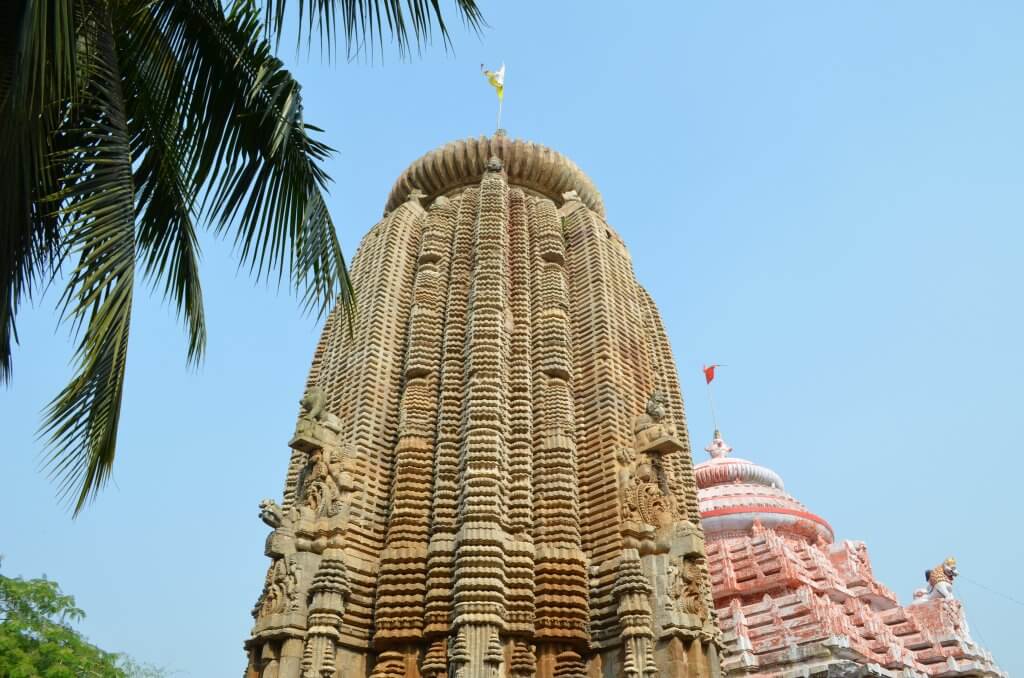
4. Rupakāra (ରୂପକାର) : Woodcarvers. Various parts of the ratha contain carvings of traditional motifs, the aim being to create a moving replica of the temple. The rupakaras sculpt the wood in the shape of bidala, parswadebata, sakhi, prabha, sarathi, olata sua and so on.
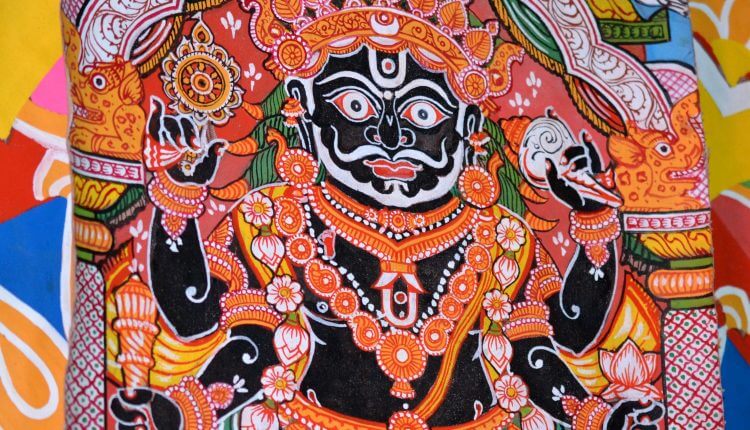
5. Chitrakāra (ଚିତ୍ରକାର) : Painters. All wooden statues and components are painted with traditional motifs in the ancient Pattachitra style of Odisha. The three rathas are a storehouse of Kalingan iconography, containing fascinating creatures of multiple categories, from composite bidalas to parrots, geese, lions, elephants to sages, maidens, yakshas and much more.
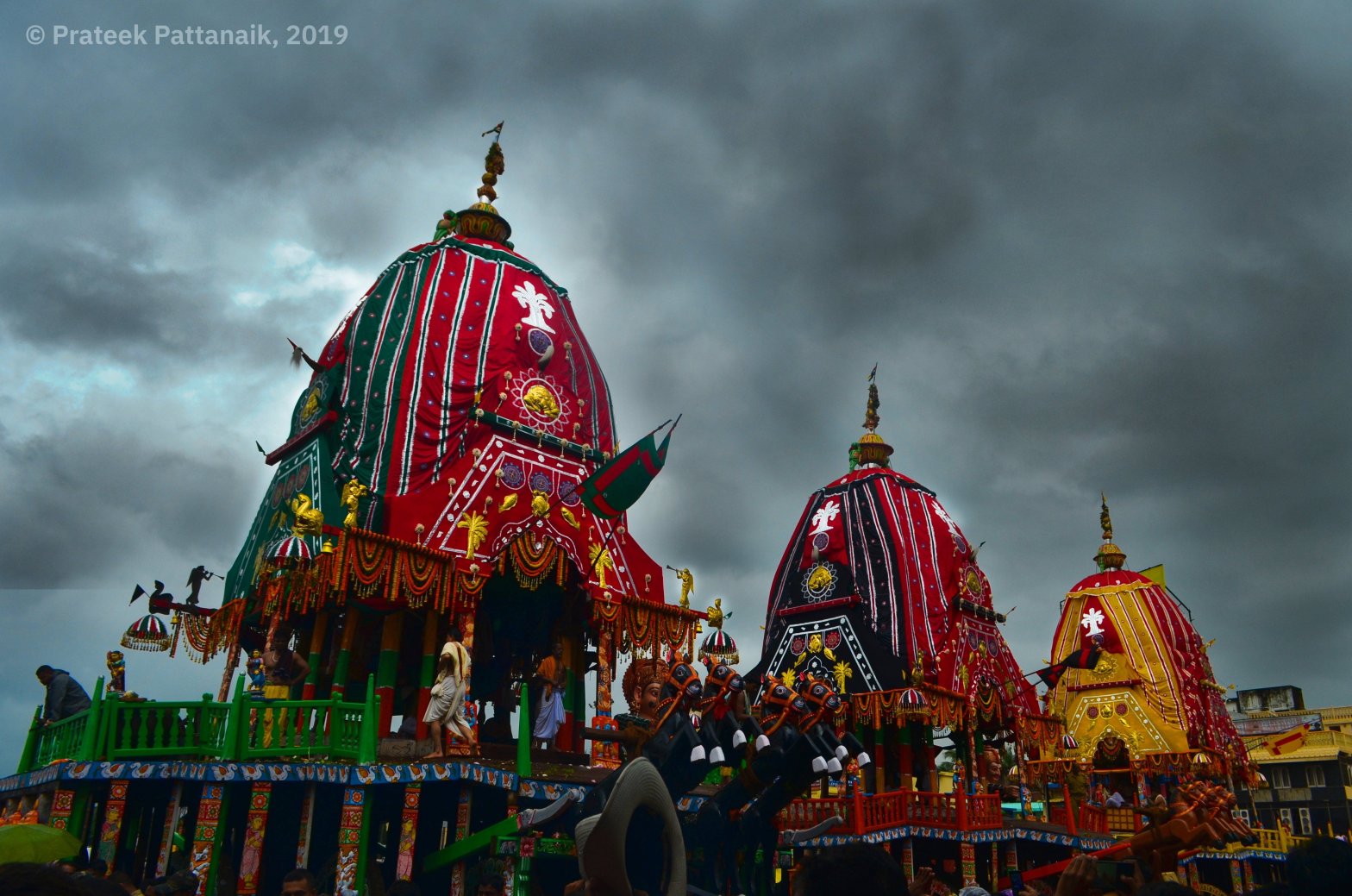
6. Daraji or Suchikāra (ଦରଜୀ ବା ସୂଚୀକାର) : Tailors. The colourful applique work adorning the rathas is known by the name maṇḍaṇi (ମଣ୍ଡଣି). Taladhwaja, Debadalana and Nandighosa are identified by their green, black and yellow stripes respectively. All three use the red cloth. These bright fabrics are one of the first things one sees during the festival.
7. Bhoi or Chhandakāra (ଭୋଇ ବା ଛନ୍ଦକାର) : Assemblers. The group of bhoi sebayatas assemble the structure, connecting pieces and putting it all together.
Besides these seven, many others are also engaged : including those who make the ropes, those who craft metallic adornments and those who decorate it with flowers. The division of labour among the servitors of the Puri temple is very well-defined since ancient times and so also is the case here. It is truly amazing to see how organised and inclusive the activity is— perhaps that is why an endeavour of this scale can be successfully accomplished, year after year.
The writer researches and documents vulnerable aspects of Odisha’s culture using technology. e-Mail: pattaprateek@gmail.com
Jagannatha might be the ideal deity for millions of his devotees around the globe, but his one wife is not too impressed. Just within a fortnight of their wedding, he bathes too much and falls ill for 15 days. Immediately after, he goes out on a vacation with his siblings, not bothering to even ask her if she would like to come along. How insensitive! As one would expect, Lakshmi is not too happy.
Nandighosa, Jagannatha’s Ratha.
Sad, she goes to her friend Bimala. In Balarama Dasa’s Jagamohana Chhanda, Lakshmi is depicted as doleful and crying. Newly-married Lakshmi being very simple bursts out into tears. Bimala, on the other hand, is a clever goddess; she tells Lakshmi that she has all the power and Jagannath is in fact, afraid of her. Convincing her so, Bimala herself goes and spies on Jagannath. He spots her and before she can reply, apologises and admits his fault. Craftily he also convinces her not to speak too much about all this. He asks Bimala how Lakshmi is feeling back at home and Bimala presents a sad picture- “To distract herself she is learning how to play the veena from Saraswati. Even then she strikes all the wrong notes out of grief. She’ll be coming here any moment. Go and placate her before sorrow turns to anger.”
On the day of Hera Panchami, all of this gets out of hand. Lakshmi marches to the Gundicha Temple secretly and breaks Jagannath’s chariot in her fury. She scurries back through hidden ways again. Even then he won’t budge.
About a week later he finally returns. On the day of Niladri Bije, the triad returns to the sanctum sanctorum from the Rathas. Balabhadra enters, Subhadra enters but when it is Jagannath’s turn, the door is shut. This is how Lakshmi decides to repay the unjust treatment doled out to her. And here starts the divine squabble between Lakshmi and Jagannath; wife and husband. This is known as the Lakshmi Narayana Bachanika or the Lakshmi Narayana Kali, ‘Kali’ in Odia referring to a verbal fight.
This is not the only kali that exists in Odia culture. There are the kela-keluni kali (snakecharmer and his wife) and sabara-sabaruni kali (tribal couple) in the ancient Danda Nacha of Odisha. Even Parbati has a squabble with Lingaraja after the Rukuna Ratha Jatra, perhaps an emulation of the Puri model. This is the Hara-Parbati Kali. Our folk stories even have a Lakshmi-Parbati Kali song where both goddesses slyly tease the other’s consort and their eccentricities. In the Puri temple tradition, Lakshmi also keeps nagging poor Saraswati. This is a peculiar humanisation of divinity and everyone derives a lot of enjoyment from the unlikely scenario.
The Lakshmi Narayan Kali itself has various retellings. Balarama Dasa, Jagannath Dasa, Gauracharana Dasa, Pindika Srichandana, Bipra Maheswara and many other poets have written their own versions of this squabble. That just goes on to explain how popular the storyline used to be. It still is.
In Gauracharana Dasa’s version, Jagannath decides to keep his cool and stay quiet when Lakshmi scolds him in anger. Lakshmi does not hold back; she scolds him for being with the gopis and takes a dig at Subhadra, who she calls ‘her majesty, a milkman’s daughter.’ Jagannath laughs all the while, chuckling at her complaints but when she scolds the gopis a bit too much, he points out her excessive pride and how her father, the Mahodadhi sea keeps ‘roaring’ all the time.
Atibadi Jagannath Dasa was the creator of the magnum opus Bhagabata in Odia. He lived in the 15th century. In his retelling, Lakshmi calls out Balabhadra for being too laconic and afraid to confront the reality. That is why, in her opinion, he gets away first in his Ratha, unconcerned that his young brother is ignoring his wife. When he returns, Lakshmi conspires with Indra, telling him to ‘throw hailstones on earth’. Poor Jagannath is all exhausted and wet. He almost catches a cold and his lips shiver. Lakshmi tells him ‘be there like you left me!’ and leaves the scene. Jagannath meanwhile bribes the servitors and enters inside.
He finds Lakshmi sitting in a corner, angry and unwilling to talk. Here comes the placating: he shows her the kalameghi saree he has brought for her from the market; the various types of ornaments kanaka dudura, banka daunria, padakamala and suabasa nakachana. But she is not amazed by the shimmer. They enter into another argument until Balabhadra interferes.
Balabhadra shouts “What are you doing Jagannath? You speak so many harsh things to Lakshmi. What do you think you do? She cooks all the food while I bring all the things to run the house. All you do is dress yourself with those silks while sitting like a king. Stop this matter right now or I’ll have to take action.”
Afraid, both of them now become quiet. Jagannath himself adorns Lakshmi with all the ornaments and asks her to forgive his faults. Lakshmi also joins her palms in a gesture of humility.
Quite notably, Jagannath offers her a sweet rasagola to pacify her further. Mentioned in 15th-century Odia texts like the Dandi Ramayana, the Rasagola has its origin in this ancient ritual of the Jagannath Temple of Puri. Sweet tale, isn’t it?
When you think about the Indian conception of God, most Gods live either alone or with their consorts. Jagannatha lives with his elder brother and sister in his huge home at Puri. Quite a departure from the usual norm; it doesn’t end there too. Not only does he have more members in this wonderful ‘divine’ family, the members are spread all across the state. Each of these deities has a very well-formed popular understanding of their characters. At times, it is just fascinating to study these beliefs and how anything or the else in Odisha invariably leads to Jagannatha.
Madhabananda Jiu of Niali
Let us look inside the grand temple of Puri first. This is the Badadeula, quite literally the ‘big temple’. Of the twenty four styles of homes this is considered to be Vishnu’s favourite and Jagannatha was accepted to be a primarily Vaishnavite deity when this temple (the third one) was constructed. He does not live only with his family though; he lives with his relatives, acquaintances and in a complex socio-cultural web, the entire society of Puri operates like a family for this deity to whom the Gajapatis of Odisha voluntarily acceded subservience.
Inside the sanctum sanctorum on the huge singhasana his elder brother Balabhadra sits to the left and Jagannatha himself sits to the right; their sister Subhadra is in between her brothers.
Balabhadra is white and his eyes are slightly reddish, intoxicated by the kadambari wine, which is considered to be his favourite. Canopying his head is the seven-headed white snake and he holds a huge pestle and plough in his hands. Being the elder brother, he is revered and obeyed without question.
Besides, everybody knows that he is easy-to-anger and easy-to-please and hence, no one messes with him. No one. Jagannatha on the other hand is everyone’s friend. They can talk to him as they are, without pretension, even hurling abuses and joking about his black face. To the young guys he’s the cool dude, to the elderly & the octogenarian priest he is a son and to the dancing Mahari servitor her husband.
Balabhadra is a bachelor while Jagannatha’s wives Bhudebi and Sridebi sit on both sides of him. Bhudebi is generally equated with Saraswati; calm, composed, artistic and knowledgeable. Sridebi or Lakshmi on the other hand is fickle, jealous and always looking for a fight. Lakshmi even dares to get into an argument with Jagannatha when he returns after the Ratha Jatra. One of the insults hurled is from Jagannatha who calls her squint-eyed. Going one step further he calls her father, the sea god Mahodadhi ‘salty’ and ’screaming’ and at the end, poor Jagannatha concedes and gives her a sweet Rasagola. He does his job of being a good son-in-law by regularly paying visits to his father-in-law though, so points for that.
The temple rituals acknowledge these ancient, nuanced behavioural analyses by the public. At one point Lakshmi and Saraswati get into a headless fight and poor Saraswati finds that nobody is by her side because all the other greedy demigods want some fast cash by siding with Lakshmi. Jagannatha is in an even pitiable state as the husband; he has to stop the banter and he calls the goddess Bimala for help in coaxing the womenfolk. She gets irritated and finds this squabble of no use, preferring to retire to seclusion with her music. The tantric goddess Bimala sits behind the towering badadeula in her own shrine. She is the mistress of the yoginis and the matrukas, possessing chants and adept in the mystic arts. Donning a classic black saree she tells Lakshmi to throw magic dust on her husband to bring him to his senses if he is too enamoured with his fantastic journey during the Ratha Jatra.
There are other members too. Natua Ganesha, for example, maintains records of the visitors. Agniswara Mahadeba inspects the food that comes out of the stove and Goddess Hingula of Talcher burns as the flame in the kitchen. Lakshmi herself is the head cook. Goddess Kuttama Chandi appears as a dog on the premises if there has been any pollution of the food before offering. Bhandara Lokanatha is the treasurer and the protector of the Ratnabhandara. Isaneswara Mahadeba towards the northern side is Jagannatha’s teacher. Hari Sahadeba tends the cattle and is in-charge of the dairy. Khetrapala Mahadeba maintains the security and the ferocious Bedhakali guards the inner complex. Each one has his or her duty in the grand scheme.
Perhaps the most well-known of all of Jagannatha’s relatives is Mausi Maa, his maternal aunt. Her actual name is Ardhashani and she looks a lot like Subhadra because they are from the same family. She lovingly cooks a podapitha each year when Jagannatha stops by at her humble home by the Badadanda each year during the Ratha Jatra. Bhubaneswar’s Lingaraja Shiva similarly stops by at his sister Kapalini’s house at the Baitala Deula and gives her a gift.
Within Puri, the five major Shivas are good friends of Jagannatha. He goes for his boating sessions with them during the Chandana Jatra. Lokanatha and Jagannatha have a hilarious conversation on the way. Jagannatha tells his pal about his wives always squabbling with each other, and Lokanatha breathes a deeper sigh because his condition is no better. Moreover, his vehicle is a bullock and his wife’s a lion. Their sons have a peacock and a rat. Fed up of all this worldly stuff both of them resign. Jagannatha turns to wood and Lokanatha to stone. And so the people of Puri have a saying “He is wood, he is stone; to whom can one turn to?”
A little far away, Niali’s Madhabananda is Jagannatha’s uncle. Madhaba lives with his sister Durga in that place. Before the Ratha Jatra, the siblings get permission from their uncle for their outing. The 15th-century philosopher-poet Balarama Dasa even mentions deities across the state who come to Puri to get a sight of Jagannatha night time Badasinghara attire.
We have talked about all kinds of relations, but who are the parents? Strange are the deities of Puri; they have not one but five pairs of parents. Each year they offer funeral oblations to Kasyapa-Aditi (for Vamana), Kausalya-Dasaratha (for Rama), Basudeba-Debaki and Nanda-Jasoda (for Krishna). At the end, they make offerings to Indradyumna and Gundicha, the legendary king and queen who erected the first temple and started it all. Indradyumna had asked Jagannatha to give him no offspring because then his children would have claimed the temple as a feat of their ancestors. Childless, the couple would have nobody to complete their funeral and so Jagannatha took that upon himself.
The dark God of Odisha surely knows how to pay gratitude.
Jagannatha brushes his teeth and chews a ‘paan’ daily, but he does not take a bath each day. Well he does, but it is a symbolic ritual. Every morning, he is dressed in barebones clothing; only two pieces of cloth known as tadapa and uttari. The tadapa is wound around his waist while the uttari is thrown across his shoulders. Three metal mirrors are placed in front of the three deities and angled such that their faces are reflected. These mirrors are then bathed with scented water. This elaborate arrangement acts as the daily bathing ritual of the gods.
Once in the year however, he comes out for an actual bath and when he does, the bath is with more than a hundred pitchers. That night he gets a fever and has to be cured for 15 days. This period is known as Anabasara, or the more colloquial Anasara. He is hidden from public view for this period and the people get to see three paintings in his place instead. These are the Anasara Pati paintings, humanised depictions of the beloved triad. Behind the partition however, the ailing deities need to be cured of their fever. And the only ones who have access to the secret chamber are the Daitapatis, believed to be descendants of the Sabara king Biswabasu who originally worshipped Nilamadhaba. The treatment inside is hence believed to be reflective of the Sabari tribal rituals. To everybody else, the secret of the Anasarachamber remains hidden.
Only a flickering earthen lamp provides light to the enormous temple during this period. No loud instruments are rung because that would disturb the deities, who only wear a single white cloth and pure white flowers. It is said that there must not be even a single coloured petal in the floral ornaments woven during Anasara. It has to be pure white to maintain the solemn mood. For a temple that is bursting with colours, sounds and festivity throughout the year, this period is a dramatic departure. Shrouded in these surroundings is the mystery of the Anasara chamber. These secrets have remained secret for centuries. We only know a little here and a little there, but nothing more.
Of the things that we do know are the few rituals that occur outside the temple. On the fifth day of Anasara, the Bada Odia Matha of Puri provides Phuluri Tela, a special kind of medicinal oil. Myriad scented flowers and barks combine with camphor, sandalwood and other ingredients to form this oil. The oil is actually kept underground for a year, then dug out and carried to the temple in earthen pots. This is said to provide relief to the ailing Gods. Also prepared is the Anasara Pana, a special drink made to cure. The Gods’ also have their very own doctors; the Baidya family. With their knowledge of ancient medicine, they prepare various medicinal concoctions, of which notable is the Dasamula Modaka or rounded pills of a special concoction whose ingredients are secret.
Most of the other details remain unknown. This secrecy, as one would expect, has often stimulated curiosity. Back in the 12th century, Karnama Giri, a tantric expert came to know that the deities were ill. When he was refused a sight, Karnama rebelled – how could God fall ill? He somehow convinced the king that this was all a hoax and declared that he would expose it all. He first flew in as a fly, but he saw a lotus and so pungent was its smell that he fainted. Somehow he struggled outside through the crevice in the door. The next time he turned invisible, but inside he saw eight maidens who chuckled at his stupidity. Bewildered he acceded defeat and left. Stories such as these still lurk around.
The practical point of view is that all the bathing washes off the colour, and the images have to be remade and repainted. This keeps the deities looking as new as ever. The last day is theNaba Joubana, when the completed deities are finally shown to the public. Before that the faces of the idols are painted. This work is done only by the Datta Mahapatra at Puri. The Datta Mahapatra family carefully keeps the Banaka Pothi in their home. This is their prized heirloom, and the only painting manual found in Odia palm leaf manuscripts. It mentions in detail how the three deities have to be painted. Like everything else concerned with Anasara, the contents of this manuscript too are a secret. After painting the eyes, eyebrows, eyelashes, mouth and nose, the eyeballs are filled with black at the very end. This concluding process of filling the eyes completes the images. A day later would be the magnificent Ratha Jatra, when the dormant temple would rise up again with the most splendid celebration of the entire year.
On the full moon day of the Indian month of Jyeshtha, something peculiar happens – a god falls ill. The great triad enshrined in the Jagannath Temple in Puri bathe too much and are afflicted with fever. In the 15 days of their ‘treatment’ they are hidden away from public view. In this period known as ‘anasara’, they are substituted by majestic paintings that represent them. This is the tale of the origin of the ancient Pattachitra art of Odisha.
Ananta Narayana, old Pati Dian set of the Puri Temple.
A number of traditional painter families live in Puri and the surrounding villages. They are called chitrakaras in Odia, and in Puri, there is an entire street consisting of only chitrakara families. The nearby village of Raghurajpur has been declared a ‘heritage village’ because the entire settlement consists of only chitrakaras. At the helm of this ancient clan of painters are those who paint in the service of Jagannath, the beloved deity of Odias.
To paint for Jagannath is no small task; it is a service assigned only to the senior-most craftsmen of the chitrakara lineage. The Gajapati Raja would select three families for the three deities – Balabhadra, Subhadra and Jagannath. The chitrakara masters would be initiated into the service of the temple in a formal ceremony called sadhi-bandha. The raja would tie their heads with the sacred fabric of Jagannath. It is after this that the painters would start their magnanimous task. Many researchers and chitrakaras trace the origin of Pattachitra back to the painting at the Puri temple. This forms an unbroken link with Jagannath, symbolic of their antiquity.
This temple-service of painters, apart from being a very challenging task, is also an honorific one. They look up on the master, who has the experience and expertise to be engaged in the direct service of Jagannath himself. Due to the intrinsic socio-political importance of the temple, these masters enjoy high status within the community and respect in the town of Puri. As of now, only two families are in this service – one for Jagannath and one for both Balabhadra and Subhadra.
A fortnight before the bathing festival of Jyeshtha, the painters receive a note requesting them to make the revered ‘anasara patis’. With the commencement of their services, utmost cleanliness has now to be observed. The family would now sleep on the bare ground, abstaining from sex, intoxicants, meat, garlic and onion. The next day as dawn breaks, the chitrakara cooks with his wife the tamarind gum and chalk mixture for priming the canvas. A huge cotton cloth is cut into dimensions, which can be as large as 1.2 metre long and a metre wide. While he cuts the canvas to the required size, she painstakingly grinds stones to produce pigments.
Pigments play a major role in distinguishing the anasara patis. Only ‘traditional’ (which implies naturally obtained) pigments are used. Industrial oil-based paints are considered unclean. The master chitrakaras look down upon these ‘foreign’ paints. This is to be expected. The Puri temple, until this date, has not a single of its 56 dishes made using potato. Potato, like commercial paints, is ‘foreign’ and thus done away with in tasks related to the temple, a living institution of Odia tradition as it has been through the centuries. Moreover, the pigments are never mixed and are only used as they are, in their ‘pure’ forms.
Once the priming is done, the master painter takes over. We take a peek into the first workshop in the artist’s street. With a thin brush dipped in red hingula, he deftly outlines the figure of Jagannath in all detail. This is the base sketch, or what is known as the tipana. Years of practice have made this process so natural that he needs no reference. A small blotch indicates that the master intends every second flower in the garland to be a full-bloomed pink lotus.
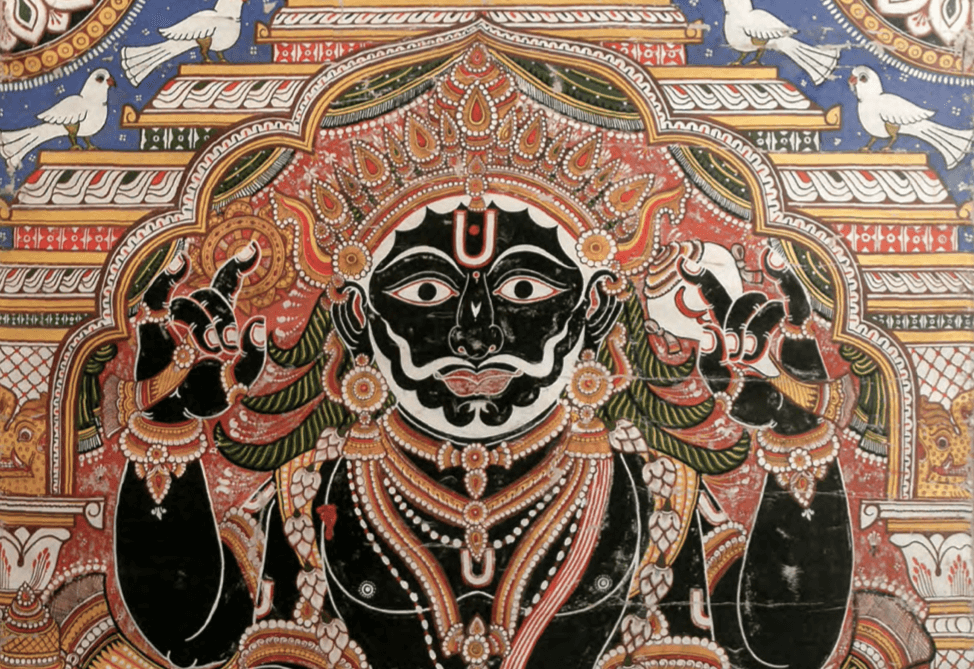
His work done, the master now withdraws and lets his apprentices take over. This is the first big engagement in their internship and training, and the master keenly supervises each brushstroke. Nothing can be wrong; more importantly, how can he give a painting with the slightest fault to his beloved deity? The helpers begin their work of filling in the colours. First, they fill the red background, then the black body of Jagannath. Finally, the ornaments are painted in chrome yellow and other elements are completed. The master takes over again, this time for the fine black outlines throughout. Intricate parallel lines and foliate designs adorn the garments and jewellery. Two conch-shell like eyes, a nose and rather fleshy red lips emerge as the process progresses. A fashionable flame-like moustache rises from under his nose, and a trimmed beard frames the face. Since Jagannath is black, all detailing is done in white. The studio needs to hurry up, for there is only about a week left, and there is a lot more to do.
Meanwhile, on the other end of the road, the other workshop has double the work to complete. This is the bada bada workshop, where the elder brother’s work is being done. The elder brother is also the one for whom more work has to be done in the pigments department, because filling the entire body in bright white requires grinding a lot of conch shells. White has been the most difficult colour to produce in Pattachitra workshops due to the exhausting task of turning shell into fine-grain pigment.
Balabhadra wears a seven-hooded white snake. His figure resembles his brother’s. He holds a pestle and a plough in his hands, motifs of his association with agriculture. Typical of Puri is the respect mixed with a hint of fear towards Balabhadra, who has a reputation for getting angered easily. Nobody messes with him. People may pull off a joke on Jagannath, who is like an all-weather friend.
The youthful sister is not to be forgotten. Subhadra is painted in dazzling yellow. She wears a sari. She wears traditional Odia-womenfolk ornaments – notha, tarata jhumpa, hansaguna, bajubandha and khadu. Like the rustic lady, her feet are lined with bright red alta. Her left eyeball is slightly smaller than the right one – in this part of the earth it is considered ‘auspicious’ to be so.
In a matter of another week, the paintings will be complete, except for a small white hole in the centre of their eyeballs. That part is reserved for the master chitrakara. He fills in the black when life is infused into the paintings before worship. The paintings are now complete.
The next morning is special. The entire family wakes up early. They bid their goodbye to the lifelike painted deities born in their households while a delegation from the temple arrives to escort the gods to their palace. The ghantua beats the gong (ghanta) and the kahalia sounds his trumpet (kahali). After all, this is the deity to whom the Gajapati rulers of Odisha had willingly acceded subservience to. Under a silver-handled royal umbrella, the master chitrakara walks with the rolled-up painting cradled between his arms. The party moves through the lanes to the temple.
Late that night, when the fever-sick gods return to the inner chamber for rest, a bamboo partition is strung in front, blocking them from public view. On this partition, the three painted deities are displayed in order – Ananta Basudeba (Balabhadra), Bhubaneswari (Subhadra) and Ananta Narayana (Jagannath). A fortnight hence, the high-ceiling chambers of the temple shall remain in the light of a flickering earthen lamp. It is in this yellow light of the flame that one sees how the lifelike Pati Dian (the depiction of the deities) appear to be gazing intensely far into the darkness of the silent chamber.
When the deities recover from their fever, they will come out of their sanctum in the Ratha Jatra. The endless cycle shall recur as it has for centuries.
It was when the King Nrupa Keshari ruled over ancient Odisha. Historians think that the years are 852–857. Karama, the old Marathi woman lived in one of Puri’s mutts. It had been a long time since she’d been there. She had come to Puri to search for her missing husband and look at Jagannatha, but hadn’t left. Here she had accepted the famed Indraswami as her guru.
Every morning, Karama would wake up and offer something to Jagannatha at her home. One day, she decided to do something special. She would make Khichdi. And so she got a small earthen pot from the potter and the ingredients for the food. The next morning she woke up early and lit the fire. Khichdi would take time.
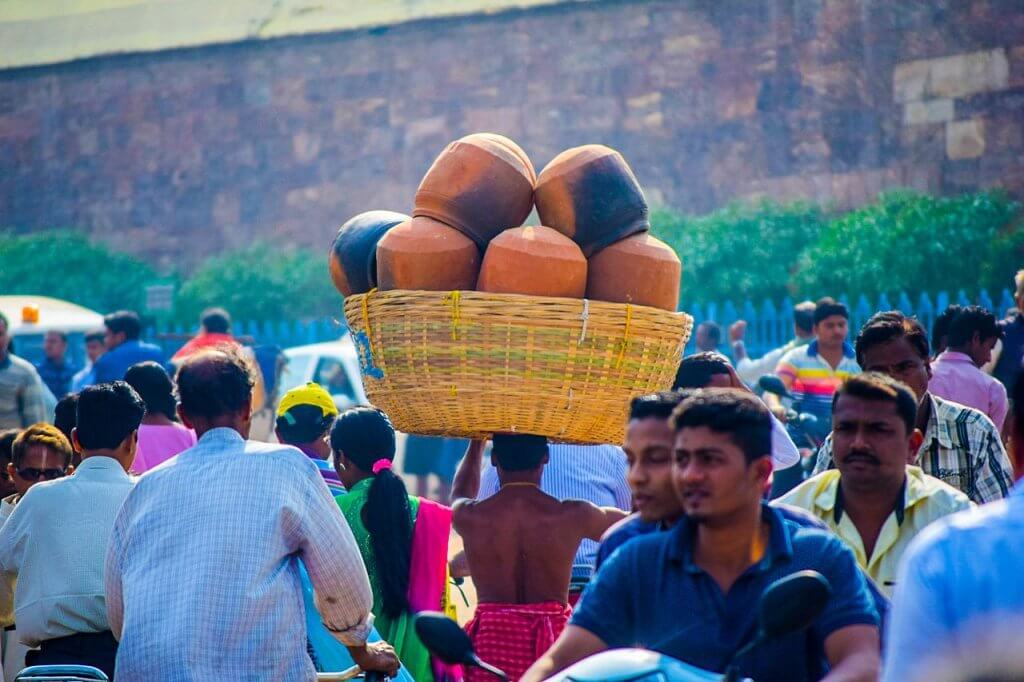
Man carries earthen pots for the Puri temple. Picture : Prachites Subham Das
When food is offered to Jagannatha in the sanctum sanctorum of the great temple of Puri, there are a number of rituals that have to be done. Hundreds of earthen pots filled with cooked prasada are stacked in front of the smiling deities. The chief priest then cups his palms together and looks into them. If he sees, for a split-second, the form of Jagannatha — then the food is saidd to be divinely approved. But this day he did not. Something was surely out of place. Perhaps a dog had entered the temple or someone had not been ritually ‘pure’ while cooking food for God.
As always, Karama had gone for her daily visit to the temple. There she came to know about the situation and thinking that perhaps the deity wanted her Khichdi, asked the temple officials if she could offer it in the temple. The priests refused. One of them had seen Karama cook the food that morning. He had seen how she used the same twig to stir the mixture with which she brushed her teeth. Meanwhile, how can food from a whore’s hands be offered to God?
That night the King received a dream to bring Karama and apologise to her for what had happened. All she said was that Jagannatha was beyond notions of pure and impure. She was told to cook again. When she did she could see two young boys gazing at her from the corner of the street. She gave them some of it out of motherly love when they asked for the prasada.
When the food was taken to the temple, someone noticed a grain of rice stuck to Jagannatha’s lips. The offering was made. Now the priest saw him in his palm. The God was satisfied.
Some others Karma think was born in the Nagaur district of Rajasthan, sometime in the 1600s. This is clearly another lady, but the story is somewhat similar. The earlier Karama’s is the better-known story, since the 16th-century poetess Madhabi Dasa mentions her name in one of her jananas to Jagannatha.
ମୀରା କରମାଙ୍କ ଭାବେ ହୋଇ ରଙ୍କ ସ୍ଥାନ ଦେଲ ବ୍ରଜପୁରୀ
ଚକାନୟନ ହେ ଜଗୁଜୀବନ ଶ୍ରୀହରି, ମାଧବୀ ଦାସୀ
Of course she wouldn’t have written about somebody living in her times. Anyways, here goes.
Hers was a Jat family. Once, her father instructed her to offer food to Krishna since he was too busy. The young Karama took the statement literally. She woke up early the next morning and making some khichdi, offered it to Krishna. When she saw that Krishna was not eating anything, she felt bad — she herself did not eat until he would. It is said that Krishna then appeared and ate the khichdi. Her father was shocked at the incident, and Krishna appeared again to prove her true. Karama took a living samadhi at the end.
थाळी भरके ल्याई रे खीचड़ो ऊपर घी की बाटकी
जीमो म्हारा श्याम धणी जीमावै बेटी जाट की ।
Bai Handi
The offering of Karama’s Khichdi was a great thing back then, and is even now, for food prepared outside the temple had never been offered before. Her recipe was introduced into the Temple Kitchen nonetheless. The earthen pot in which Karama Bai cooked became known as the Bai Handi. The new prasada came to be called Karama Khechudi or Mahadei Paka. The practice continues till today.
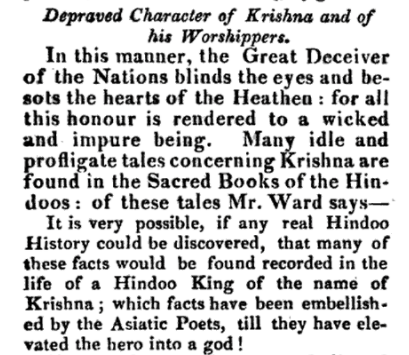
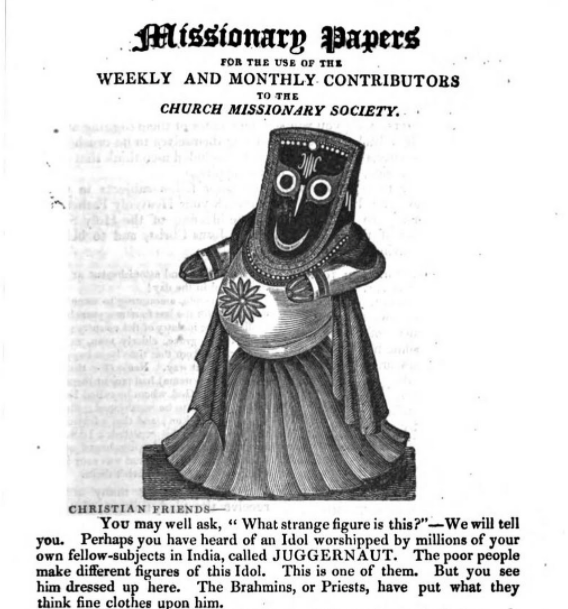
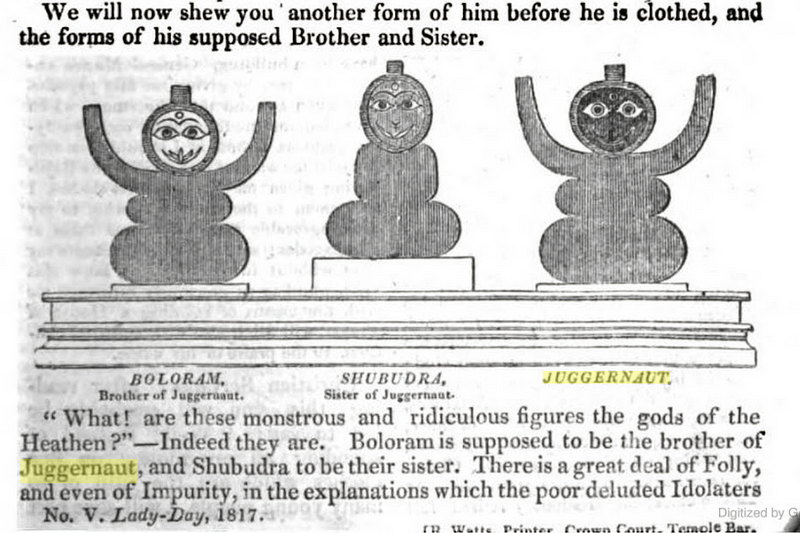
I recently came across a book called ‘The Wesleyan Juvenile Offering’. Multiple editions of this book are on Google Books, in case you would like to have a look. Curiously, there’s a bit about Jagannatha and the Dola Jatra of Puri.
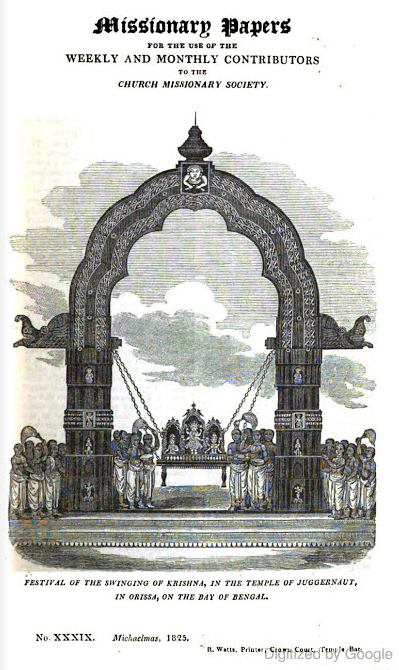
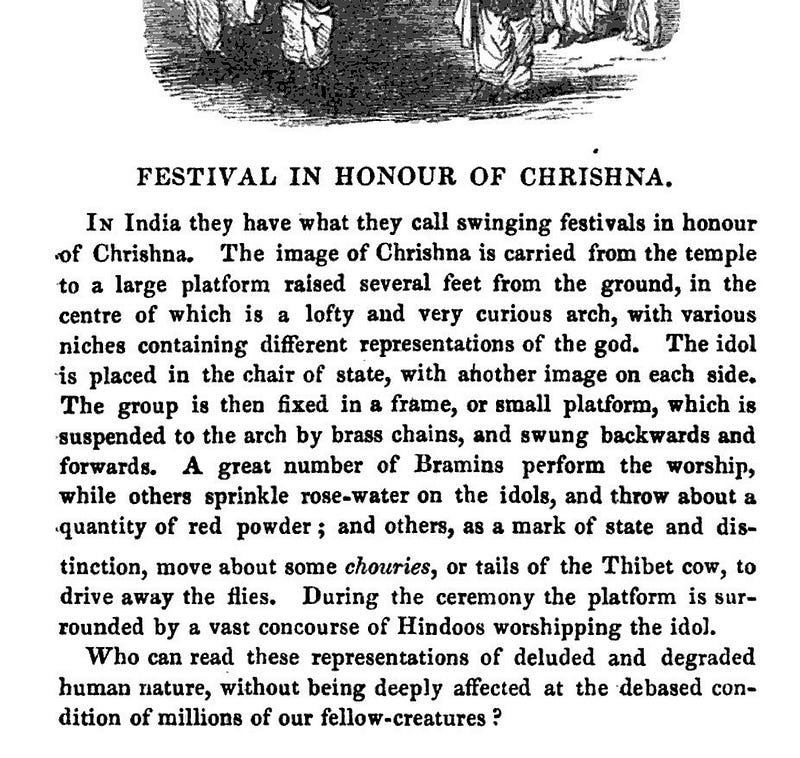
Without further ado, here’s what he says. Note that the author hasn’t actually said anything about Odisha till now- this could well be anoher place. But the lithograph beside has typical Odia architectural features, as you can probably notice. Since that set of pages was deleted from the free preview in Google Books, here’s the same content from another book. This one explicitly states that it is from the Jagannatha Temple. But intentionally spelling it as ‘Juggernaut.’
And here’s the next page.
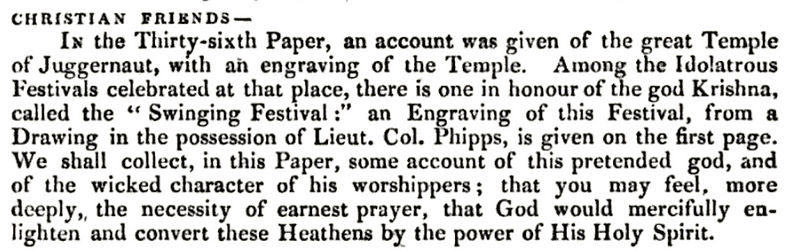
“Pretended god”, “wicked character of his worshippers”, “heathens.” Let’s continue reading.
“Depraved character”, “Great Deceiver of the Nations.”
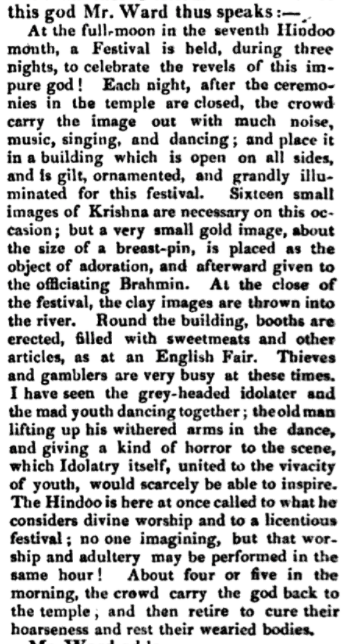
Then he describes the Dola Jatra of Puri.
And later in the book, he presents an image of Jagannatha, which confirm my hypothesis.
His conclusion remains baseless though. Next, he switches to ranting.
People are happy- they dance and sing for their deity- what’s wrong with that? And this much when he has not introduced the deity at all!
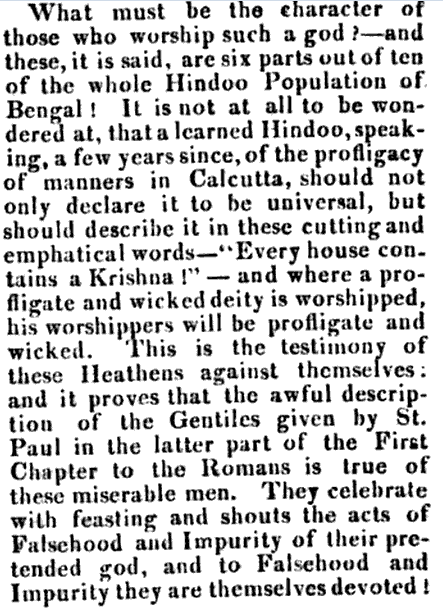
For the grand finale, he comes up with an intentionally twisted image.
And doesn’t stop there.
This person has such an established imaginary world it’s difficult to explain.
The book reveals a clear hatred for the colourful rituals and festivals of Puri. All of this so that they can call an entire nation ‘wrong’ and ‘satanic’, whom they must bring on to the ‘correct’ path. Read it on your own if you want more. There’s hundreds of pages full of this rubbish.
Update : Those sets of pages have been hidden away from preview now. There remain other copies though. Like Missionary Papers.
Jagannatha has many Besas (special attires), somewhere around thirty. Some of them are done on a daily basis. Others are done on a special day each year. Yet others are done based on specific astronomical conjunctions- in which case the Besa may be done every five years or every ten years. By this point, we have only three or four of these, each one of these being very rare. Going further, the rarest of all of them is the fabulously luxurious Raghunatha Besa, in which Jagannatha is dressed as Rama. In this grand ‘Besa’ or costume, Jagannatha is dressed as Rama and Balabhadra as Lakshmana. Subhadra is Rama’s elder sister, Shanta. In a very graceful pose, Jagannatha wields the bow and the arrow in his hands. Hanuman sits by his feet and Sita on his lap.
And why is it rare? Because of the gold. The sheer amount of gold used in this one attire far surpasses those used in any other ceremony or festival- even the Suna Besa, the ‘Golden attire’ which gets its name from the quantity of the gold. In 1577, Gajapati Ramachandra Deba made hundreds of pieces of jewellery to adorn the triad. Back then he issued coins with Rama’s sign. This is the very same jewellery. So much is the gold that this costume has not been done for the last century out of security concerns. The last time was in 1905. And in the last 600 years, this costume has only been done 9 times. Only nine.
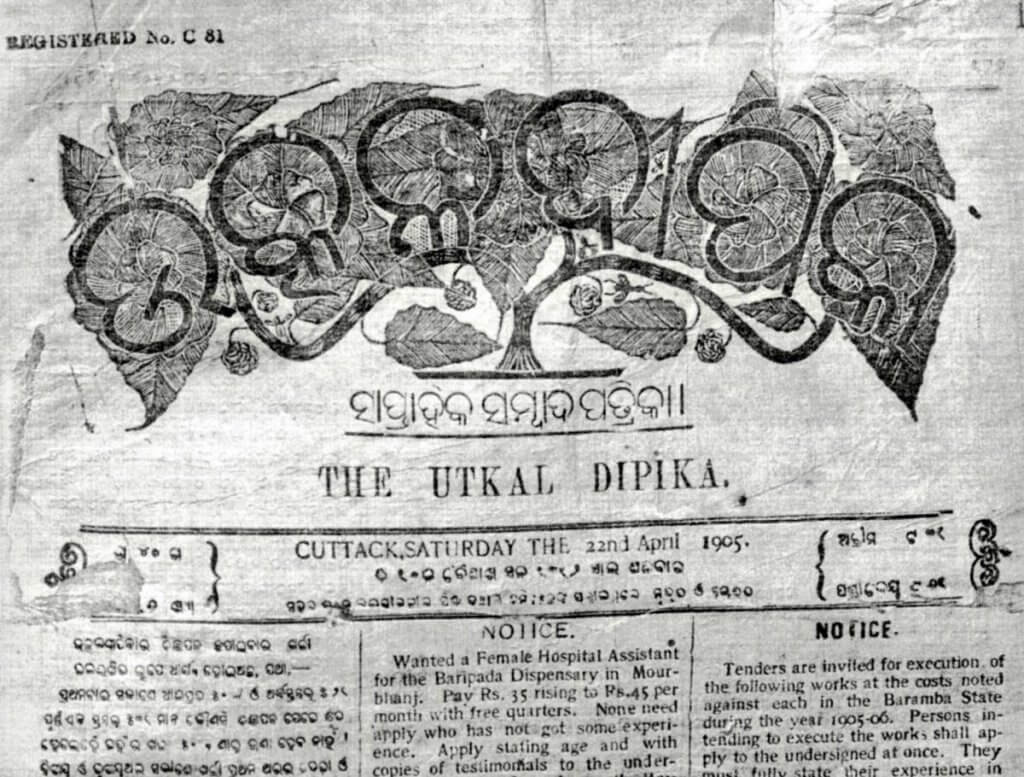
The Utkal Dipika
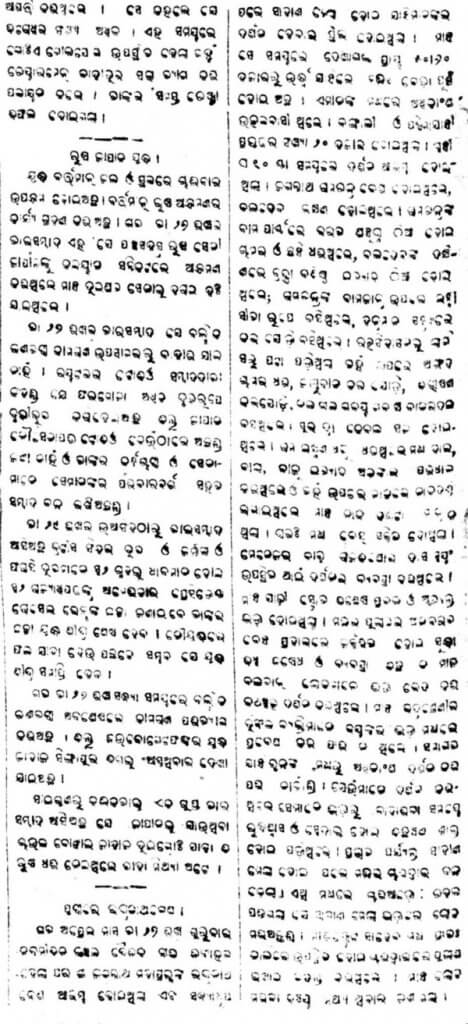
Most sources today agree that the last time Raghunatha Besa was done was in 1905. So I checked the first Odia newspaper. This is ‘The Utkal Dipika’, the first ever Odia newspaper. Fortunately it has been scanned and the pages have been preserved.
On 15th April 1905, Saturday : There’s a full one-page report that Raghunatha Besa will be done on 27th April 1905 and a public invitation.
Nothing in the 29th April 1905 issue. Perhaps the page did not survive or the Besa was not over yet. Quite unexpected.
On 6th May 1905, Saturday : Raghunatha Besa has been organized. 50–60,000 inside temple. Overcrowding, many unable to see deities.
“Balabhadra, as Lakshmana held an umbrella. Jagannatha was dressed as Rama with Sita on his lap. Angada, Jambaba stood beside him. Powerful men from various places misused their power to break the system & go to the sanctum while many others couldn’t. Jagannatha was wearing a golden nose-ring, bracelets, rings and other ornaments. I (editor) felt the nose-ring looked a bit odd. Those who saw the deities were completely suffocated and sat down for a while to take a deep breath.”
Utkal Dipika, 06.05.1905
On 6th May 1905, Saturday : Since the people of Puri couldn’t see anything, the Besa was held again on 3/5/1905. “Everything went well.”
That’s it. I wonder whether this Besa will ever be done again, for that’s all we can do for now. Let’s see.
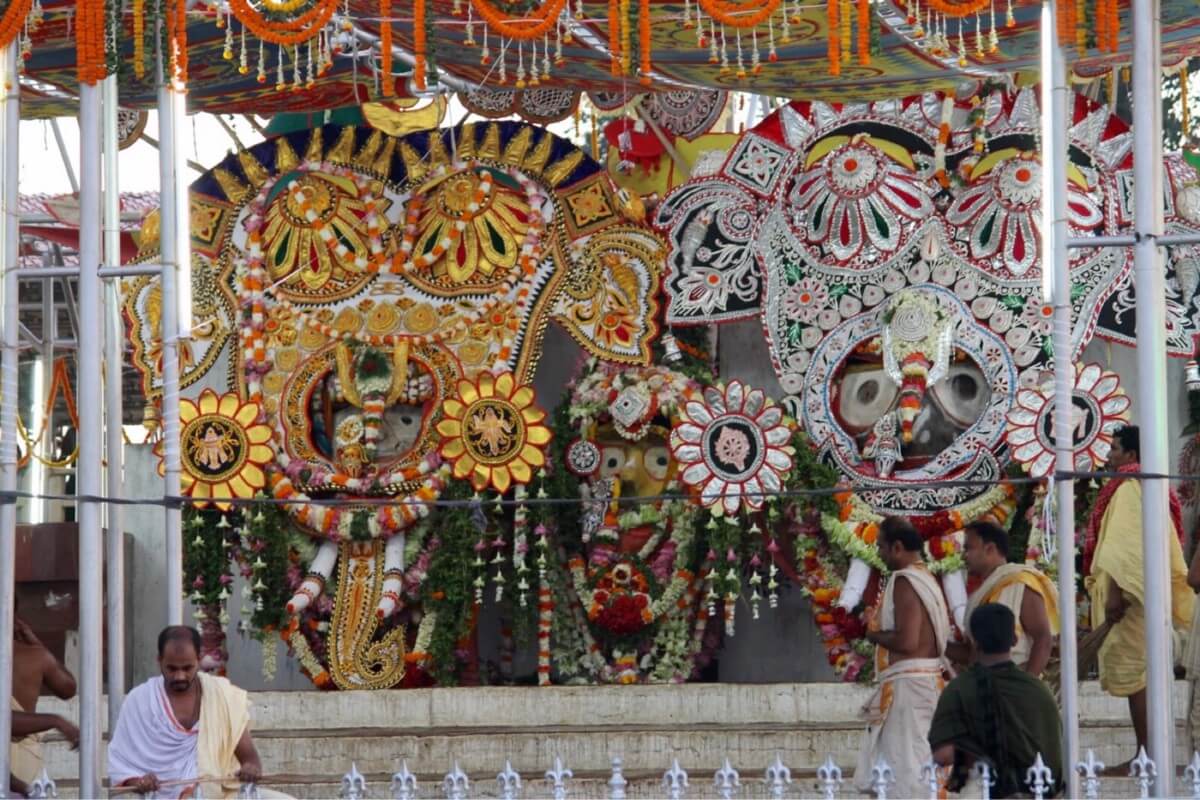
Every year on the full moon day of the Odia month of Jyestha, the Jagannatha triad come out of the temple’s inner sanctum for the annual Snana Jatra. After the ritual bath, the deities are dressed in the Gajanana/Hati Besa, the elephant attire. The story behind this costume has been recounted in the ancient text of Dardhyata Bhakti. The story is still told fondly by members of the Mahaganapatya sect, followers of Ganesha.
Hati Besa of Jagannatha triad, Puri
A sage by the name of Ganapati Bhatta used to live in the land of Karnata (present day Karnataka.) Others say he was from Maharashtra. Whatever that may be, he was an ardent devotee of Ganesha. Being a religious Brahmin, he had read the scriptures thoroughly. One day, as he was turning the pages of the Brahma Purana, he read a line that said, “The Supreme Brahma resides on the Blue Mountain. His sight itself grants Mukti.” When Ganapati realised what this meant, he set out immediately for Puri. On the way, he thought of his foolishness in being blissfully unaware of the God who grants redemption.
Walking, he came across a few fellows singing merry songs, with the divine Mahaprasada in their hands. Amazed, Ganapati asked them why they were so elated, to which the leader said, “We are returning from Puri. We’re on our way to our homes after a five day long visit.” This created a doubt in the poor Brahmin’s mind, “How can one return alive after sight of the supreme? Surely this could not be God. After all, the Puranas and scriptures are nothing other than conjured-up tales of human imagination.” Saddened, he turned to walk back.
Suddenly, another priest had appeared from nowhere. He spoke to Ganapati, convincing him of the ways of the Lord at Puri. “Why should he grant Mukti to one who wants to return to his family ? He gives what one asks for. You should go and see him. Ask him for redemption. He shall extend it to you.”
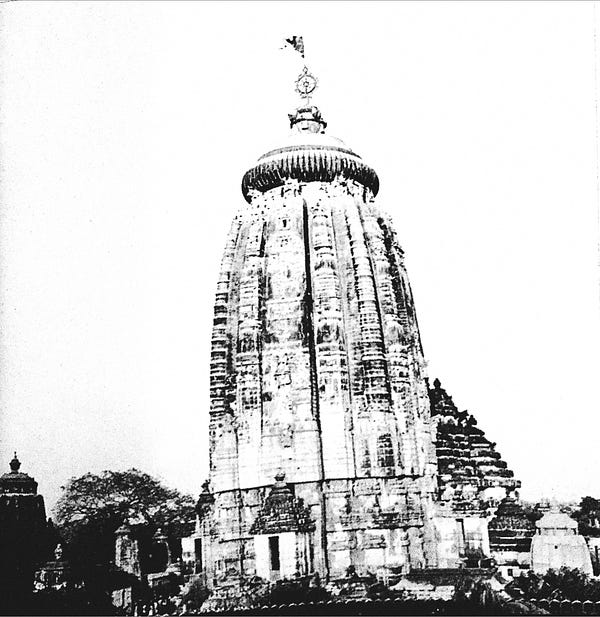
An old photograph of the Jagannatha Temple
Hesitating, Ganapati again resumed his journey to Puri. When he reached the Temple of Lord Jagannatha, the people told him that it was a festive occasion. The full-moon day was when the Lord would have his ritual bath. It was Snana Purnima. The Gods had left the sanctum sanctorum and were instead on the Snana Mandapa, a special platform inside the temple for the festival. Ganapati saw him, and again wondered, “Where is the elephant trunk? Where are the tusks? He doesn’t seem to have an elephant head. He is not my Ganesha. He is not God. This is all a huge hoax.” And one more time, the Mudirathasebayataconvinced him to wait till the evening on Lord Jagannatha’s orders.
That evening, Ganapati returned. He had decided that he would not come again, that this was the last try. The Lords were dressed in the Gajanana Besa, the elephant attire. Balabhadra was dressed as a white elephant and Jagannatha as a black one. Ganapati was ecstatic. He sang out an instant prayer in the Lord’s praise-
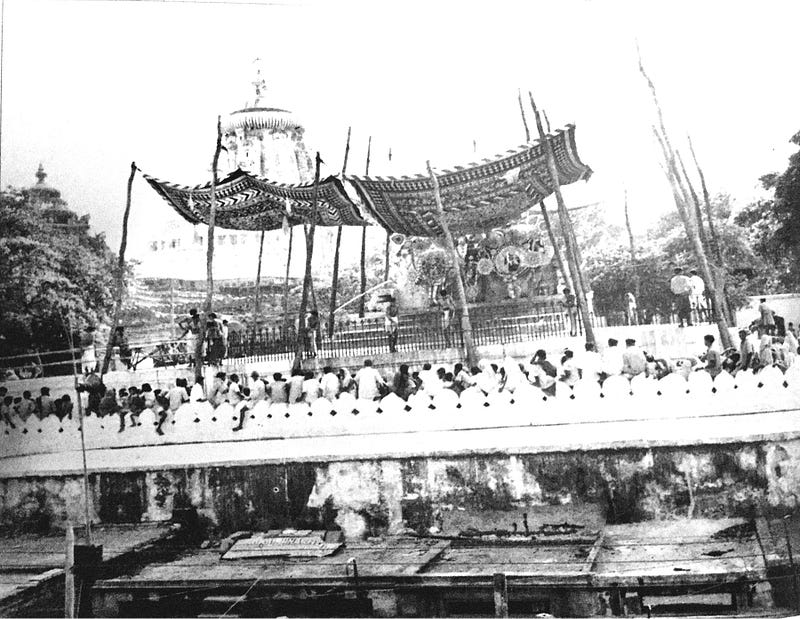
Gajanana Besa in 1972
ତବ ଦର୍ଶନେ ଦାରୁବ୍ରହ୍ମ । ତୁଟିଲା ମୋର ମତିଭ୍ରମ ॥
ଲଭିଲି ପରମ କାରଣ । ଏବେ ଯା ମାଗୁଅଛି ଶୁଣ ॥
ଆଜୁଁ ଏ ଦେବସ୍ନାନ ଯାତ । ଯେବେ ହୋଇବ ଜଗନ୍ନାଥ ॥
କେବଳ ହସ୍ତୀ ବେଶ ହୋଇ । ବିଜେ କରିବ ଭାବଗ୍ରାହୀ ॥
ଏତେକ ମାତ୍ର ଆଜ୍ଞା ହେଉ । ଏକଥା ଯୁଗେ ଯୁଗେ ଥାଉ ॥
At your sight, O Lord, my doubts have been shattered. I have gained supreme happiness, now I ask from you- From today every year, on this eve of Debasnana Purnima, you shall dress in the elephant attire. Let this be fulfilled. Let this tale be remembered forever.
Ganapati asked the Lord for Mukti, and he was redeeemed from the world instantly. People watched in awe as a flash from his lifeless body flew out and became one with Lord Jagannatha’s idol.
A ruckus had been created among the Cooks and Servitors of the Jagannatha Temple. Everyone was either speaking about it or hearing it from someone else. In a place and time where a sera of milk cost four or six paise, and one of Ghee cost twelve annas or a rupee, what would be done with a lakh of rupees? What bhoga would be worth a lakh? What could be done?
Not hundred, Not thousand. It was one lakh. One hundred thousand. The sages and servants sat counting the zeros in the figure. Not a penny less, not a penny more. One lakh rupees, and that was that.
Everyone was perplexed, and at the same time, desperate. Hours and hours of bewildered musings and still no way to the problem. Still no idea, no solution, no answer, nothing. No panacea for this Gordian Knot. Then again, cutting the knot was no solution, was it? They couldn’t say no; simply couldn’t refuse the money, and say that it was too greater than required. They couldn’t tell him to reduce the money substantially, convincing him that it was still excessive.
This was a matter of great shame. To put it rather too frankly, there was no bhoga worth a lakh that could be offered to the Lord of the Cosmos- Jagannatha. The God who is the ultimate refuge; whose huge outstretched hands lend him his name Mahabahu; whose cartwheel eyes gaze at all that is; whose temple is the Great Temple, Bada deula; whose street is the Grand Street, Bada danda; whose prasad is Mahaprasad; who himself is Mahaprabhu- The Lord Jagannatha -has no bhoga that would cost a lakh rupees. No, not one. Such would be the humiliation if they refused. No, they couldn’t deny the offer. Not even for their life could they do that.
The dearest eatable was butter. Churned from milk, it cost the most. It was called La-hoo-ni in Odia. Krishna loved it so much that he stole and finished off all the butter he could see. From butter was made ghee- the Food of the Messenger of Gods, Agni. But what could be made with only ghee? Even if they served the deities butter sweetened with caramelized sugar, it would cost ten thousand at most. But this was ten times that.
The year was 1727. It would be two days since the Seth had arrived. The word ‘Seth’ in India means a magnate, a magnifico. He was from Hyderabad in South India. His name was Dhananjay Mehta. True to his name, he sure was a winner of wealth. Too much of it. Ostensibly, he wanted to show his devotion to the Lord by offering him a bhoga worth Rupees 100, 000. There was but a single condition- a single bhoga would have to be offered. And therein lied the problem. Had that condition not been there, they could have offered numerous food offerings spread over a span of time. But it was there, and they had to nod their shaved heads in agreement.
Usually, well-to-do pilgrims offered money for bhogas. They gave money for additional bhogas to be offered on the days of their stay, and even after that, on previously settled dates and days, when the stars were in a favourable arrangement in the night sky. Days together after they left, the bhogas were offered by chanting their names within verses of priestly Sanskrit. By selling those bhogas, the pandas and cooks made a living. They served the Lord, and he supported them. But Seth-ji didn’t want that. Why make a fuss in your name when you aren’t present in person? Who would see him after he had left? Better to make a single bhoga, on a single day of his stay, and become known as ‘The-generous-Seth-ji-who-had-made-a-bhoga-of-one-lakh-rupees’. How the people would look up to him after that! How they would hold him in high esteem!
Ananda bazar, the Temple Kitchen, was at that time the World’s Largest Kitchen and it still is. It fed lakhs and crores of people each day, without any previous order. Its foods were called Maha-prasada, not just prasada. From the untouchable Chandala to the revered Brahmin,its gates were open to all. The steamy aromata of the foods as if held the pilgrims by hand and led them to the food. Such a kitchen and still no food worth a lakh.
At last, the cooks and the servitors said in unison-“Why are we foolishly pondering over the issue? Why bother when the answer to all is beside you? He has given us the problem, he will solve it. Let’s ask him. Jaga will surely answer.”
And so they proceeded to the head priest, who ritually went alone to him and in his troubled state spoke out-“Kalia, spare some thought for us and save your and our honour. Tell us what you wish to eat, for it is you who will relish the food. Answer our helpless queries, O Jagannatha!”
And on the other side, our self-proclaimed-great-devotee-Seth was worried over his business. He had to return, you know, to assume control of his business. These assistant-types could not be relied on for long. When they would eat up his empire God alone knew. He would live here in Puri for one more day or would leave straightaway if the main priest did not take his money. That he had fixed in his mind.
When he got the news that Lord Jagannatha would himself tell his choice, he could not help but feel a bit puffed up. His money was so great that the Lord was consulted. He would humble the world with his notes, he thought to himself. What if he would be a day or two late to home? His name would be forever etched in the memory of these people of one of the four holy dhaams, of Jagannath Puri. He would not let go of such a golden chance. God would himself announce what he wanted from his greatest-devotee-ever-Seth-Dhananjay-in-terms-of-money-donated.
One who is the Lord of the fourteen spheres and the world, what does one lakh rupees mean to him? But to his sevakas, his servitors, it was too much. At last, the Lord appeared amidst a cloud of radiance. He said to his head priest, his sincere sevaka-“Tell to Sethji, that I want from him a Paan. Everyday before my sleep, the same betel leaf wrapped around the same things does not feel good to me now. I want something different. The same bidia paan bores me. Let Sethji give me what I desire eagerly. I want from him a Paan, a different one, in which the lime should be from the pearl of a Bull-elephant. Let me first relish that Paan, then shall I think of what to eat worth a lakh rupees.”
A Paan. But not an ordinary one. One with the lime from the pearl of an Elephant’s forehead. Not from shells of ordinary sea creatures, or from the finest conch shell. It is said, traditionally, that pearls grow in the foreheads of bull-elephants. They were called Gaja-muktas, that is, Elephant-pearls. Now the phenomenon has been scientifically confirmed. Elephant pearls are the equivalent of pulp stones in human teeth. They are formed from rounded calcified masses of dentine (ivory) and are recovered from the large soft tissue pulps of the continuously growing teeth (tusks) of mammals such as the elephant (recent and fossil). Anyway, one such pearl was to be obtained. And that, was that.
When Seth-ji was told that all he had to offer was a Paan, he laughed, creating a cacophony. However, his uproarious bellows did not last. His head swayed as he listened to the statement in its entirety. He thought to himself- ‘Elephant-pearl.’ All elephants do not have a pearl. The old phrase came to him- Elephants, dead or alive, are worth a lakh. Lakhs of elephants had to be killed for this. Still, there was a chance that none of them possessed a pearl. Even if one did, it had to be extracted. The pearl had to be burnt over a flame and ground to a fine paste. Then would it be smeared over a betel leaf, and wrapped up for Lord Jagannatha.
This task would take him a lifetime. Still the odds would be against him. He found himself nowhere, lost. Dhananjay Seth’s head reeled. Unknotting his embroidered turban and flinging his sandals outside, he rushed into the Temple, climbing the twenty-two steps representing the twenty-two human fallacies, overcoming them truly. He ran to the sanctum sanctorum, and lowered his head below the jewelled pedestal on which the smiling deities sat. Once again, Lord Jagannatha’s smile waved across his lips. Dhananjay lay defeated. He lay humbled. His pride crushed to pieces, just like the lime-paste, he raised his arms and joined his palms in the gesture of humility and respect, tears streaming from his eyes.
Now changed, he said-“Take whatever I have. Let me not lose this lesson ever in my life. Incapable as I am of giving you a Paan, what can I give you worth a lakh? Take my heart, purified by you. Take my sweet-smelling heart filled with true devotion now, wrapped in the betel leaf of humility, and smeared with the paste of my crushed pride.”
Near the shimmering sands of the Golden Beach and the sparkling shore of the Mahodadhi, lies the conch-shaped city of Puri. The great river’s waters shimmer with glee as the first rays of the crimson sun touch them. The exquisitely carved black chlorite figure of Aruna, Surya’s celestial charioteer, present on top of a massive column in front of the Singhadwara, shines under the soft glow of the rising Sun. The waves of Mahodadhi dance on the tides, as if paying their obeisances to this great temple that stands by its shores since time immemorial.
At the break of dawn, in the holy temple, three of the four gates of the temple are opened. But the actual, huge massive gates are not the ones that are opened. At five o’clock, some specific sevayats enter the temple through much smaller, concealed doors in the larger metallic doors. These smaller ‘doors’ are called Chora Kabata, literally ‘Secret Door’. The sevayats enter into the temple premises to awaken the Lord from his restful sleep.
But it’s not as simple as that.
It is not so simple to awaken the ‘Lord of the Cosmos’ from his repose. Just like every other ritual in the Jagannatha Temple, this one too has a number of tasks.
Of course, before them, the temple guards inspect every nook and corner. The sevayats who do these early morning rituals are the Pratihari, Bhitarachu Mahapatra, Muduli, Mekapa, and Akhanda Mekapa. These servitors first gather at the Southern(Elephant) Gate or Dakshina Dwara, and then proceed towards the main temple. They go to the Jaya-Vijaya door of the Natamandapa (The terms refer to architectural components and specific doors). This door is locked by an earthen seal a day before, during the nighttime rituals. Now, the seal is inspected, and the lock is opened with the key. The key is taken from the Muduli sevayat, who keeps it through the night.
Now all of them enter into the main temple, specifically the Jagamohana, and reach the inner door to the sanctum sanctorum. This door, called the Kalahata Dwara, or the Chhamu Dwara,with abeautifully ornamented doorjamb gilded with silver, is then opened.
But before that, there’s another thing to be done.
Before that, the Pratihari Sevaka calls at the top of his voice, to wake up the Lord lest he be sleeping while the door is opened. He calls aloud-
Only after that do they open the door to see a wonderful sight. As the Mekapa & the Akhanda Mekapa light a lamp, the darkness is dispelled by the flickering light of the lamp, to reveal one of the most captivating sights- the three deities, in their Nighttime attire, the Badasinghara Besha, adorned with all sorts of flower-ornaments, their round eyes looking through the net of fragrant flowers. In this way, the Mekapa and the Akhanda Mekapa light nine huge brass lamps. All the doors in the temple are then opened completely.
Then do the Pushpalakas enter the sanctum sanctorum and perform the morning ritual of waving the sacred fire before the deities, or Aarti. The Pushpalakas do the ritual with the help of the Mekapas and the Mahapatra sevayats. This Aarti or Alati(aa-la-ti) ritual has 3 steps-
The first is done with Camphor, called Karpura Alati.
The second with 21 lamps of Ghee, is called Ekoishi Batti Alati, as it is done with twenty-one lamps.
The third with liquid batter of moistened rice, called Pithau. Hence this alati is called Pithau Batti Alati.
These three steps together are called the Morning Alati, or Mangala Alati. So, the Mangala Alati marks the beginning of the day in the Jagannatha Temple.
An important thing is that the devotees can see the entire Mangala Alati. This is because, after opening the Southern Gate, Bhitarachu Mahapatra orders for the four main gates to be completely opened, so that people may enter the temple precincts. Again, after the Khata-sheja mekapas keep aside the ivory beds of the deities, called Ratnapalanka, the other doors- namely the Sata Pahacha Dwara, the Panda Dwara, the Beharana Dwara are opened in the order. The general public then view the deities, standing near the Bhitara-katha-argali.( that is, the stout wooden bars put just after the sanctum sanctorum to keep the people from entering the sanctum sanctorum while rituals are going on)