Tag: Festivals

  • Seven makers of the Ratha

    Seven makers of the Ratha

    Published on 2 Jul 2019 in OrissaPOST

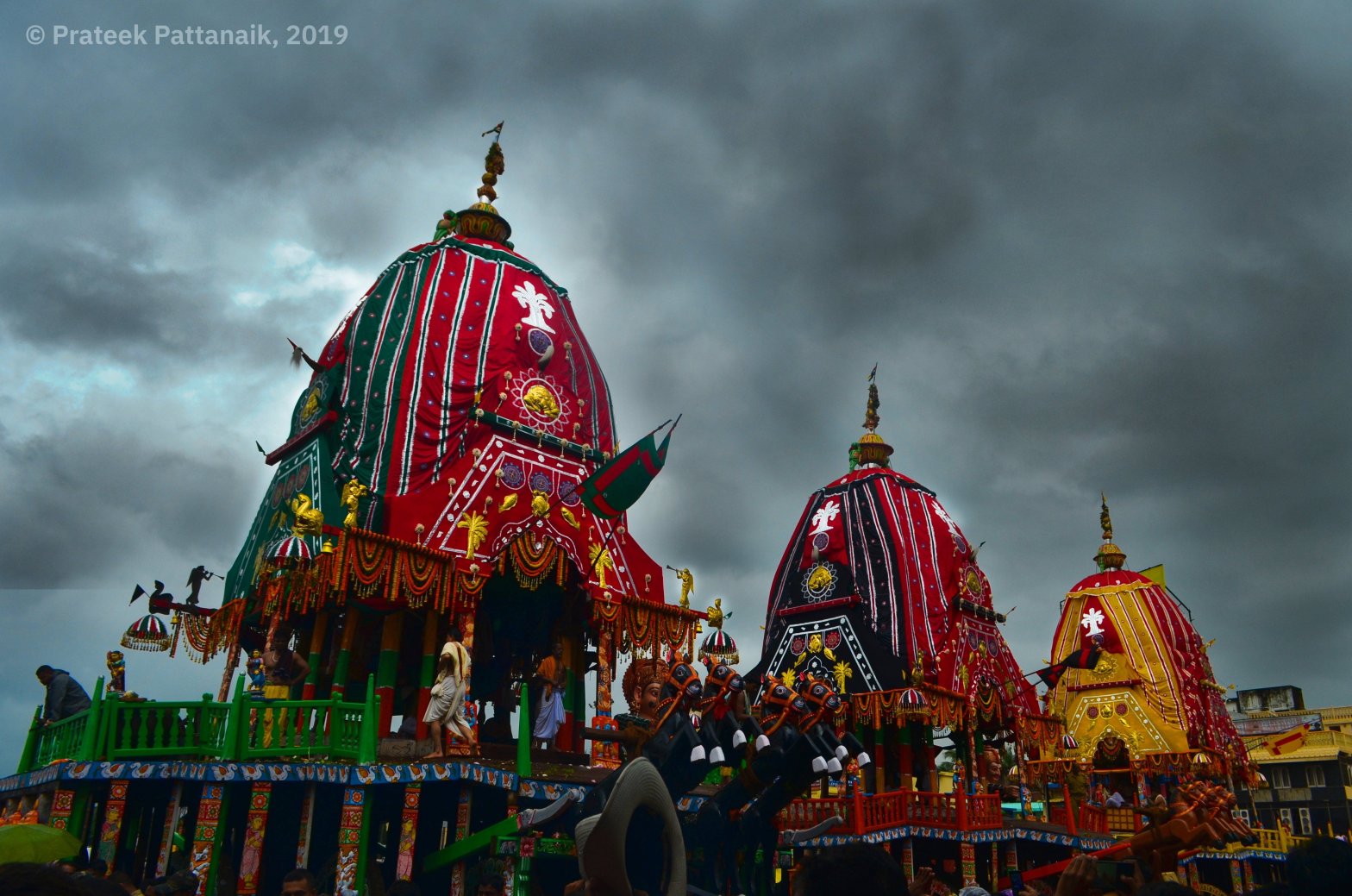
    Every year for the Ratha Jatra, three huge rathas or chariots are made by artisans in Puri. While being huge structures that must be capable of supporting several people at once, the rathas are also spectacular pieces of traditional art, combining multiple branches of craftsmanship into a harmonious whole. 

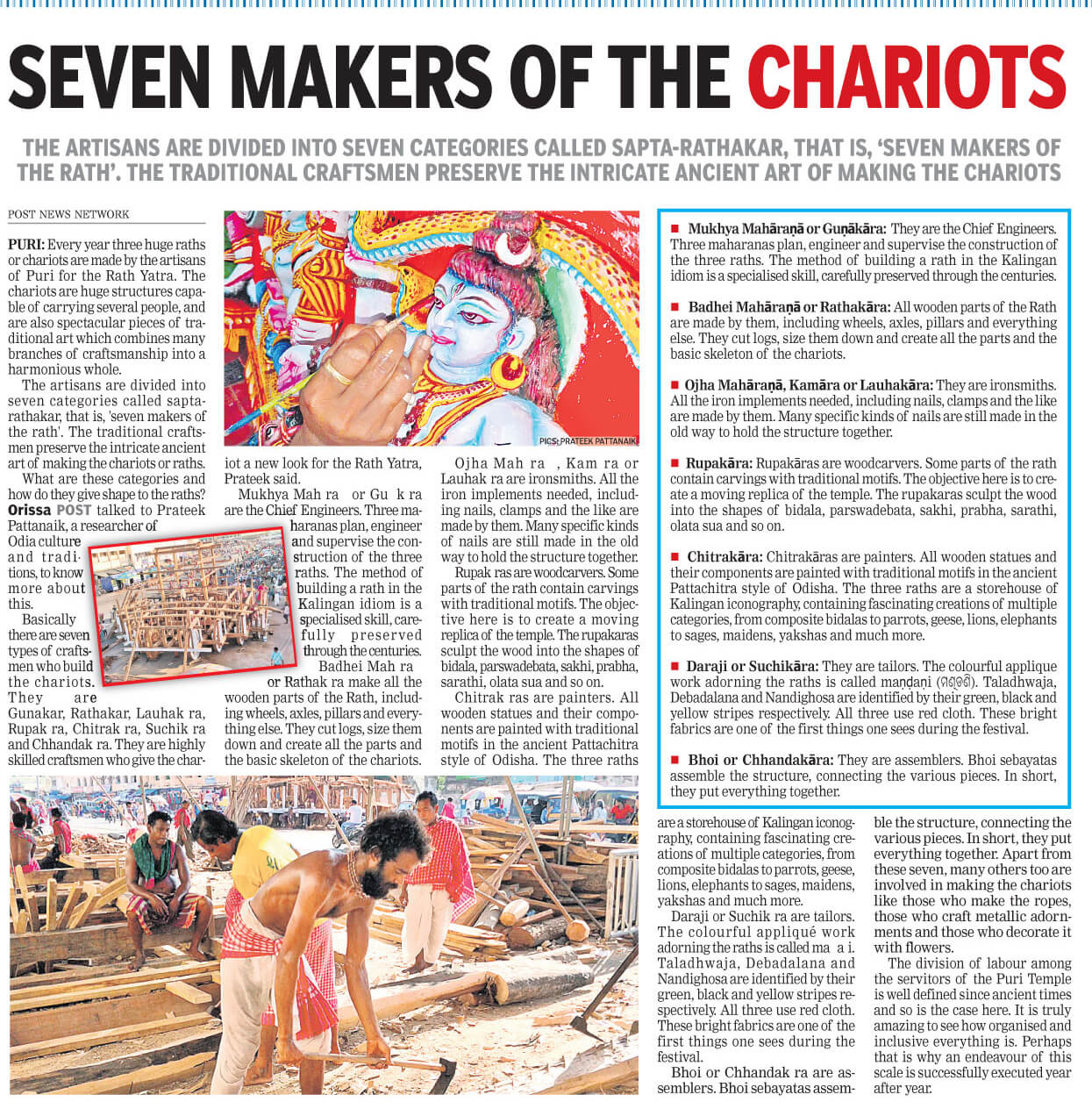
    Traditionally the artisans are divided into seven categories called sapta-rathakāras, ‘seven makers of the ratha’. These traditional craftsmen hence preserve the intricate ancient art of making rathas. What are these categories and how do they work separately yet together to build the rathas?

    1. Mukhya Mahāraṇā or Guṇākāra (ମୁଖ୍ୟ ମହାରଣା ବା ଗୁଣାକାର) : Chief engineers, so to say. Three maharanas plan, engineer and supervise the construction of the three rathas respectively. The method of building a ratha in the Kalingan idiom is a very specialised skill, carefully preserved for centuries.

    2. Badhei Mahāraṇā or Rathakāra (ବଢ଼େଇ ମହାରଣା ବା ରଥକାର) : All the wooden parts of the Ratha are made by them, including the wheels, axles, pillars and everything else. They cut up logs, size them down and form all parts, creating the basic skeleton.

    3. Ojha Mahāraṇā, Kamāra or Lauhakāra (ଓଝା ମହାରଣା, କମାର ବା ଲୌହକାର) : Ironsmiths. Iron implements needed, including nails, clamps and the like are all made by them. Several specific kinds of nails are still made in the old way to hold the structure together.

    4. Rupakāra (ରୂପକାର) : Woodcarvers. Various parts of the ratha contain carvings of traditional motifs, the aim being to create a moving replica of the temple. The rupakaras sculpt the wood in the shape of bidala, parswadebata, sakhi, prabha, sarathi, olata sua and so on.

    5. Chitrakāra (ଚିତ୍ରକାର) : Painters. All wooden statues and components are painted with traditional motifs in the ancient Pattachitra style of Odisha. The three rathas are a storehouse of Kalingan iconography, containing fascinating creatures of multiple categories, from composite bidalas to parrots, geese, lions, elephants to sages, maidens, yakshas and much more.

    6. Daraji or Suchikāra (ଦରଜୀ ବା ସୂଚୀକାର) : Tailors. The colourful applique work adorning the rathas is known by the name maṇḍaṇi (ମଣ୍ଡଣି). Taladhwaja, Debadalana and Nandighosa are identified by their green, black and yellow stripes respectively. All three use the red cloth. These bright fabrics are one of the first things one sees during the festival.

    7. Bhoi or Chhandakāra (ଭୋଇ ବା ଛନ୍ଦକାର) : Assemblers. The group of bhoi sebayatas assemble the structure, connecting pieces and putting it all together.

    Besides these seven, many others are also engaged : including those who make the ropes, those who craft metallic adornments and those who decorate it with flowers. The division of labour among the servitors of the Puri temple is very well-defined since ancient times and so also is the case here. It is truly amazing to see how organised and inclusive the activity is— perhaps that is why an endeavour of this scale can be successfully accomplished, year after year.

    The writer researches and documents vulnerable aspects of Odisha’s culture using technology. e-Mail: pattaprateek@gmail.com
  • Where mother is son

    Published on 2 Sep 2018 in OrissaPOST

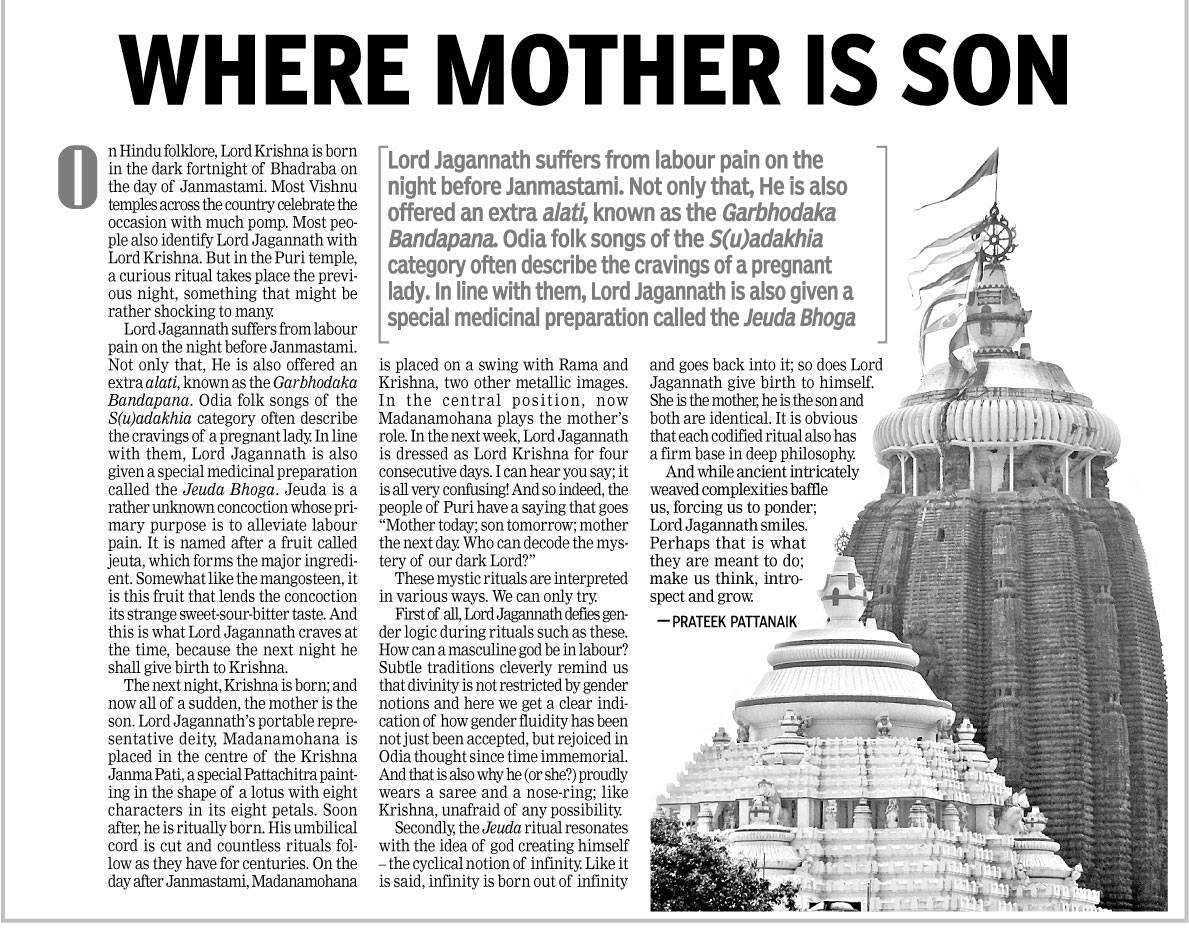
    In Hindu folklore, Krishna is born in the dark fortnight of Bhadraba on the day of Janmastami. Most Vishnu temples across the country celebrate the occasion with much pomp. Most people also identify Jagannatha with Krishna. But in the Puri Temple, a curious ritual takes place the previous night, something that might be rather shocking to a few.

    Jagannatha suffers from labour pain on the night before Janmastami. Not only that, he is offered an extra alati, called the Garbhodaka Bandapana. Odia folk songs of the S(u)adakhia category often describe the cravings of a pregnant lady. In line with them, Jagannatha is also given a special medicinal preparation called the Jeuda Bhoga (ଜେଉଡ଼ ଭୋଗ). Jeuda is a rather unknown concoction whose primary purpose is to alleviate labour pain. It is named after a fruit called Jeuta, which forms the major ingredient. Somewhat like the mangosteen, it is this fruit that lends the concoction its strange sweet-sour-bitter taste. And this is what Jagannatha craves at the time, because the next night he shall give birth to Krishna.

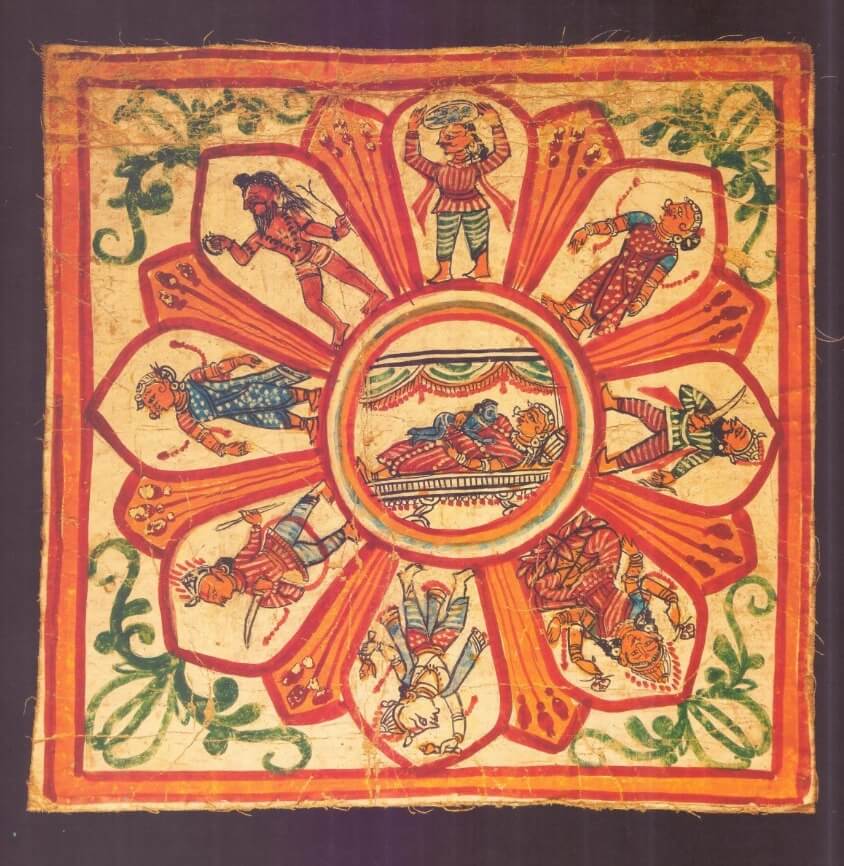
    Krishna Janma Pati of the Puri temple.

    The next night, Krishna is born; and now all of a sudden, the mother is the son. Jagannatha’s portable representative deity, Madanamohana is placed in the centre of the Krishna Janma Pati, a special Pattachitra painting in the shape of a lotus with eight characters in its eight petals. Soon after, he is ritually born. His umbilical cord is cut and countless rituals follow as they have for centuries. On the day after Janmastami, Madanamohana is placed on a swing with Rama and Krishna, two other metallic images. In the central position, now Madanamohana plays the mother’s role. In the next week, Jagannatha is dressed as Krishna for four consecutive days. I can hear you say; it is all very confusing! And so indeed, the people of Puri have a saying that goes “Mother today; son tomorrow; mother the next day. Who can decode the mystery of our dark lord?”

    These mystic rituals are interpreted in various ways. We can only try.

    First of all, Jagannatha defies gender logic during rituals such as these. How can a masculine god be in labour? Subtle traditions cleverly remind us that divinity is not restricted by gender notions and here we get a clear indication of how gender fluidity has been not just been accepted, but rejoiced in Odia thought since time immemorial. And that is also why he(or she?) proudly wears a saree and a nose-ring; like Krishna, unafraid of any possibility.

    Secondly, the Jeuda ritual resonates with the idea of god creating himself, the cyclical notion of infinity. Like it is said, infinity is born out of infinity and goes back into it; so does Jagannatha give birth to himself. She is the mother, he is the son and both are identical. It is obvious that each codified ritual also has a firm base in deep philosophy.

    And while ancient intricately weaved complexities baffle us, forcing us to ponder; Jagannatha smiles. Perhaps that is what they are meant to do; make us think, introspect and grow.