Category: Articles

  • Fine pigment of sacred depiction

    Published on 1 Jul 2018 in Swarajya Mag

    On the full moon day of the Indian month of Jyeshtha, something peculiar happens – a god falls ill. The great triad enshrined in the Jagannath Temple in Puri bathe too much and are afflicted with fever. In the 15 days of their ‘treatment’ they are hidden away from public view. In this period known as ‘anasara’, they are substituted by majestic paintings that represent them. This is the tale of the origin of the ancient Pattachitra art of Odisha.
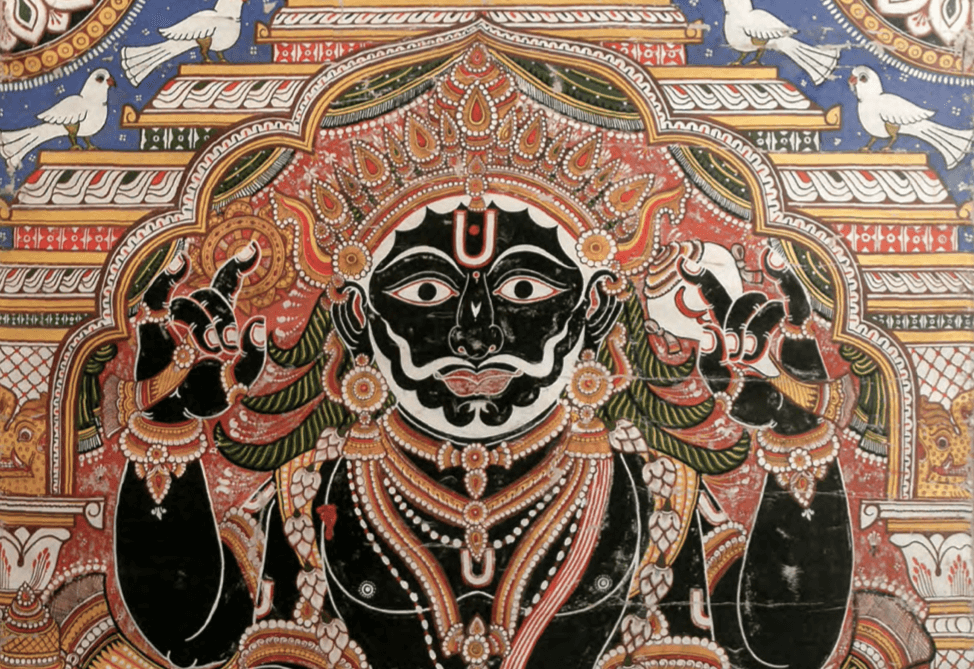
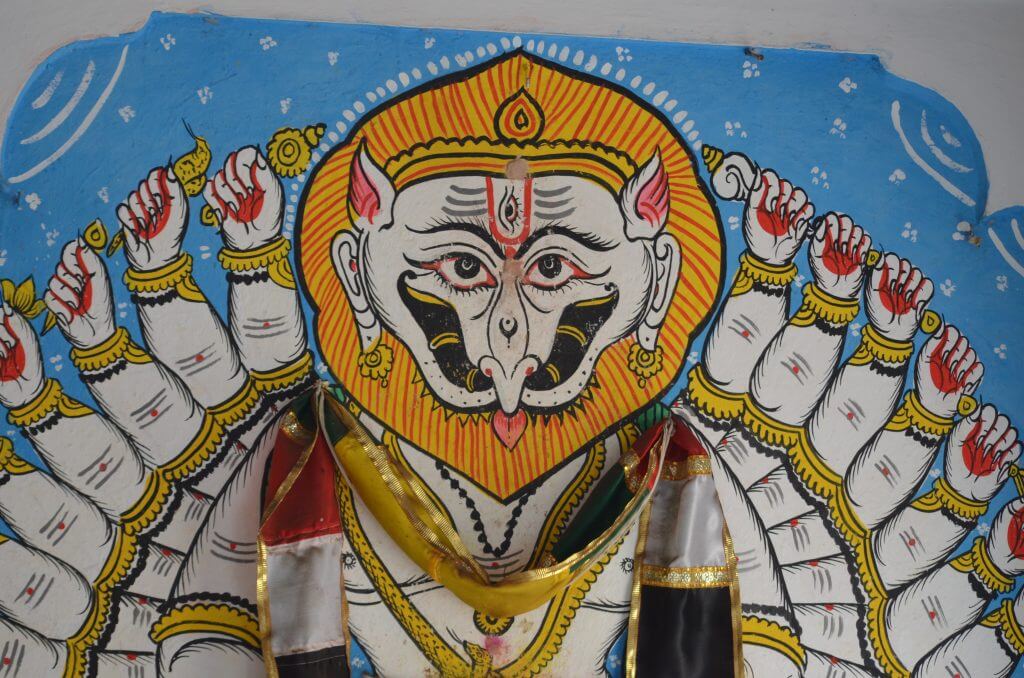
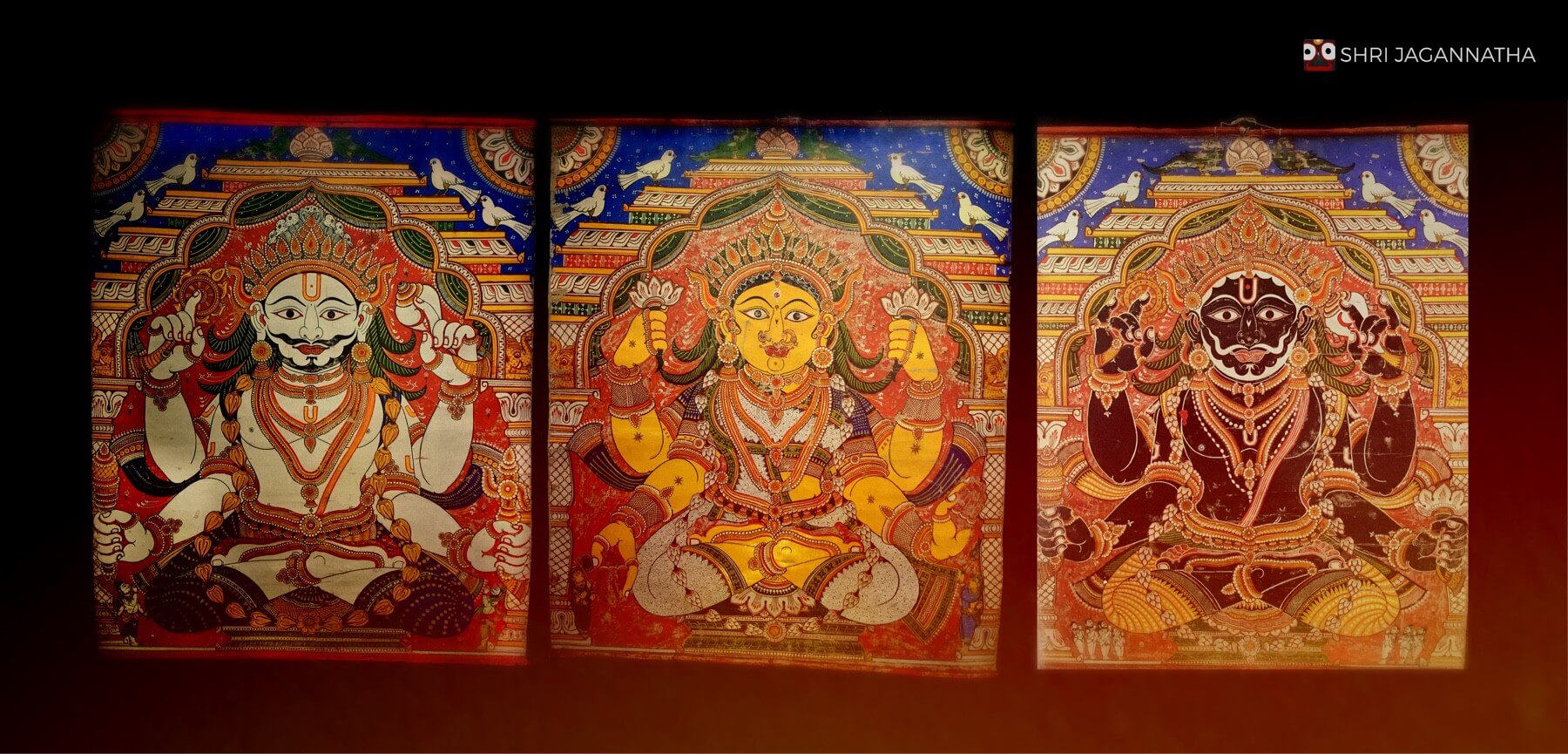
    Narayana
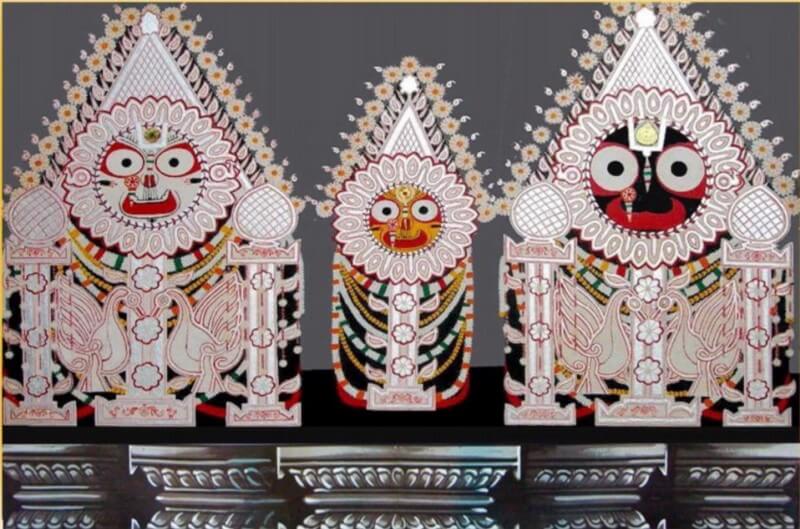
    Ananta Narayana, old Pati Dian set of the Puri Temple.

    A number of traditional painter families live in Puri and the surrounding villages. They are called chitrakaras in Odia, and in Puri, there is an entire street consisting of only chitrakara families. The nearby village of Raghurajpur has been declared a ‘heritage village’ because the entire settlement consists of only chitrakaras. At the helm of this ancient clan of painters are those who paint in the service of Jagannath, the beloved deity of Odias.

    To paint for Jagannath is no small task; it is a service assigned only to the senior-most craftsmen of the chitrakara lineage. The Gajapati Raja would select three families for the three deities – Balabhadra, Subhadra and Jagannath. The chitrakara masters would be initiated into the service of the temple in a formal ceremony called sadhi-bandha. The raja would tie their heads with the sacred fabric of Jagannath. It is after this that the painters would start their magnanimous task. Many researchers and chitrakaras trace the origin of Pattachitra back to the painting at the Puri temple. This forms an unbroken link with Jagannath, symbolic of their antiquity. This temple-service of painters, apart from being a very challenging task, is also an honorific one. They look up on the master, who has the experience and expertise to be engaged in the direct service of Jagannath himself. Due to the intrinsic socio-political importance of the temple, these masters enjoy high status within the community and respect in the town of Puri. As of now, only two families are in this service – one for Jagannath and one for both Balabhadra and Subhadra.

    A fortnight before the bathing festival of Jyeshtha, the painters receive a note requesting them to make the revered ‘anasara patis’. With the commencement of their services, utmost cleanliness has now to be observed. The family would now sleep on the bare ground, abstaining from sex, intoxicants, meat, garlic and onion. The next day as dawn breaks, the chitrakara cooks with his wife the tamarind gum and chalk mixture for priming the canvas. A huge cotton cloth is cut into dimensions, which can be as large as 1.2 metre long and a metre wide. While he cuts the canvas to the required size, she painstakingly grinds stones to produce pigments.

    Pigments play a major role in distinguishing the anasara patis. Only ‘traditional’ (which implies naturally obtained) pigments are used. Industrial oil-based paints are considered unclean. The master chitrakaras look down upon these ‘foreign’ paints. This is to be expected. The Puri temple, until this date, has not a single of its 56 dishes made using potato. Potato, like commercial paints, is ‘foreign’ and thus done away with in tasks related to the temple, a living institution of Odia tradition as it has been through the centuries. Moreover, the pigments are never mixed and are only used as they are, in their ‘pure’ forms.

    Once the priming is done, the master painter takes over. We take a peek into the first workshop in the artist’s street. With a thin brush dipped in red hingula, he deftly outlines the figure of Jagannath in all detail. This is the base sketch, or what is known as the tipana. Years of practice have made this process so natural that he needs no reference. A small blotch indicates that the master intends every second flower in the garland to be a full-bloomed pink lotus.

    His work done, the master now withdraws and lets his apprentices take over. This is the first big engagement in their internship and training, and the master keenly supervises each brushstroke. Nothing can be wrong; more importantly, how can he give a painting with the slightest fault to his beloved deity? The helpers begin their work of filling in the colours. First, they fill the red background, then the black body of Jagannath. Finally, the ornaments are painted in chrome yellow and other elements are completed. The master takes over again, this time for the fine black outlines throughout. Intricate parallel lines and foliate designs adorn the garments and jewellery. Two conch-shell like eyes, a nose and rather fleshy red lips emerge as the process progresses. A fashionable flame-like moustache rises from under his nose, and a trimmed beard frames the face. Since Jagannath is black, all detailing is done in white. The studio needs to hurry up, for there is only about a week left, and there is a lot more to do.

    Meanwhile, on the other end of the road, the other workshop has double the work to complete. This is the bada bada workshop, where the elder brother’s work is being done. The elder brother is also the one for whom more work has to be done in the pigments department, because filling the entire body in bright white requires grinding a lot of conch shells. White has been the most difficult colour to produce in Pattachitra workshops due to the exhausting task of turning shell into fine-grain pigment.

    Balabhadra wears a seven-hooded white snake. His figure resembles his brother’s. He holds a pestle and a plough in his hands, motifs of his association with agriculture. Typical of Puri is the respect mixed with a hint of fear towards Balabhadra, who has a reputation for getting angered easily. Nobody messes with him. People may pull off a joke on Jagannath, who is like an all-weather friend.

    The youthful sister is not to be forgotten. Subhadra is painted in dazzling yellow. She wears a sari. She wears traditional Odia-womenfolk ornaments – notha, tarata jhumpa, hansaguna, bajubandha and khadu. Like the rustic lady, her feet are lined with bright red alta. Her left eyeball is slightly smaller than the right one – in this part of the earth it is considered ‘auspicious’ to be so.   In a matter of another week, the paintings will be complete, except for a small white hole in the centre of their eyeballs. That part is reserved for the master chitrakara. He fills in the black when life is infused into the paintings before worship. The paintings are now complete.

    The next morning is special. The entire family wakes up early. They bid their goodbye to the lifelike painted deities born in their households while a delegation from the temple arrives to escort the gods to their palace. The ghantua beats the gong (ghanta) and the kahalia sounds his trumpet (kahali). After all, this is the deity to whom the Gajapati rulers of Odisha had willingly acceded subservience to. Under a silver-handled royal umbrella, the master chitrakara walks with the rolled-up painting cradled between his arms. The party moves through the lanes to the temple.

    Late that night, when the fever-sick gods return to the inner chamber for rest, a bamboo partition is strung in front, blocking them from public view. On this partition, the three painted deities are displayed in order – Ananta Basudeba (Balabhadra), Bhubaneswari (Subhadra) and Ananta Narayana (Jagannath). A fortnight hence, the high-ceiling chambers of the temple shall remain in the light of a flickering earthen lamp. It is in this yellow light of the flame that one sees how the lifelike Pati Dian (the depiction of the deities) appear to be gazing intensely far into the darkness of the silent chamber.

    When the deities recover from their fever, they will come out of their sanctum in the Ratha Jatra. The endless cycle shall recur as it has for centuries.
  • A God’s Mother : Karama

    It was when the King Nrupa Keshari ruled over ancient Odisha. Historians think that the years are 852–857. Karama, the old Marathi woman lived in one of Puri’s mutts. It had been a long time since she’d been there. She had come to Puri to search for her missing husband and look at Jagannatha, but hadn’t left. Here she had accepted the famed Indraswami as her guru.

    Every morning, Karama would wake up and offer something to Jagannatha at her home. One day, she decided to do something special. She would make Khichdi. And so she got a small earthen pot from the potter and the ingredients for the food. The next morning she woke up early and lit the fire. Khichdi would take time.

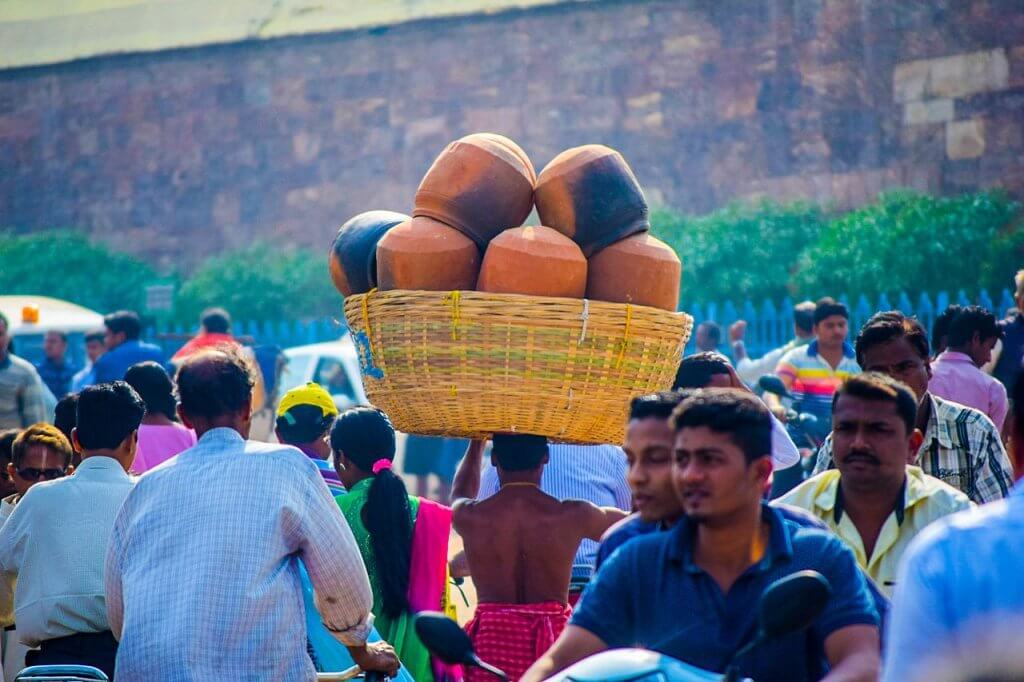
    Man carries earthen pots for the Puri temple.
    Picture : Prachites Subham Das

    When food is offered to Jagannatha in the sanctum sanctorum of the great temple of Puri, there are a number of rituals that have to be done. Hundreds of earthen pots filled with cooked prasada are stacked in front of the smiling deities. The chief priest then cups his palms together and looks into them. If he sees, for a split-second, the form of Jagannatha — then the food is saidd to be divinely approved. But this day he did not. Something was surely out of place. Perhaps a dog had entered the temple or someone had not been ritually ‘pure’ while cooking food for God.

    As always, Karama had gone for her daily visit to the temple. There she came to know about the situation and thinking that perhaps the deity wanted her Khichdi, asked the temple officials if she could offer it in the temple. The priests refused. One of them had seen Karama cook the food that morning. He had seen how she used the same twig to stir the mixture with which she brushed her teeth. Meanwhile, how can food from a whore’s hands be offered to God?

    That night the King received a dream to bring Karama and apologise to her for what had happened. All she said was that Jagannatha was beyond notions of pure and impure. She was told to cook again. When she did she could see two young boys gazing at her from the corner of the street. She gave them some of it out of motherly love when they asked for the prasada.

    When the food was taken to the temple, someone noticed a grain of rice stuck to Jagannatha’s lips. The offering was made. Now the priest saw him in his palm. The God was satisfied.


    Some others Karma think was born in the Nagaur district of Rajasthan, sometime in the 1600s. This is clearly another lady, but the story is somewhat similar. The earlier Karama’s is the better-known story, since the 16th-century poetess Madhabi Dasa mentions her name in one of her jananas to Jagannatha.

    ମୀରା କରମାଙ୍କ ଭାବେ ହୋଇ ରଙ୍କ ସ୍ଥାନ ଦେଲ ବ୍ରଜପୁରୀ

    ଚକାନୟନ ହେ ଜଗୁଜୀବନ ଶ୍ରୀହରି, ମାଧବୀ ଦାସୀ

    Of course she wouldn’t have written about somebody living in her times. Anyways, here goes.

    Hers was a Jat family. Once, her father instructed her to offer food to Krishna since he was too busy. The young Karama took the statement literally. She woke up early the next morning and making some khichdi, offered it to Krishna. When she saw that Krishna was not eating anything, she felt bad — she herself did not eat until he would. It is said that Krishna then appeared and ate the khichdi. Her father was shocked at the incident, and Krishna appeared again to prove her true. Karama took a living samadhi at the end.

    थाळी भरके ल्याई रे खीचड़ो ऊपर घी की बाटकी

    जीमो म्हारा श्याम धणी जीमावै बेटी जाट की ।


    Bai Handi

    The offering of Karama’s Khichdi was a great thing back then, and is even now, for food prepared outside the temple had never been offered before. Her recipe was introduced into the Temple Kitchen nonetheless. The earthen pot in which Karama Bai cooked became known as the Bai Handi. The new prasada came to be called Karama Khechudi or Mahadei Paka. The practice continues till today.


  • A Pangram in Odia

    Well, I’m not exactly the first one to come up with this. This is, as far as my knowledge extends, the third experiment of its kind in Odia. (after Subhashish Panigrahi and Nasim Ali)

    pangram is a sentence containing all the letters of the language it is written in. Here’s an elegant pangram in English which you’ve probably seen somewhere.

    The quick brown fox jumps over the lazy dog.

    But with Odia, it’s not that easy. Firstly, it has 44 letters instead of 26. The increased number obviously affects the length of the pangram itself. To add to that, we have some letters that are very rarely used- ଊ, ଐ or ଔ, as an example.

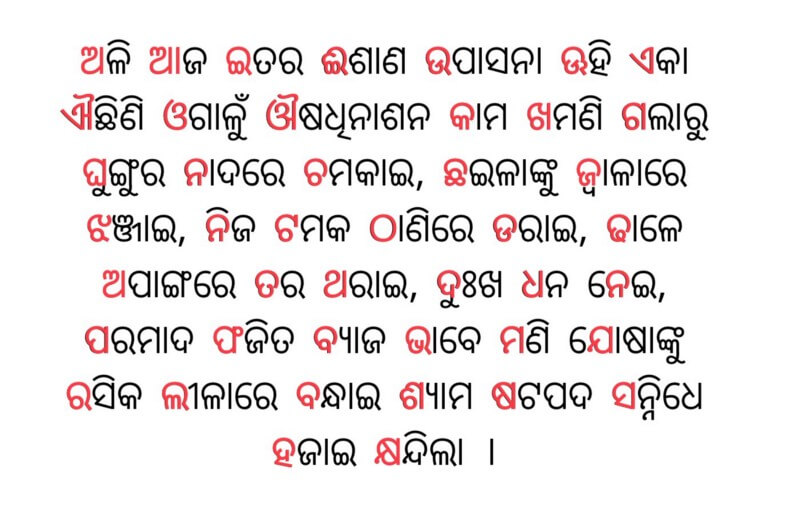
    Here’s the pangram I made. It has another nice feature though- there are exactly 10+34 words, with their first letters being in the order of the alphabet. That means that you can read out the entire alphabet from the first letters. This is wordplay typical of Odia literature, existing since almost a 1000 years. Also, in keeping with traditional literature, I’ve used ନ for ଙ, ଞ and ଅ for ଣ. Those letters are indeed present in other words though, to make this a pangram.

    Another ‘feature’ that unconsciously crept in is that most of the words in that sentence are simple colloquial desaja words. That is a good thing to have because it makes the sentence much more readable and if I may add some praise, it has a distinctly nice ring. (Well, at least to my ears.)

    What does it mean though? A lot. The meaning itself is reminiscent of heavy medieval Radha-Krishna literature and some familiar metaphors. Having said that, it also makes it quite poetic. No wonder it doesn’t lend itself particularly well to translation due to the cultural context being lost. It can be very difficult to not look weird in such a situation. I’ll try, anyway.


    O Cuckoo! Today, in this place, when I thought of worshipping Shiva¹ and invoking him as I sat alone, that destroyer-of-all-remedies, Cupid came. As the sun went away (that is, night descended) Cupid devised various ways [to torture] poor ladies. [He] surprises them with the jingle of his anklets, burns them in the fire [of passion] and frightens them with the beat of his drum. [Again, he] makes them shiver with his sidelong glance. [He] takes their sadness² as debt, and to return more grief as a despised form of interest, he entangles them in the tricks of the playful bee-like Krishna by leaving them at his feet.

    (1) Worshipping Shiva is believed to help one get his/her beloved.
    (2) Due to the absence of their beloved ones.

    Whew! Tell me when you’re out of the trauma.


    Update : This pangram can now be found on the Omniglot page for Odia all thanks to Subhashish Panigrahi. You can also find the other two pangrams on the page.


  • Missionaries and Jagannatha

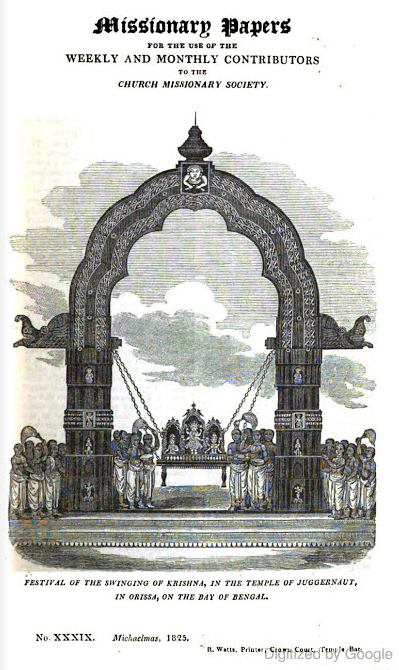
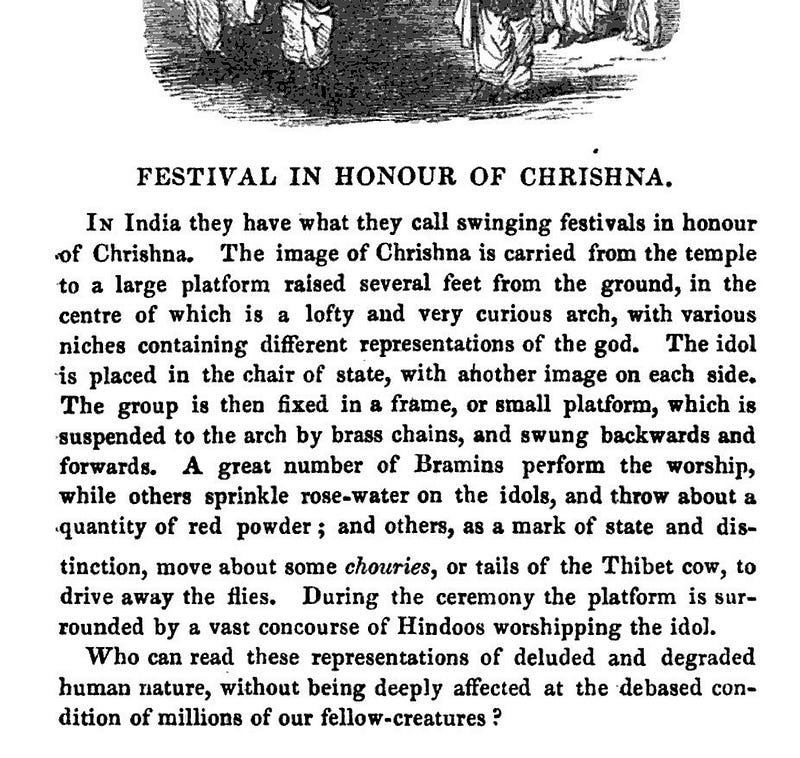
    I recently came across a book called ‘The Wesleyan Juvenile Offering’. Multiple editions of this book are on Google Books, in case you would like to have a look. Curiously, there’s a bit about Jagannatha and the Dola Jatra of Puri.

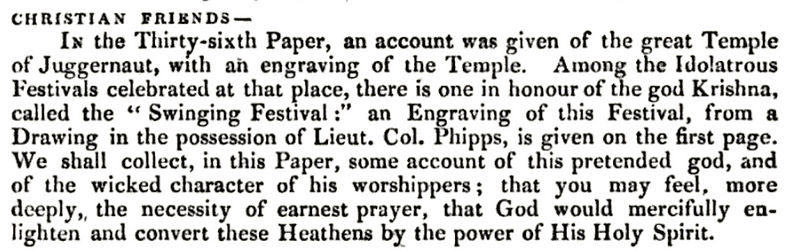
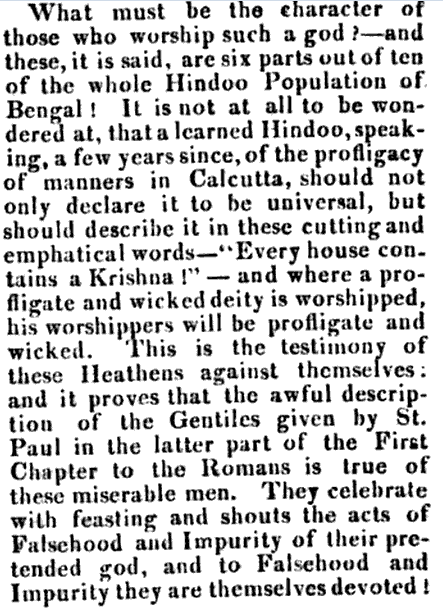
    Without further ado, here’s what he says. Note that the author hasn’t actually said anything about Odisha till now- this could well be anoher place. But the lithograph beside has typical Odia architectural features, as you can probably notice. Since that set of pages was deleted from the free preview in Google Books, here’s the same content from another book. This one explicitly states that it is from the Jagannatha Temple. But intentionally spelling it as ‘Juggernaut.’

    And here’s the next page.

    “Pretended god”, “wicked character of his worshippers”, “heathens.” Let’s continue reading.

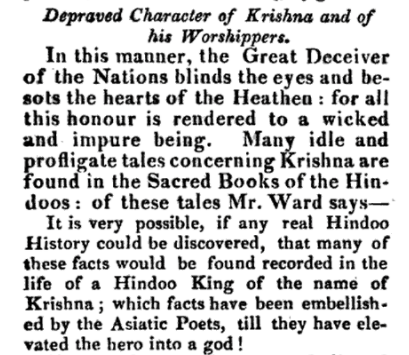
    “Depraved character”, “Great Deceiver of the Nations.”

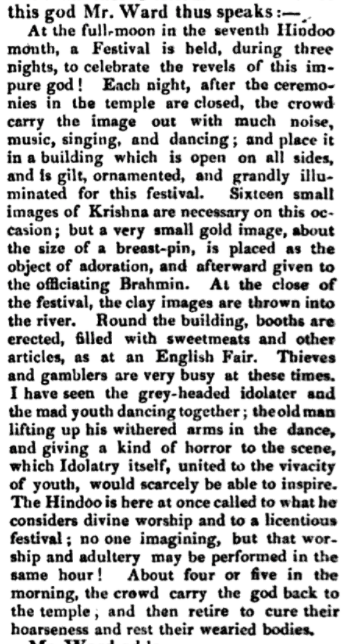
    Then he describes the Dola Jatra of Puri.

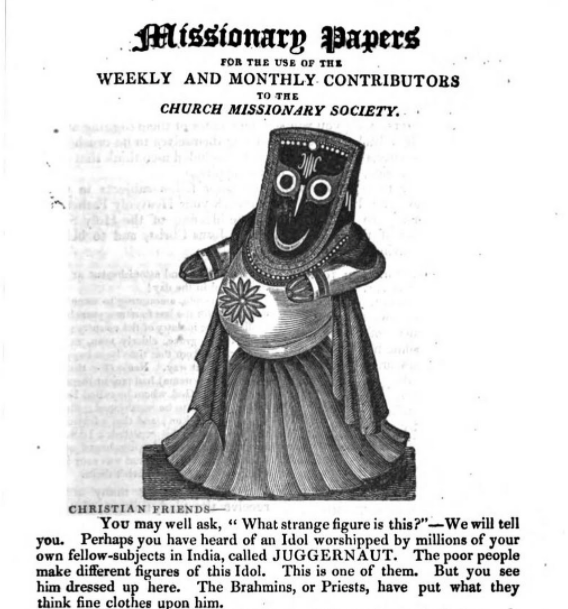
    And later in the book, he presents an image of Jagannatha, which confirm my hypothesis.

    His conclusion remains baseless though. Next, he switches to ranting.

    People are happy- they dance and sing for their deity- what’s wrong with that? And this much when he has not introduced the deity at all!


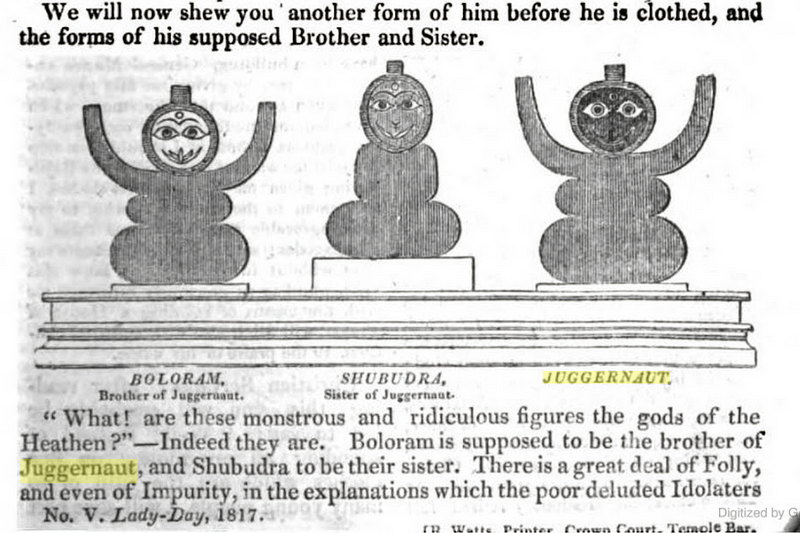
    For the grand finale, he comes up with an intentionally twisted image.

    And doesn’t stop there.

    This person has such an established imaginary world it’s difficult to explain.


    The book reveals a clear hatred for the colourful rituals and festivals of Puri. All of this so that they can call an entire nation ‘wrong’ and ‘satanic’, whom they must bring on to the ‘correct’ path. Read it on your own if you want more. There’s hundreds of pages full of this rubbish.

    Update : Those sets of pages have been hidden away from preview now. There remain other copies though. Like Missionary Papers.

  • Raghunatha Besa

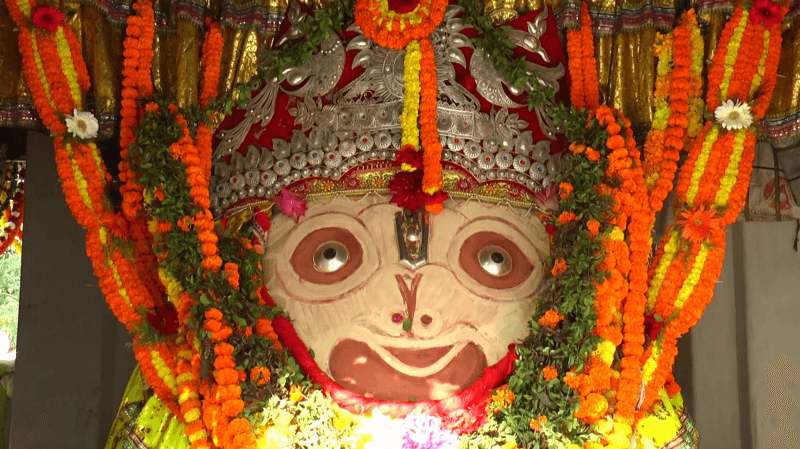
    Jagannatha has many Besas (special attires), somewhere around thirty. Some of them are done on a daily basis. Others are done on a special day each year. Yet others are done based on specific astronomical conjunctions- in which case the Besa may be done every five years or every ten years. By this point, we have only three or four of these, each one of these being very rare. Going further, the rarest of all of them is the fabulously luxurious Raghunatha Besa, in which Jagannatha is dressed as Rama. In this grand ‘Besa’ or costume, Jagannatha is dressed as Rama and Balabhadra as Lakshmana. Subhadra is Rama’s elder sister, Shanta. In a very graceful pose, Jagannatha wields the bow and the arrow in his hands. Hanuman sits by his feet and Sita on his lap.

    And why is it rare? Because of the gold. The sheer amount of gold used in this one attire far surpasses those used in any other ceremony or festival- even the Suna Besa, the ‘Golden attire’ which gets its name from the quantity of the gold. In 1577, Gajapati Ramachandra Deba made hundreds of pieces of jewellery to adorn the triad. Back then he issued coins with Rama’s sign. This is the very same jewellery. So much is the gold that this costume has not been done for the last century out of security concerns. The last time was in 1905. And in the last 600 years, this costume has only been done 9 times. Only nine.


    The Utkal Dipika

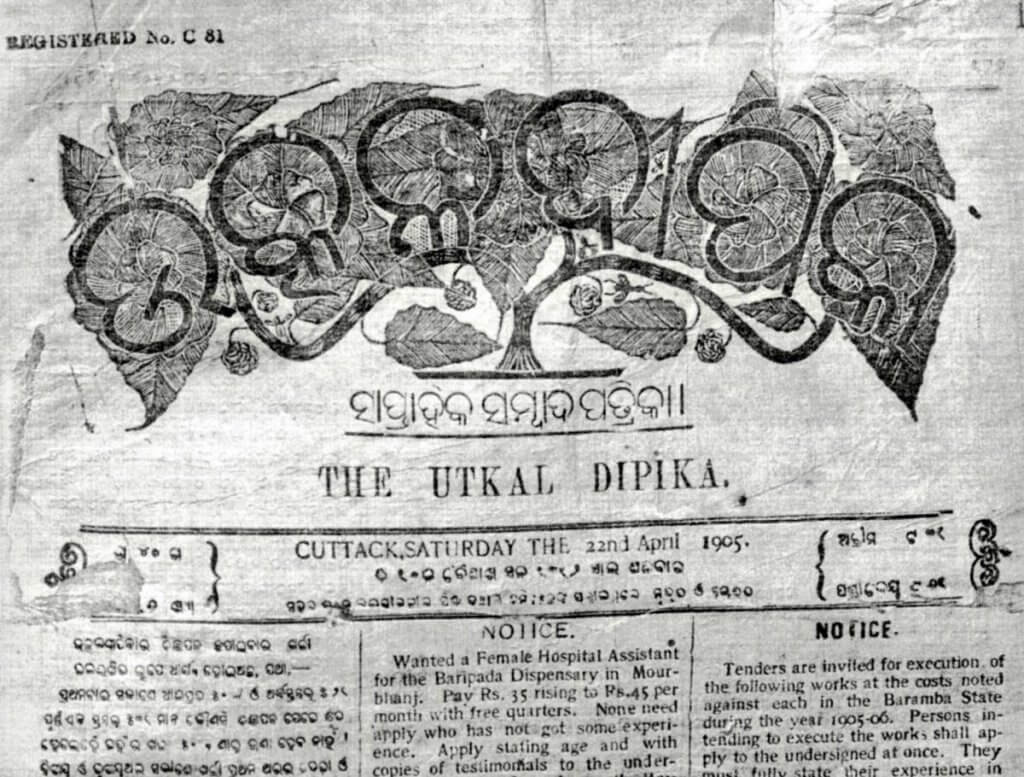
    Most sources today agree that the last time Raghunatha Besa was done was in 1905. So I checked the first Odia newspaper. This is ‘The Utkal Dipika’, the first ever Odia newspaper. Fortunately it has been scanned and the pages have been preserved.

    On 15th April 1905, Saturday : There’s a full one-page report that Raghunatha Besa will be done on 27th April 1905 and a public invitation.

    Nothing in the 29th April 1905 issue. Perhaps the page did not survive or the Besa was not over yet. Quite unexpected.

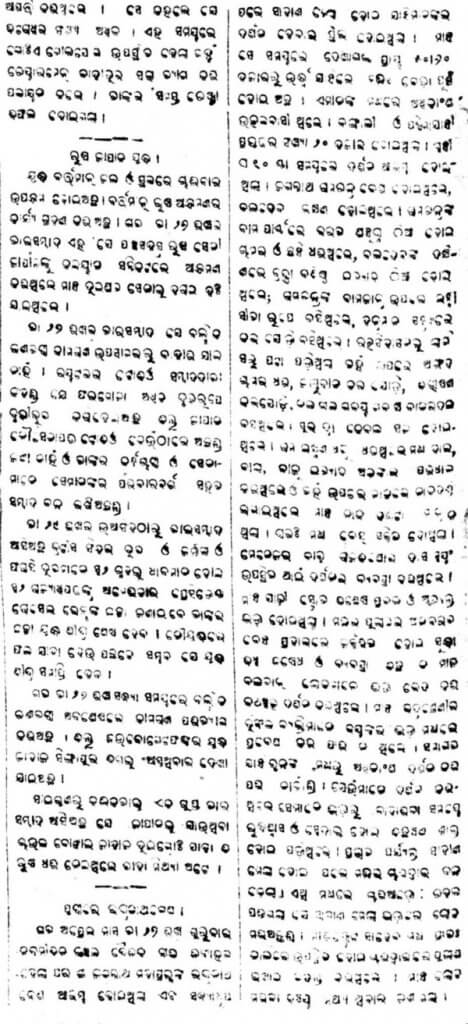
    On 6th May 1905, Saturday : Raghunatha Besa has been organized. 50–60,000 inside temple. Overcrowding, many unable to see deities.

    “Balabhadra, as Lakshmana held an umbrella. Jagannatha was dressed as Rama with Sita on his lap. Angada, Jambaba stood beside him. Powerful men from various places misused their power to break the system & go to the sanctum while many others couldn’t. Jagannatha was wearing a golden nose-ring, bracelets, rings and other ornaments. I (editor) felt the nose-ring looked a bit odd. Those who saw the deities were completely suffocated and sat down for a while to take a deep breath.”

    Utkal Dipika, 06.05.1905

    On 6th May 1905, Saturday : Since the people of Puri couldn’t see anything, the Besa was held again on 3/5/1905. “Everything went well.”

    That’s it. I wonder whether this Besa will ever be done again, for that’s all we can do for now. Let’s see.

  • Witness Krishna

    At half an hour’s distance from Puri is the town of Satyabadi, dense with Bakula trees. Almost a decade ago, Shilpa Shetty had landed in trouble here. A century ago, a school established in these forests revolutionised Odisha’s education scenario. A few millenia ago, a temple built here gave the place its identity.

    The quite town of Satyabadi turns active every year on the occassion of Amla Navami in the Hindu month of Kartika. It is on this day that the lively golden image of Radha housed in the grand Sakhigopal Temple is dressed in the typical Odia-woman attire instead of the usual ghaghra-choli. As a consequence, the feet of Radha are visible, and Hindus consider it to be an auspicious sign- and thus the need to celebrate it.

    What’s amusing is that the town of Satyabadi is in Odisha, and so everything in this temple is built in the Kalingan style- from the lions at the main gate of the temple to the ‘temple’ itself. Everything, apart from one of the deities enshrined in it, whose features reflect the art of North India.

    Krishna’s image enshrined in this temple, carved out of excellent dark stone, is called Gopinatha. This is a deity who has travelled a lot- from Vrindavan to Satyabadi, his present home — via Vidyanagar, Cuttack and Puri. Vajranabha, Krishna’s great-grandson once wished to carve out an idol of his great-grandfather so that he could make up for his longing to gaze upon his form. Uttara, Abhimanyu’s wife was the only one living of all those who had seen Krishna. From Uttara’s descriptions of Krishna, Vajranabha carved out eight idols of Krishna from an imperishable stone called ‘Vajra’- each one of them had one feature exactly as Uttara had seen it. Vajranabha kept all of them in different temples spread across all of North India, and Gopala’s temple was in Vrindavan.


    Vrindavan had always been famous for its Holi- a Holi far more spectacular than anywhere else. It saw pilgrims from everywhere, even from far southward regions- like the small town of Vidyanagari by the Godavari. Among countless pilgrims were two whose story would be remembered forever- an old man and a young lad from that small town of Vidyanagari. The duo had finally reached the final destination after six years of pilgrimage- Vrindavan. The younger, named ‘Satyavadi’ humbly served his elderly companion who suffered from a colic disease for the entire period. At the end, when both of them reached Vrindavan on Dola Purnima, a joyful marriage procession passed in front of them. It turned out that amidst splashes of colour, a newly wed couple were going to the temple of Gopinatha. The scene was so dramatic that it struck to the old Brahmin that his younger daughter Sumati, was still unmarried. Oh, what a fine girl she was! Six long years had gone by, and not for once had he been reminded of his family. His little girl would be sixteen now, and who would find a match for her? What if he died today? Who would then marry his child? As he rose up, his eyes fell on the well-built man in front of him- why, he’d known this lad all this time! This good-mannered lad was the one who would marry his child. What if he belonged to a lower caste or had no money?

    And so, keeping Gopinatha as witness, the elderly Brahmin offered his daughter’s hand to Satyavadi, who hesitantly accepted the offer to please the old man. As the sun set, the old man’s life fled, after the pilgrimage. Satyavadi performed the funeral rites of the Brahmin and walked back to Vidyanagari. When he approached the Brahmin’s family to tell them of the man’s death and his promise, the wise man’s wife and daughter believed him, but not Sumant, his son. He was thrown out and threatened with a stick- unafraid, he approached the village chief.

    And so, when the village folk assembled for the judgement, poor Satyavadi was accused of the Brahmin’s murder. When asked for testimony of the veracity of his words, Satyavadi pleaded for a week’s time to go bring his witness, Krishna. The village folk called him mad, but they allowed him anyway. “Idols don’t walk and talk”, they said, but it was all very exciting, and what fun they’d have when this Satyavadi returned empty-handed! And so he set out for Vrindavan once again.

    Falling down at Gopinatha’s feet, Satyavadi innocently asked him to come with him to tell them all the truth. Not a bit was he surprised when Krishna spoke, “I will come, but I don’t know the way. Keep walking and I shall follow you. Don’t look back, my child, for no one has seen me walking and I’ll be shy if you catch a glance.” And so they started, Satyavadi in front and Krishna behind him. Satyavadi sang songs to Krishna, and Krishna tapped his feet to match the rhythm. From the ringing of his anklets, he knew that Krishna was following him. So they went till they reached the Godavari. As both of them crossed the mighty river and reached the other bank, the tinkling sound stopped. “Oh, has Krishna deserted me before the destination?” Anxious, he looked back. And that was it.

    Frozen stood Gopinatha- he would walk no more. Sand from the banks of the river had clogged his anklets, and that had subdued. the sound. How foolish of him to have doubted Krishna, God himself! And so it dawned upon him, that God was never lifeless- it was human doubt that had turned speaking gods into mute idols & walking deities to still images. Alas, nothing could move Gopinatha now. Sad, Satyavadi called the villagers to the spot. Amazed, they bent before him and the marriage was a sight worth seeing. Krishna came to be known as ‘SatyaGopinatha’, Krishna who saved truth and ‘SakhiGopala’, Krishna, the witness. But it doesn’t end here.

    Years later, the princess of Kanchi, Padmavati fell in love with Purushottama Deva, the Gajapati King of Odisha. The king’s request was rejected by her father who abused him, calling him a chandala, for the Gajapatis had to customarily sweep the chariot of Jagannatha with a broom. It was then that Padmavati touched the feet of Gopinatha and asked him to unite her with his servitor at Puri. Gopinatha heard, and the frozen idol came to life and spoke again- “I will.” After a legendary conquest of Kanchi by Purushottama, the lovers were united. Gopinatha now came to be known as ‘PritiGopinatha’, Krishna who saved love.

    Krishna who saves truth and love. Satya-Gopinatha and Priti-Gopinatha.


    On his victorious return the king took with him three Krishna idols from Kanchi, all of which he first installed in Cuttack and then brought inside the Jagannatha Temple of Puri. Lord Jagannatha was not too happy- Bala-Gopala from Kanchi would eat up all his butter and Gopinatha would dance away with the Gopis. Poor Jagannatha! That night the King was told in a dream to take the new deities into separate temples across Odisha.

    Later, Gopinatha was shifted to Satyabadi, which then came to be known after the young man. There, he fell in love with a girl called Lakshmi. Lakshmi considered him her husband and would dance with him. When she grew up and her marital palanquin was raised, sounds of “Lakshmi”, were heard from the sanctum. The king decided that a golden image of Radha would be crafted, and it would resemble the girl, Lakshmi. As the image reached completion, the girl waned and grew weak- the day the image was put beside Gopinatha, Lakshmi died.

    ମଞ୍ଜୁ ଛୁରିଅନା କୁଞ୍ଜ ବିହାରିଣୀ
    ସାକ୍ଷୀ ଗୋପୀନାଥ ହୃଦୟ ହାରିଣୀ ।
    ଦ୍ୱିଜ କନ୍ୟା ଲକ୍ଷ୍ମୀ ସ୍ନାନେ ପୁଣ୍ୟନୀରା
    ସୌଗନ୍ଧିକ ଗନ୍ଧେ ଚାରୁ ରତ୍ନଚିରା ।

    “Satyabadi, where Gopinatha’s heart was taken by the girl Lakshmi”
    From Sakhigopala, Radhanath Ray (1848-1908)

    Years have passed since then but the legends still survive. There are still numerous sightings of mysterious divine dances in the Bakula forest. And when devotees go to visit Lord Jagannatha at Puri, they still come here to have a taste of the wheat delicacies here (not like typical rice offerings in Vishnu temples) and to tell Gopinatha of their visit to Jagannatha- Gopinatha, who upheld truth and would always remember their visit to Puri. My great-grandma never forgot this ancient ritual- not once in her life had she gone to Jagannatha Puri and not to Gopinatha. If at anytime Jagannatha forgot any devotee visiting him, Gopinatha would still act as the truthful witness to remind him.

    Of course, the local priests had to have a say in all of this.

    Belive him and he will protect. Doubt him and he will freeze again.

    As dramatic as it sounds, it is indeed something to ponder over- that belief is the foundation of all cultures.

  • Bira Singha and Odia mysticism

    Bira Singha was a fifteenth-century seer who possessed occult powers. This is his only discovered literary creation, pondering over the nature of knowledge and metaphysical ideas.

    An ardent follower of Narasingha, Binoda Mishra turned into the mystic Bira Singha when he converted to Buddhism. He used to live in a cave atop a mountain. The legendary Upendra Bhanja used to respect this ancient mystic. He could fly through space and time at his own will, for he had mastered the occult-psychic arts, the ‘Naganta.’ He could control the flow of air within his body. His pupils once used their occult powers to torment people- they would write a mantra in the figure of a person and then hold the sheet over fire — as the sheet lit to fire, the person would burn to death. Not very different from the idea of voodoo dolls, except that this was in 5 or 600-year old Odisha.

    When he took mercy on the queen for her miseries, the queen served him humbly. The Brahmins were hit by the ascendancy of a Buddhist mystic they loathed, and thus asked the king to test Bira Singha. In the trial of the snake-within-the-jar, Bira Singha escaped with the skin of his teeth from being clubbed to death.

    This is such a rare song that people do not even hear a single mention of anything related to it in their entire lives. In short, 400-year old mystic mumbo-jumbo for your ears.

  • Teaching a God

    In the north-eastern corner of the Jagannatha temple is a humble shrine. A temple of Shiva, it is not a magnificent structure. However, the inner chamber of this small shrine, where the shiva-linga is enshrined, is buried deep under the plinth- about 25 feet below the temple floor.

    Ishana, digapala of the aishanya
    (north-eastern) direction
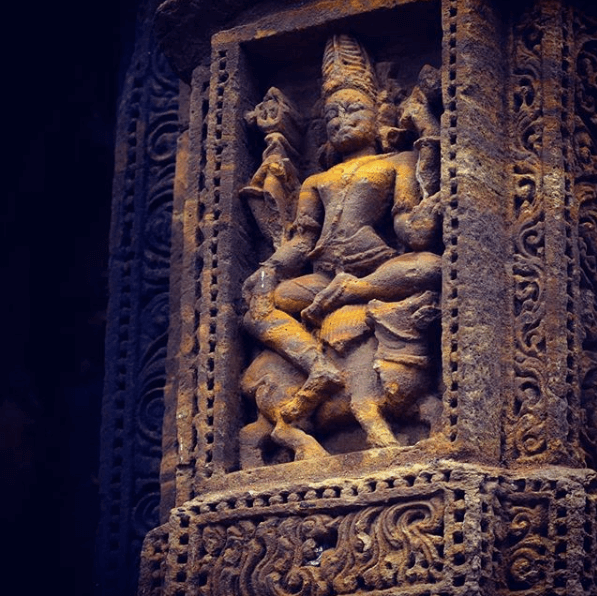
    Gopinatha Temple, Kakudia

    This temple only has a single door facing towards the north, which is rather strange for a Hindu Temple. Nonetheless, when one enters the temple, the inner door faces the east. Since the temple is located in the north-eastern corner of the entire temple complex, the deity is called Aishaneshwara or IshaneshwaraAishanya being the Sanskrit word for the north-east direction.

    The medieval Odia poet, Kabisurjya Baladeba Ratha mentions Ishaneshwara in the first song of his incomplete imaginary epic-poem, Chandrakala. That he chooses to talk about this deity while describing the temple complex indicates the god’s fame.

    ଈଶାନ ପ୍ରଭାବ ପ୍ରଭୁ ଈଶାନନାଥର

    ସମଗ୍ରତା ସେ କରିବେ ମୋ ମନୋରଥର ଯେ |

    Ishaneshwara, as brilliant as the sun- surely (he) will fulfill my wishes.

    According to historians, this temple is older than the present temple of Jagannatha himself. Interestingly, the word ‘Ishana’ can also mean preceptor- and hence, folk traditions speak of this form of Shiva being the teacher of Lord Jagannatha. Shiva is often portrayed as a teacher, as in the famous Dakshinamurti form- however, what makes this example unique is the idea of a God teaching another. Jagannatha has an uncle, an aunt, a brother, a sister; and a teacher too.

    The entire idea surely conveys one message, and does that effectively- that even God needs a teacher.

  • Where the garland fell

    Nemala, Kendrapada

    Achyutananda, one of the Pancha-Sakha (the five great saints in 15th century Odisha) wanted to establish an ashrama. Hence, it was decided that Achyuta would be given an agyāñmāla of Jagannath as per the ancient tradition. Where the garland fell would be the chosen spot.

    And so, Achyuta was given a lotus garland of Jagannatha. He took the garland and walked & walked until the garland fell at a place. Here he established his ashrama. The place came to be known by multiple names due to this incident.

    • Nemāla, from ‘Ne-Mala’, meaning ‘take-garland’
    • Padmabana, because it was a lotus garland that fell here
    • Gupta Brundābana, because people took the garland falling to be a divine indication that god himself wanted to stay here

    (Collected from folklore)

  • Tale of a Tantric

    What happens when a seer uses his occult powers to violate the rules of the Jagannatha temple?

    When Lord Jagannatha is bathed with a hundred and eight pots of sacred water on the occasion of the Snana Jatra, he falls ill with a fever. And so he is unable to grant his sight, darshan to his devotees. This period is called the Anasara in Odia, corrupted form of Sanskrit Anavasara. It is during this period that devotees throng to the famed Alarnath Temple at Brahmagiri. Meanwhile, they can see Pattachitra Paintings of the Triad in the temple sanctum. After treatment from the traditional Ayurvedic Vaidyas, the Gods recover after a fortnight.

    This story precisely touches on the topic of Anasara. With an magical angry tantric, this is one of those mystical legends that still amaze people.

    Anasara Patis of Puri, edited image.

    The Story

    Part 1

    “How can the supreme have a fever? What is this rubbish? People believing in this can not be true followers of Jagannatha. By doing this, not only are you sinning by disbelieving him, but also by denying his sight to millions of anxious devotees. Open the door.”

    The angry Tantric was fuming with anger. His name was Karnama Giri. A muscular man, he wore a humble cloth and held a cloth bag with his ritual paraphernalia- his piercing eyes refused to take a ‘no’ for an answer. Vermillion smeared all over his face and ashy matted hair- he looked like a masculine manifestation of Shakti herself.

    One man from the crowd that had flocked there, amused by his frightening appearance asked-”It hasn’t even been a day since you arrived here, and you dare to question the rituals of this centuries old temple? Who are you to challenge the way of the Gods?”

    Another of the crowd said, “It has been said- the deities are sick with fever. Let them rest. Why do you try to interrupt their sleep?

    But the sadhu was stubborn. In his years of rigorous learning, he had come to realise that the Brahma is supreme. And when he comes to gaze at the formless being’s form, here are a bunch of stupid people who believe that the Brahma can catch a fever. What fools! How arrogant!

    While the ascetic was lost in his thoughts, a man from the crowd sarcastically said, “If you are so confident that what you hold is the truth, then why don’t you go to our King, the Gajapati, and convince him to change the system? Only he has the power to alter what has been for centuries. And with strong evidence.”

    However, Karnama didn’t see the humour in it. He asked for the Gajapati King’s address and set out. Not for a moment did he stop for fifty miles. Such was his mastery over Tantra that he could replenish his lost energy in a snap.

    This is an incident of the 12th century, when Odisha was ruled by the Gangadynasty. The King was then in Sarangagada, and it took no time for the ghastly, emaciated sadhu to reach the fort’s entrance.

    The King was amused at the sight- and even more at his demand. He patiently explained the sadhu that it was not possible for him to change what has been for years. Moreover, the Anasara Puja is the most secret ritual- no one knows what happens inside those closed doors. Not even the King. Only the Daitapatis, said to be blood-descendants of the Tribal King Bishwabasu who originally worshipped Jagannatha, do. And the secret was not to be revealed, for what is hidden must remain hidden. When the guest argued that this was a great hoax, the Maharaja was forced to concede to his demands, though partially. First the sanyasi had to prove what he claimed, and then the Maharaja would do his bit.

    The invigorated sadhu said, “Let us depart for P uri. There I shall reveal to you the secret behind the Anasara Room.”The King gave him a few chickpeas. He watched the sadhu proceed towards a banyan tree and climb atop it like a madman. The ancient sadhu shut his eyes and remembered his revered deity, Karnameshwara, a form of Shiva. He ordered the Banyan tree to take him to Puri. The tree uprooted itself and flew like an aircraft. The Raja stood there, speechless with wonder. This was no ordinary mortal. He was an elevated being.

    (I know I know, hard to believe because we know science. But stories are not science. You listen to it or you don’t.)


    Part 2

    Karnama popped them into his mouth, one by one. By the time he flung the last bit towards his mouth, the tree landed in Puri.

    He went to the temple. All he had to do was get behind those closed doors. Nothing difficult for him. He gathered his yogic powers and tried to walk past those huge doors. When he shut his eyes and peeked inside in his mind, Karnama saw thousands of roads. Which was the right path that would lead him to the Anasara Chamber? Confused, he withdrew. He had to think of some other method.

    This time he used Tantra. He turned himself to a bee, and flew through the narrow slit in the darkness. Immediately behind, he saw a huge lotus flower. It had eight petals. Eight enchanting maidens sat around it, each with a petal. Now, Karnama, having taken the form of a bee, was drawn towards the lotus. As much as he tried to resist his temptation, he could not. As an accomplished tantric he could withdraw effortlessly from carnal desires, but as a bee, he could not control himself. The heavy scent of the flower pulled him towards it. He flew towards the flower and fell inside. The tiny bee got drenched in the lotus’ irresistible scent.

    Panicking, the sadhu remembered his adored BhairavaKarnameshwara was the only one who could save him. Oh, how many years of practice had made him perfect in the Tantras. Countless hours in terrible graveyards, heart-chilling Tantric rituals, beasts and ghouls and ghosts- all of these tests he had passed unscathed. Not once had he quivered- by the grace of Karnameshwara. And now, when he puts his art into use, it fails him! The deity at whose feet he has spent his life- that very deity is now unable to protect him! Here he is, as a bee, helplessly flapping his wings to escape the cursed flower.

    Why, Jagannatha was none other than that being whom the Tantras worship.” Oh Jagannatha, won’t you pull me out of this cavernous flower?” prayed Karnama. Gathering all the life left in him, he tried as hard as he could to escape. Escape, and never return. Go away from this wretched fate. Somehow, he went through a hole in the door. Ah, how he had escaped alive! Who wanted to know what is inside that room? Life was more precious.

    Now safe, Karnama wondered to himself, “How strange is the aura of this place that all my accomplishments fail me! How great is the deity that presides over this land that my god fails me! What would I not achieve by his sight!”

    The thought energised Karnama. He wanted to try again. Who knows if what he would see could change his life! How many people would bless him, how the King would thank him for uncovering the fact.

    They said that only the descendants of the Tribal King Bishwabasu had access to the Lord. Why, was that man more knowledgeable! He himself was inferior to none. Excited, he used his prowess, this time to make himself invisible. He waited for the Daitapatis to enter the room. He would enter it behind them, and no one could harm him this way. Soon, the said servitors arrived. They entered the secret chamber, and Karnama went behind. He became blind for a moment before his eyes could adapt to the darkness. As the darkness faded away to the dim light of a flickering lamp, he saw something very strange.

    What he saw was an empty throne. The temple’s Ratnasinghasana was empty. No one sat on it. No Godly image was present. Suddenly, he noticed eight maidens at the four corners of the temple. What heavenly beauties! They sat surrounding the temple in an octahedral shape. A bit later, he realised that he was swaying away from his goal. He ran his eyes across the room again, but could find no God. Where was that great deity?

    The eight ladies turned. They looked at him and at each other, and chuckled. Karnama felt he was being mocked. He could never find what he had ventured out to.

    The defeated ascetic left. He returned to that Banyan tree. When the King arrived, he would make it clear- no one could tell what lay behind those doors. While leaving through the gates of the temple, he bowed down his head in obeisance to the Lord of this Land, Jagannatha- the great Lord of the Tantras before whom his life’s accomplishments had failed.

  • The Elephant Attire

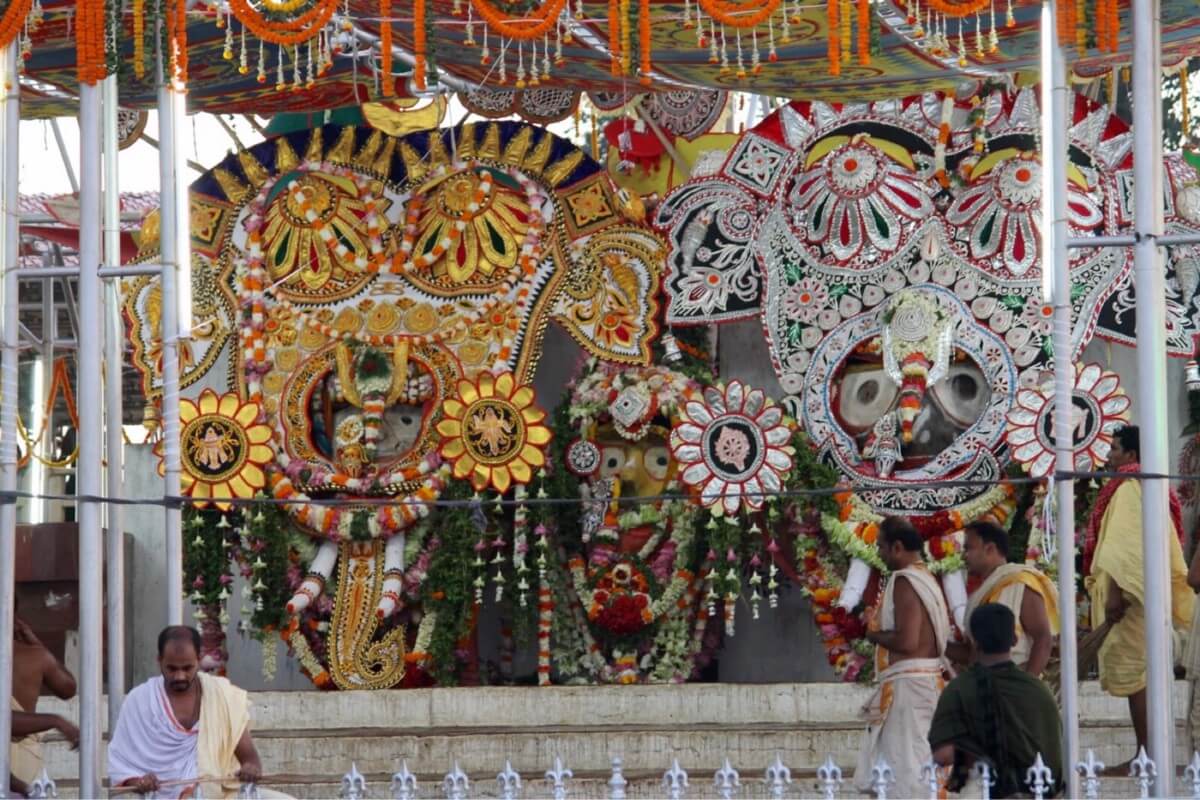
    Every year on the full moon day of the Odia month of Jyestha, the Jagannatha triad come out of the temple’s inner sanctum for the annual Snana Jatra. After the ritual bath, the deities are dressed in the Gajanana/Hati Besa, the elephant attire. The story behind this costume has been recounted in the ancient text of Dardhyata Bhakti. The story is still told fondly by members of the Mahaganapatya sect, followers of Ganesha.

    Hati Besa of Jagannatha triad, Puri

    A sage by the name of Ganapati Bhatta used to live in the land of Karnata (present day Karnataka.) Others say he was from Maharashtra. Whatever that may be, he was an ardent devotee of Ganesha. Being a religious Brahmin, he had read the scriptures thoroughly. One day, as he was turning the pages of the Brahma Purana, he read a line that said, “The Supreme Brahma resides on the Blue Mountain. His sight itself grants Mukti.” When Ganapati realised what this meant, he set out immediately for Puri. On the way, he thought of his foolishness in being blissfully unaware of the God who grants redemption.

    Walking, he came across a few fellows singing merry songs, with the divine Mahaprasada in their hands. Amazed, Ganapati asked them why they were so elated, to which the leader said, “We are returning from Puri. We’re on our way to our homes after a five day long visit.” This created a doubt in the poor Brahmin’s mind, “How can one return alive after sight of the supreme? Surely this could not be God. After all, the Puranas and scriptures are nothing other than conjured-up tales of human imagination.” Saddened, he turned to walk back.

    Suddenly, another priest had appeared from nowhere. He spoke to Ganapati, convincing him of the ways of the Lord at Puri. “Why should he grant Mukti to one who wants to return to his family ? He gives what one asks for. You should go and see him. Ask him for redemption. He shall extend it to you.”

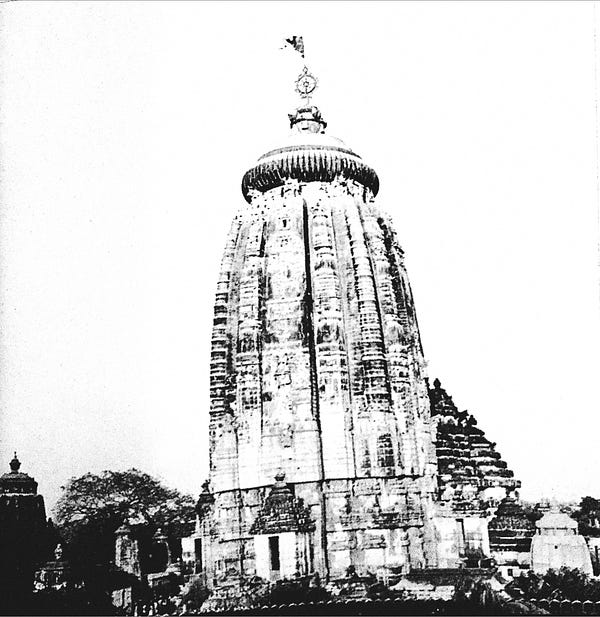
    An old photograph of the Jagannatha Temple

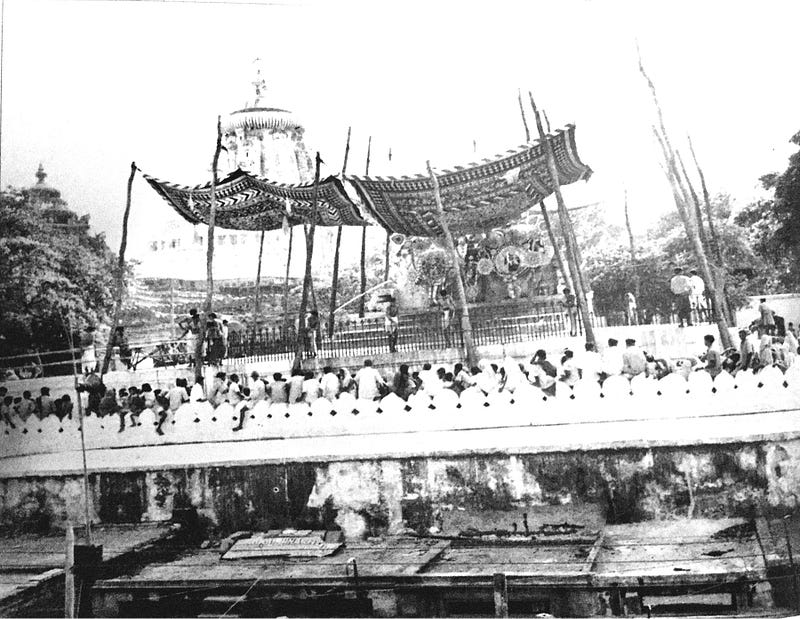
    Hesitating, Ganapati again resumed his journey to Puri. When he reached the Temple of Lord Jagannatha, the people told him that it was a festive occasion. The full-moon day was when the Lord would have his ritual bath. It was Snana Purnima. The Gods had left the sanctum sanctorum and were instead on the Snana Mandapa, a special platform inside the temple for the festival. Ganapati saw him, and again wondered, “Where is the elephant trunk? Where are the tusks? He doesn’t seem to have an elephant head. He is not my Ganesha. He is not God. This is all a huge hoax.” And one more time, the Mudiratha sebayataconvinced him to wait till the evening on Lord Jagannatha’s orders.


    That evening, Ganapati returned. He had decided that he would not come again, that this was the last try. The Lords were dressed in the Gajanana Besa, the elephant attire. Balabhadra was dressed as a white elephant and Jagannatha as a black one. Ganapati was ecstatic. He sang out an instant prayer in the Lord’s praise-

    Gajanana Besa in 1972

    ତବ ଦର୍ଶନେ ଦାରୁବ୍ରହ୍ମ । ତୁଟିଲା ମୋର ମତିଭ୍ରମ ॥

    ଲଭିଲି ପରମ କାରଣ । ଏବେ ଯା ମାଗୁଅଛି ଶୁଣ ॥

    ଆଜୁଁ ଏ ଦେବସ୍ନାନ ଯାତ । ଯେବେ ହୋଇବ ଜଗନ୍ନାଥ ॥

    କେବଳ ହସ୍ତୀ ବେଶ ହୋଇ । ବିଜେ କରିବ ଭାବଗ୍ରାହୀ ॥

    ଏତେକ ମାତ୍ର ଆଜ୍ଞା ହେଉ । ଏକଥା ଯୁଗେ ଯୁଗେ ଥାଉ ॥

    At your sight, O Lord, my doubts have been shattered. I have gained supreme happiness, now I ask from you- From today every year, on this eve of Debasnana Purnima, you shall dress in the elephant attire. Let this be fulfilled. Let this tale be remembered forever.

    Ganapati asked the Lord for Mukti, and he was redeeemed from the world instantly. People watched in awe as a flash from his lifeless body flew out and became one with Lord Jagannatha’s idol.


  • The Lotus Attire

    Odisha was a land of great rulers- great kings, warriors and patrons of the arts. Towards the last part of the tenth century, ruled the King Udyota Keshari. During the period of that great ruler, lived Manohar Das, a great sadhu. He had spent his entire life meditating on the Mahendra range. He lived in the village of Shahpur, far, far, away from the town of Puri. However, he would regularly visit Puri, only for a glimpse of his Lord. He would happily gaze at their faces, primitive, pristine. Fulfilled, he would return back to his meditation. So famed was he that even Mattabhanu Deva, brother of the last ruler of the Ganga dynasty, would come to him for his advice. He was his guru. People rushed to him, and he rushed to Purushottama.

    One winter, Manohar felt a great longing to see his Lord. With his small bag, he set out towards Puri. Through forest tracks and crossing flowing rivers, he would keep walking, unflinching from his goal. At nights, he would halt at nearby settlements or monasteries, and the next day, he would set out again. One day, while walking, he felt thirsty. Unable to find any waterbodies nearby, he kept walking. Soon, he reached a village. In it was a pond. Filling his hands with water, he quenched his thirst. But when he stood up, he saw an enchanting sight- lotuses. The pond was full of lotuses. He was amazed- it was unnatural to find so many lotuses in this winter season. Those red and white lotuses stirred in him a desire to offer them to his Lord at Puri. Delighted, he plucked a lot of flowers, and tied them in his spare towel- his gamuchha. Carrying his towel with care, he marched on. After days and days, on the dark fortnight in the month of Magha, he reached Puri. At the Bada-Chhata Math, he unknotted his towel, but alas! All the flowers had dried up. Still, he entered the temple through the Singhadwara, and requested the servitors to offer his Lord those flowers brought so lovingly. But when the sevayats saw those rotten flowers, they scolded him-”How dare you bring such flowers for Jagannatha? Each day, hundreds of garlands of fresh flowers and tulsi leaves are offered to him. Why should he accept your offering?”. Another rebuked him-”Rotten flowers in a dirty towel, that’s what you offer your deities? Sage? You are a fake soul.”. Disheartened, Manohar walked away quietly. So great was his grief and anger at this humiliating rejection by Lord Jagannatha that he fainted near the Bada-Chhata Math.


    At that time, the Rajaguru Bhavadeva was the person in charge of the Temple. The same night, Jagannatha appeared in his dream-”How dare you throw my devotee Manohar out? Bring him and fulfill his demand.” The frightened Rajaguru immediately awoke and began searching for a sadhu called Manohar. He found Manohar, and his flowers were given to the sevayats. As soon as the rotten flowers touched Lord Jagannatha, they bloomed into divine flowers, fresh and fragrant as ever. That night, there was no Badasinghara Besha, the regular nighttime costume. Lord Jagannatha wished to remain in this attire. As per the Lord’s direction, a special khiri was made out of Padma Chaula.

    When Manohar Das saw the divine sight, he was mesmerised. He ate the special khiri, and was revived to life. Enchanted, he sang out :

    कमल नयन पंकज वदन पुरुषोत्तम जगदीशा

    कमल निवह मम धरिह प्रभु अंत न पावत शेषा ।

    चरण कमल युग विमल सकल चराचर धाम

    भावत दास मनोहर निरत पंकज भूषण श्याम ॥

    And so, since that day, the triad is dressed in Padma Besha, the lotus attire, using lotus flowers made from the spongy pith of a plant [ Aeschynomene aspera, Odia : Sola, ଶୋଲ ] and banana stem. This is because lotus flowers do not grow naturally during this season. During this Besha, the deities are covered with blankets, called Ghoda. And so, this Besha is only done on Wednesdays or Saturdays between Magha Amavasya and Vasanta Panchami, since on those days, the blanket being green and black respectively, the white Lotus designs shine resplendently.

  • Price of a Paan

    A ruckus had been created among the Cooks and Servitors of the Jagannatha Temple. Everyone was either speaking about it or hearing it from someone else. In a place and time where a sera of milk cost four or six paise, and one of Ghee cost twelve annas or a rupee, what would be done with a lakh of rupees? What bhoga would be worth a lakh? What could be done?

    Not hundred, Not thousand. It was one lakh. One hundred thousand. The sages and servants sat counting the zeros in the figure. Not a penny less, not a penny more. One lakh rupees, and that was that.

    Everyone was perplexed, and at the same time, desperate. Hours and hours of bewildered musings and still no way to the problem. Still no idea, no solution, no answer, nothing. No panacea for this Gordian Knot. Then again, cutting the knot was no solution, was it? They couldn’t say no; simply couldn’t refuse the money, and say that it was too greater than required. They couldn’t tell him to reduce the money substantially, convincing him that it was still excessive.

    This was a matter of great shame. To put it rather too frankly, there was no bhoga worth a lakh that could be offered to the Lord of the Cosmos- Jagannatha. The God who is the ultimate refuge; whose huge outstretched hands lend him his name Mahabahu; whose cartwheel eyes gaze at all that is; whose temple is the Great Temple, Bada deula; whose street is the Grand Street, Bada danda; whose prasad is Mahaprasad; who himself is Mahaprabhu- The Lord Jagannatha -has no bhoga that would cost a lakh rupees. No, not one. Such would be the humiliation if they refused. No, they couldn’t deny the offer. Not even for their life could they do that.

    The dearest eatable was butter. Churned from milk, it cost the most. It was called La-hoo-ni in Odia. Krishna loved it so much that he stole and finished off all the butter he could see. From butter was made ghee- the Food of the Messenger of Gods, Agni. But what could be made with only ghee? Even if they served the deities butter sweetened with caramelized sugar, it would cost ten thousand at most. But this was ten times that.


    The year was 1727. It would be two days since the Seth had arrived. The word ‘Seth’ in India means a magnate, a magnifico. He was from Hyderabad in South India. His name was Dhananjay Mehta. True to his name, he sure was a winner of wealth. Too much of it. Ostensibly, he wanted to show his devotion to the Lord by offering him a bhoga worth Rupees 100, 000. There was but a single condition- a single bhoga would have to be offered. And therein lied the problem. Had that condition not been there, they could have offered numerous food offerings spread over a span of time. But it was there, and they had to nod their shaved heads in agreement.

    Usually, well-to-do pilgrims offered money for bhogas. They gave money for additional bhogas to be offered on the days of their stay, and even after that, on previously settled dates and days, when the stars were in a favourable arrangement in the night sky. Days together after they left, the bhogas were offered by chanting their names within verses of priestly Sanskrit. By selling those bhogas, the pandas and cooks made a living. They served the Lord, and he supported them. But Seth-ji didn’t want that. Why make a fuss in your name when you aren’t present in person? Who would see him after he had left? Better to make a single bhoga, on a single day of his stay, and become known as ‘The-generous-Seth-ji-who-had-made-a-bhoga-of-one-lakh-rupees’. How the people would look up to him after that! How they would hold him in high esteem!

    Ananda bazar, the Temple Kitchen, was at that time the World’s Largest Kitchen and it still is. It fed lakhs and crores of people each day, without any previous order. Its foods were called Maha-prasada, not just prasada. From the untouchable Chandala to the revered Brahmin,its gates were open to all. The steamy aromata of the foods as if held the pilgrims by hand and led them to the food. Such a kitchen and still no food worth a lakh.

    At last, the cooks and the servitors said in unison-“Why are we foolishly pondering over the issue? Why bother when the answer to all is beside you? He has given us the problem, he will solve it. Let’s ask him. Jaga will surely answer.”


    And so they proceeded to the head priest, who ritually went alone to him and in his troubled state spoke out-“Kalia, spare some thought for us and save your and our honour. Tell us what you wish to eat, for it is you who will relish the food. Answer our helpless queries, O Jagannatha!”

    And on the other side, our self-proclaimed-great-devotee-Seth was worried over his business. He had to return, you know, to assume control of his business. These assistant-types could not be relied on for long. When they would eat up his empire God alone knew. He would live here in Puri for one more day or would leave straightaway if the main priest did not take his money. That he had fixed in his mind.

    When he got the news that Lord Jagannatha would himself tell his choice, he could not help but feel a bit puffed up. His money was so great that the Lord was consulted. He would humble the world with his notes, he thought to himself. What if he would be a day or two late to home? His name would be forever etched in the memory of these people of one of the four holy dhaams, of Jagannath Puri. He would not let go of such a golden chance. God would himself announce what he wanted from his greatest-devotee-ever-Seth-Dhananjay-in-terms-of-money-donated.

    One who is the Lord of the fourteen spheres and the world, what does one lakh rupees mean to him? But to his sevakas, his servitors, it was too much. At last, the Lord appeared amidst a cloud of radiance. He said to his head priest, his sincere sevaka-“Tell to Sethji, that I want from him a Paan. Everyday before my sleep, the same betel leaf wrapped around the same things does not feel good to me now. I want something different. The same bidia paan bores me. Let Sethji give me what I desire eagerly. I want from him a Paan, a different one, in which the lime should be from the pearl of a Bull-elephant. Let me first relish that Paan, then shall I think of what to eat worth a lakh rupees.”

    A Paan. But not an ordinary one. One with the lime from the pearl of an Elephant’s forehead. Not from shells of ordinary sea creatures, or from the finest conch shell. It is said, traditionally, that pearls grow in the foreheads of bull-elephants. They were called Gaja-muktas, that is, Elephant-pearls. Now the phenomenon has been scientifically confirmed. Elephant pearls are the equivalent of pulp stones in human teeth. They are formed from rounded calcified masses of dentine (ivory) and are recovered from the large soft tissue pulps of the continuously growing teeth (tusks) of mammals such as the elephant (recent and fossil). Anyway, one such pearl was to be obtained. And that, was that.

    When Seth-ji was told that all he had to offer was a Paan, he laughed, creating a cacophony. However, his uproarious bellows did not last. His head swayed as he listened to the statement in its entirety. He thought to himself- ‘Elephant-pearl.’ All elephants do not have a pearl. The old phrase came to him- Elephants, dead or alive, are worth a lakh.  Lakhs of elephants had to be killed for this. Still, there was a chance that none of them possessed a pearl. Even if one did, it had to be extracted. The pearl had to be burnt over a flame and ground to a fine paste. Then would it be smeared over a betel leaf, and wrapped up for Lord Jagannatha.

    This task would take him a lifetime. Still the odds would be against him. He found himself nowhere, lost. Dhananjay Seth’s head reeled. Unknotting his embroidered turban and flinging his sandals outside, he rushed into the Temple, climbing the twenty-two steps representing the twenty-two human fallacies, overcoming them truly. He ran to the sanctum sanctorum, and lowered his head below the jewelled pedestal on which the smiling deities sat. Once again, Lord Jagannatha’s smile waved across his lips. Dhananjay lay defeated. He lay humbled. His pride crushed to  pieces, just like the lime-paste, he raised his arms and joined his palms in the gesture of humility and respect, tears streaming from his eyes.

    Now changed, he said-“Take whatever I have. Let me not lose this lesson ever in my life. Incapable as I am of giving you a Paan, what can I give you worth a lakh? Take my heart, purified by you. Take my sweet-smelling heart filled with true devotion now, wrapped in the betel leaf of humility, and smeared with the paste of my crushed pride.”

  • At the Break of Dawn

    Near the shimmering sands of the Golden Beach and the sparkling shore of the Mahodadhi, lies the conch-shaped city of Puri. The great river’s waters shimmer with glee as the first rays of the crimson sun touch them. The exquisitely carved black chlorite figure of ArunaSurya’s celestial charioteer, present on top of a massive column in front of the Singhadwara, shines under the soft glow of the rising Sun. The waves of Mahodadhi dance on the tides, as if paying their obeisances to this great temple that stands by its shores since time immemorial.

    At the break of dawn, in the holy temple, three of the four gates of the temple are opened. But the actual, huge massive gates are not the ones that are opened. At five o’clock, some specific sevayats enter the temple through much smaller, concealed doors in the larger metallic doors. These smaller ‘doors’ are called Chora Kabata, literally ‘Secret Door’. The sevayats enter into the temple premises to awaken the Lord from his restful sleep.

     But it’s not as simple as that.

    It is not so simple to awaken the ‘Lord of the Cosmos’ from his repose. Just like every other ritual in the Jagannatha Temple, this one too has a number of tasks.

    Of course, before them, the temple guards inspect every nook and corner. The sevayats who do these early morning rituals are the Pratihari, Bhitarachu Mahapatra, Muduli, Mekapa, and Akhanda MekapaThese servitors first gather at the Southern(Elephant) Gate or Dakshina Dwara, and then proceed towards the main temple. They go to the Jaya-Vijaya door of the Natamandapa (The terms refer to architectural components and specific doors). This door is locked by an earthen seal a day before, during the nighttime rituals. Now, the seal is inspected, and the lock is opened with the key. The key is taken from the Muduli sevayat, who keeps it through the night.

    Now all of them enter into the main temple, specifically the Jagamohana, and reach the inner door to the sanctum sanctorum. This door, called the Kalahata Dwara, or the Chhamu Dwara,with abeautifully ornamented doorjamb gilded with silver, is then opened.

    But before that, there’s another thing to be done.

    Before that, the Pratihari Sevaka calls at the top of his voice, to wake up the Lord lest he be  sleeping while the door is opened. He calls aloud-

    Manima Daka

    Only after that do they open the door to see a wonderful sight. As the Mekapa & the Akhanda Mekapa light a lamp, the darkness is dispelled by the flickering light of the lamp, to reveal one of the most captivating sights- the three deities, in their Nighttime attire, the Badasinghara Besha, adorned with all sorts of flower-ornaments, their round eyes looking through the net of fragrant flowers. In this way, the Mekapa and the Akhanda Mekapa light nine huge brass lamps. All the doors in the temple are then opened completely.

    Then do the Pushpalakas enter the sanctum sanctorum and perform the morning ritual of waving the sacred fire before the deities, or Aarti. The Pushpalakas do the ritual with the help of the Mekapas and the Mahapatra sevayats. This Aarti or Alati(aa-la-ti) ritual has 3 steps-

    1. The first is done with Camphor, called Karpura Alati.
    2. The second with 21 lamps of Ghee, is called Ekoishi Batti Alati, as it is done with twenty-one lamps.
    3. The third with liquid batter of moistened rice, called Pithau. Hence this alati is called Pithau Batti Alati.

    These three steps together are called the Morning Alati, or Mangala Alati. So, the Mangala Alati marks the beginning of the day in the Jagannatha Temple.

    An important thing is that the devotees can see the entire Mangala Alati. This is because, after opening the Southern Gate, Bhitarachu Mahapatra orders for the four main gates to be completely opened, so that people may enter the temple precincts. Again, after the Khata-sheja mekapas keep aside the ivory beds of the deities, called Ratnapalanka, the other doors- namely the Sata Pahacha Dwara, the Panda Dwara, the Beharana Dwara are opened in the order. The general public then view the deities, standing near the Bhitara-katha-argali.( that is, the stout wooden bars put just after the sanctum sanctorum to keep the people from entering the sanctum sanctorum while rituals are going on)

    Thus commences the day in Jagannatha’s abode.

  • Champu

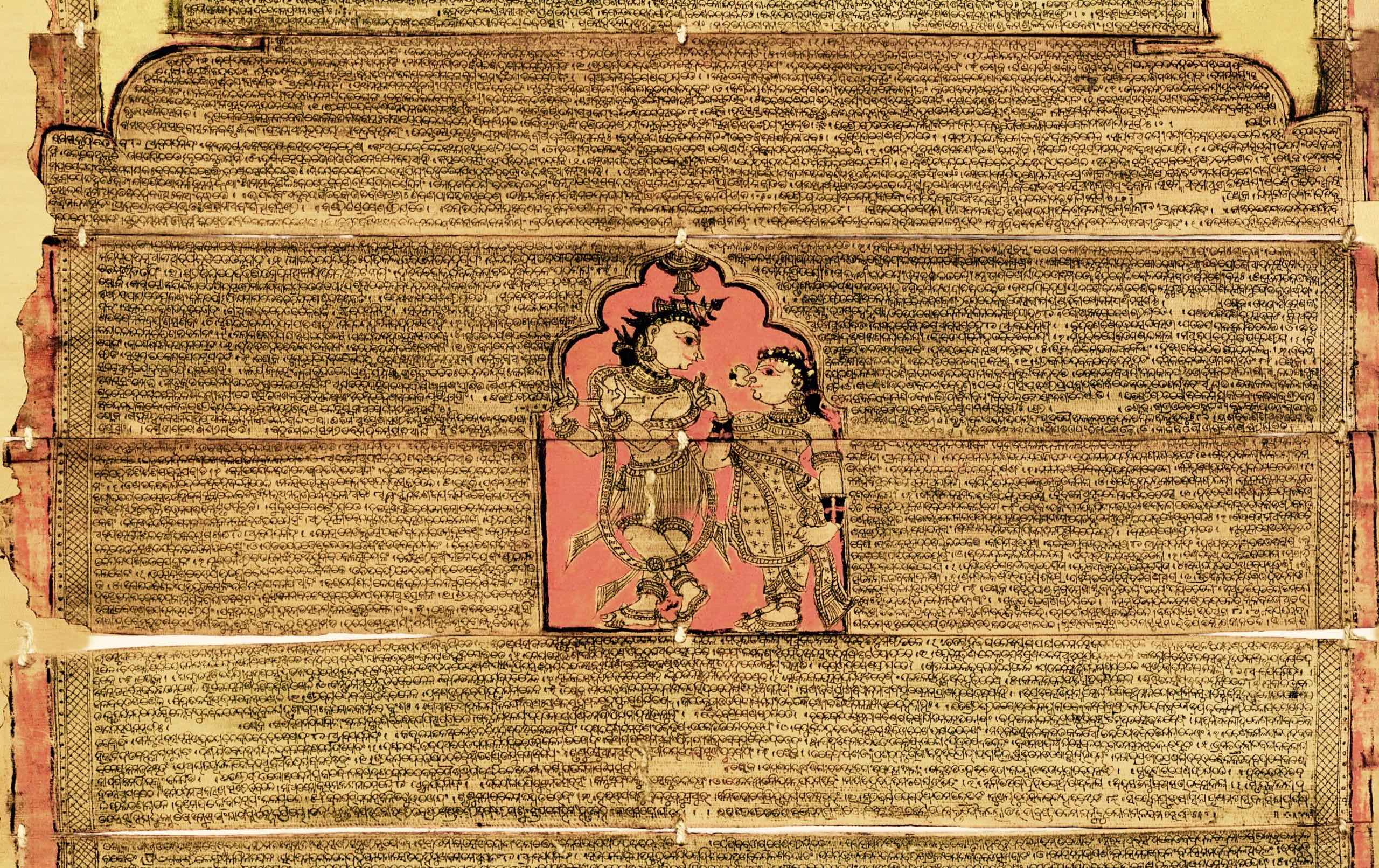
    Champu or Champu-Kavya (ଚମ୍ପୂ) is a genre in Indian Literature originated from Sanskrit. It consists of a mixture of prose (Gadya-Kavya ଗଦ୍ୟକାବ୍ୟ) and poetry passages (Padya-Kavya ପଦ୍ୟକାବ୍ୟ) with verses interspersed among prose sections.

    In simple words, a typical and unusual form of words, which is partly prosaic and partly poetic is known as Champu. In the Odia Champu composition, a song is written for every letter of the alphabet, and every stanza in the song starts with the same letter of the alphabet. Thus, tremendous literary expertise is required for every single composition. The play with the alphabet does not take away the lyrical charm from the song and the rhythm of verse. The wordplay and the delicate lyrical sense give rise to unusual sound effects of the champu (such as Alliteration, Onomatopoeia, etc.) when sung or recited.

    There are many writings of the champu genre in Sanskrit. The Sanskrit champu composed by King Bhoja is well known. Many poets, in the medieval period till this date, were and still are composing champus of numerous titles.

    Odia literature is also rich with champu compositions.

    However, amidst them all, Kabisurjya Baladeba Ratha is the unchallenged master of this genre. His epithet ‘Kabisurjya’, meaning ‘Sun Among Poets’ establishes his literary skill. So famous is his Kishorachandrananda champu that the word champu itself means to a layman in Odisha his work. Kishora-chandrananda Champu is an anthology consisting of individual champus from Ka to Khya- the 34 consonants of the Odia Alphabet, that is, there is one song for each of the 34 consonants in the Oriya alphabet. As mentioned before, a champu has part-prose and part-poetry. In the Kisora-chandrananda Champu, the prose part is in Sanskrit, while the poetry is in Odia. Each Line of the poetry starts with the same letter. For example, in the Bha Champu (‘ଭ’ ଚମ୍ପୂ )-

    ଙ୍ଗୀ ଚାହାଁ, ଭୂରୁନୀଳଭୁଜଙ୍ଗୀ-ଭ୍ରମର ଜୀବସଙ୍ଗୀ ॥ ପଦ॥
    ଭାଗ୍ୟ ଏ ଜନ ଆଖି, ଜନନରଟି ସଖି ଜାଣ ରେ,
    ରମି ନ ଯା ତୁ ମନ୍ମଥ ବାଣରେ, ଭୁଜପାଶିକୁ ଛନ୍ଦି ମୋ ଗଳେ…………..

    Did you note the repeated use of the letter ‘Bha’ at the beginning of each line ?

    The main theme of the songs is the love of Radha and Krishna. The songs are composed as dialogues, as conversations between the characters, that is, one character speaks through a song, the other one responds through another song. These are composed strictly on traditional ragas and talas of Odissi Classical music. Champu verses are used for solo singing and for rendering Odissi abhinaya. The Odissi dancer depicts the emotion – bhava, which brings out the various moods of the nayaka (hero) and nayika (heroine).