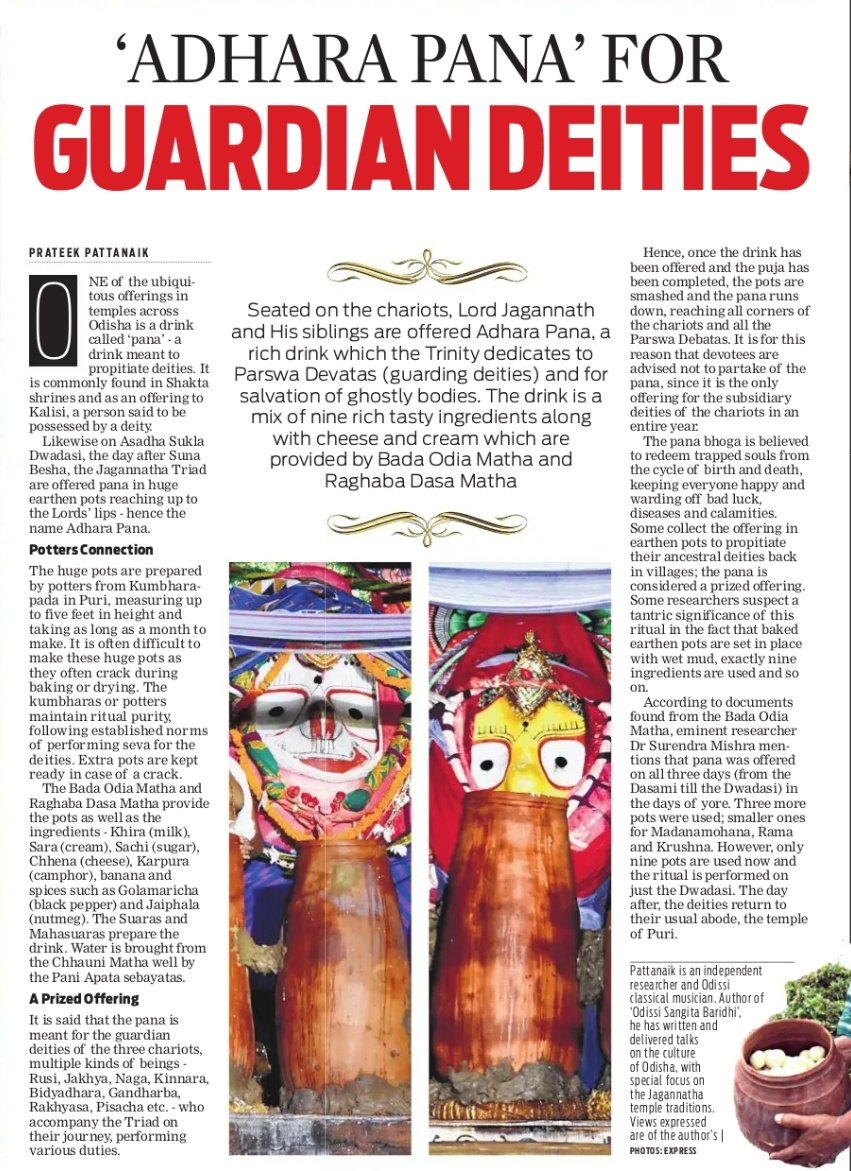
One of the ubiquitous offerings in temples across Odisha is a drink called Pana ; a cool drink meant to propitiate deities. It is commonly found in shakta shrines and as an offering to Kalisi, a person said to be possessed by a deity. Likewise, on Asadha Sukla Dwadasi, the day after Suna Besa, the Jagannatha triad are offered Pana in huge earthen pots reaching up to the Lords’ lips – hence the name Adhara Pana. The huge pots are prepared by potters from Kumbharapada, measuring up to five feet in height and taking as long as a month to make. It is often difficult to make these huge pots as they often crack during baking or drying. The kumbharas or potters maintain ritual purity, following established norms of performing seva for the deities. Extra pots are kept ready in case of a crack. The Bada Odia Matha and Raghaba Dasa Matha provide the pots as well as the ingredients – Khira (milk), Sara (cream),Sachi (sugar), Chhena (cheese), Karpura (camphor), banana and a spices such as Golamaricha (black pepper) and Jaiphala (nutmeg). The Suaras and Mahasuaras prepare the drink. Water is brought from the Chhauni Matha well by the Pani Apata sebayatas.
It is said that the Pana is meant for the guardian deities of the three Rathas, multiple kinds of beings : rusi, jakhya, naga, kinnara, bidyadhara, gandharba, rakhyasa, pisacha etc. who accompany the triad on their journey, performing various duties. Hence, once the drink has been offered and the puja has been completed, the pots are smashed and the Pana runs down, reaching all corners of the rathas and all the parswa debatas. It is for this reason that devotees are advised not to partake of the Pana, since it is the only offering for the subsidiary deities of the ratha in an entire year. The Pana bhoga is believed to redeem trapped souls from the cycle of birth and death, keeping everyone happt and warding off bad luck, diseases and calamities. Some collect the offering in earthen pots to propitiate their ancestral deities back in villages ; the Pana is considered a prized offering. Some researchers suspect a Tantric significance of this ritual in the fact that baked earthen pots are set in place with wet mud, exactly 9 ingredients are used and so on.
According to documents found from the Bada Odia Matha, eminent researcher Dr. Surendra Mishra mentions that Pana was offered on all three days (from the Dasami till the Dwadasi) in the days of yore. Three more pots were used ; smaller ones for Madanamohana, Rama and Krusna. However now, only nine pots are used and the ritual is performed on just the Dwadasi. The day after, the deities return to their usual abode, the temple of Puri.
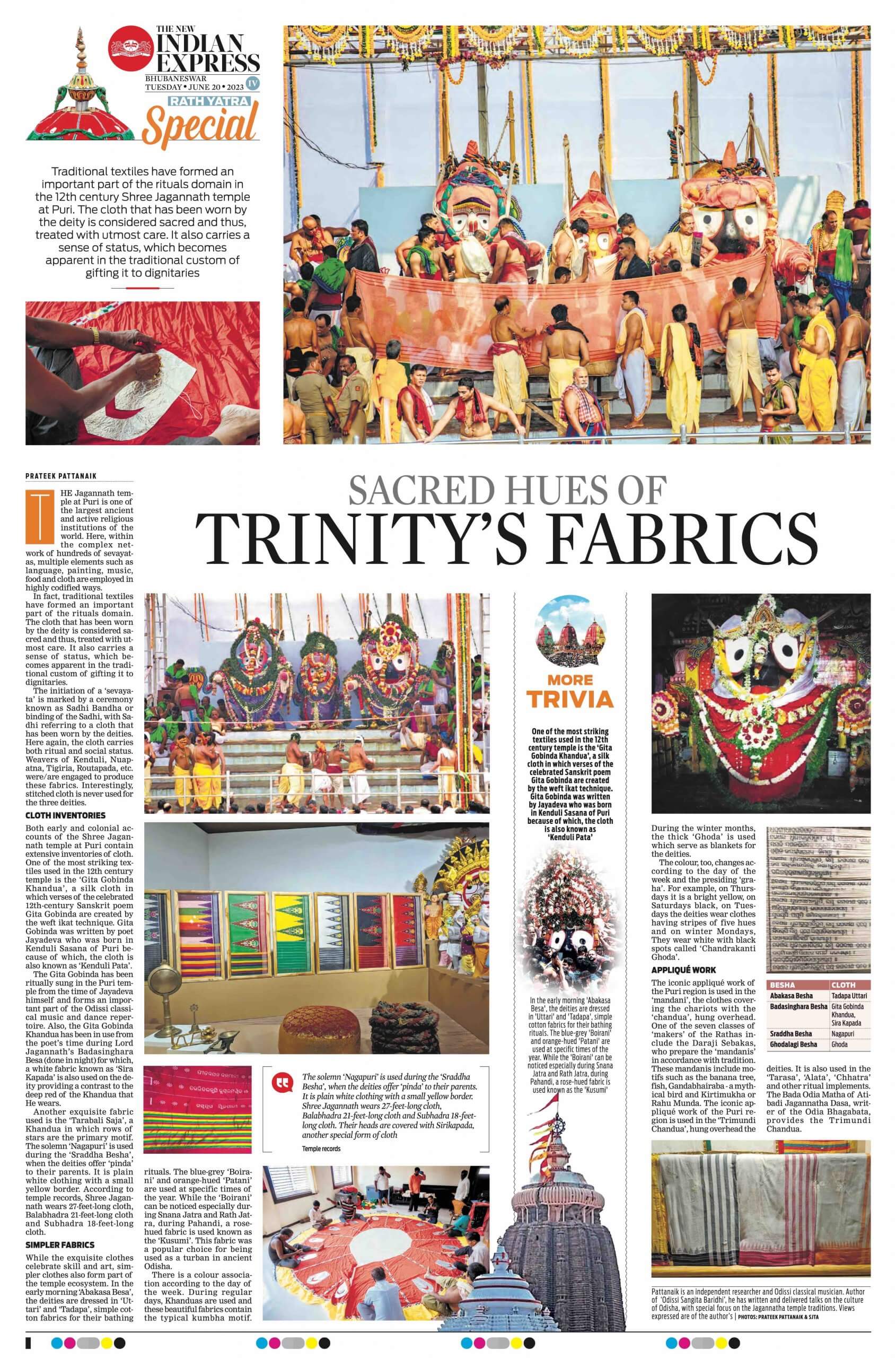
The Jagannatha Temple of Puri is one of the largest ancient institutions of the world, still active. Within the complex network of hundreds of sebayatas, multiple elements such as language, painting, music, food and cloth are employed in highly codified ways. As such, traditional textile forms an important part of the ritual domain ; a cloth that has been worn by the deity ‘maharda’ is sacred and thus treated with utmost care. It also carries a sense of status, which becomes apparent in the traditional custom of gifting it to dignitaries. The initiation of a sebayata is marked by a ceremony known as sadhi-bandha ‘binding of the sadhi’, sadhi here referring to a cloth that has been worn by the deities. Here again the cloth carries both ritual and social status. Weavers of Kenduli, Nuapatana, Tigiria, Routapada, etc. were/are engaged to produce these fabrics. Stitched cloth is never used.
Both early and colonial accounts of the Puri temple contain extensive inventories of cloth. One of the most striking textiles used in the temple is the ‘Gitagobinda Khandua’, a silk cloth in which verses of the celebrated 12th-century Sanskrit poem Gitagobinda (written by Jayadeva, born in Kenduli Sasana, Puri – because of which the cloth is also known as ‘Kenduli Pata’) are created by the weft ikat technique. The Odia script is traditionally used, for Sanskrit has no standard script and used to be written in a variety of regional scripts in ancient India. The Gitagobinda has been ritually sung in the Puri temple from the time of Jayadeva himself and forms an important part of the Odissi classical music & dance repertoire ; the Gitagobinda Khandua has also been in use from the poet’s time, in the nighttime Badasinghara Besa, in which a white fabric known as the Sira Kapada provides contrast to the deep red of the Khandua. Another exquisite fabric used is the Tarabali Saja, a Khandua in which ‘rows of stars’ are the primary motif. The solemn Nagapuri is used during the Sraddha Besa, when the deities offer pinda to their parents.
While the exquisite clothes celebrate skill and art, simpler clothes also form part of the temple ecosystem. In the early morning Abakasa Besa, the deities are dressed in Uttari and Tadapa, simple cotton fabrics for their bathing rituals. The blue-grey Boirani and orange-hued Patani are used at specific times of the year. The Boirani can be noticed especially during Snana Jatra and Ratha Jatra. During Pahandi, a rose-hued fabric is prominent, known as the Kusumi. This fabric was a popular choice for a turban in ancient Odisha.
There is a colour association according to the day of the week. During regular days, Khanduas are used. These beautiful fabrics contain the typical kumbha motif. During the winter months, the thick Ghoda is used; these serve as blankets. The colour changes according to the day of the week and the presiding graha. For example, on Thursdays it is a bright yellow ; on Saturdays black ; on Tuesdays consisting of stripes of five hues ; on winter Mondays white with black spots, called Chandrakanti Ghoda.
The iconic applique work of the Puri region is used in the ‘mandani’ the clothes covering the Rathas and the chandua, hung overhead. One of the seven classes of ‘makers’ of the Rathas include the daraji sebakas, who prepare the mandanis in accordance with tradition.
Odisha is well known as a great seat of Buddhism, especially of the Tantric kind. The Buddhist sects of Mahayana, Vajrayana, Kalachakrayana, etc. comprise Tantra as a major ingredient. However, it was not so in the beginning – Tantra was a later development in the history of Buddhism. The gradual development of philosophies and addition of layers led to schools within Buddhism which then blossomed into a rich tradition of Tantra. Ratnagiri, Udayagiri, Puspagiri, Bajragiri Mahaviharas of Odisha were renowned research institutes all over the country. (There were also Purnagiri, Alatigiri, Lalitagiri. The sheer number of these ancient educational centers in Odisha is astounding.) In these institutes, great teachers such as Lakshminkara, Pitopa, Naropa, Bodhisri would teach. These institutes of Odisha played a most crucial role as Tantra shaped itself in Buddhism, especially in the history of Vajrayana, Hinayana & Sahajayana.
Before we proceed further, it is worthwhile to note that the Buddhist treatises refer to Odisha as Oddiyana or Uddiyana. To anyone accustomed with the ancient names of Odisha, such as Odra & Udra, these seem obviously related. However there has been a historical misidentification of this Oddiyana with Swat Valley in Afghanistan, owing to the general ignorance about Odisha in scholarly circles a few centuries ago. Xuan Zang referred to Odisha as Udyana. The Buddhist texts also use Oda, Odra, Odivisa as variants of Oddiyana. The great teacher Indrabhuti is identified in Buddhist tradition as the king of Sambhala, Oddiyana – which is Sambala-pura (Sambalpur) in Odisha. Indrabhuti unsurprisingly begins his treatise with a prayer to Jagannatha. Several Buddhist deities have specific variants that are named after Oddiyana – an obvious reference to a particular manifestation of the deity being worshipped in a region. Iconographical details are meticulously described in Buddhist manuscripts preserved in the Tibet region but the only extant sculptures of such deities in the world are found in Odisha. Over the last few decades, several scholars have done pioneering research to correct the conventional misidentification and gradually, the correction is being recognised. All we need to know is that Oddiyana is Odisha, without a shred of doubt.
Sometime around the 7th century, there emerged a group of eighty four mystics across Eastern India. They were referred to as the ‘Mahasiddhas’, masters who had attained perfection. The Mahasiddhas were powerful figures, performing miraculous feats and with a significant following, viewed by the people with awe, fear and reverence. Some of the Mahasiddhas wrote songs to spread their insights; these songs, known as the Charyapada (Charjyapada) or Charyagiti are written in a sort of proto-language that is the ancestor of Odia, Bangla and Ahomiya. Some of the songs lean heavily towards Odia and likewise with the others. This provides an invaluable clue to determine the regions of the various Mahasiddhas. Together with traditional legends and biographies preserved in different regions, one can make a fair estimate of where each of them hailed from.
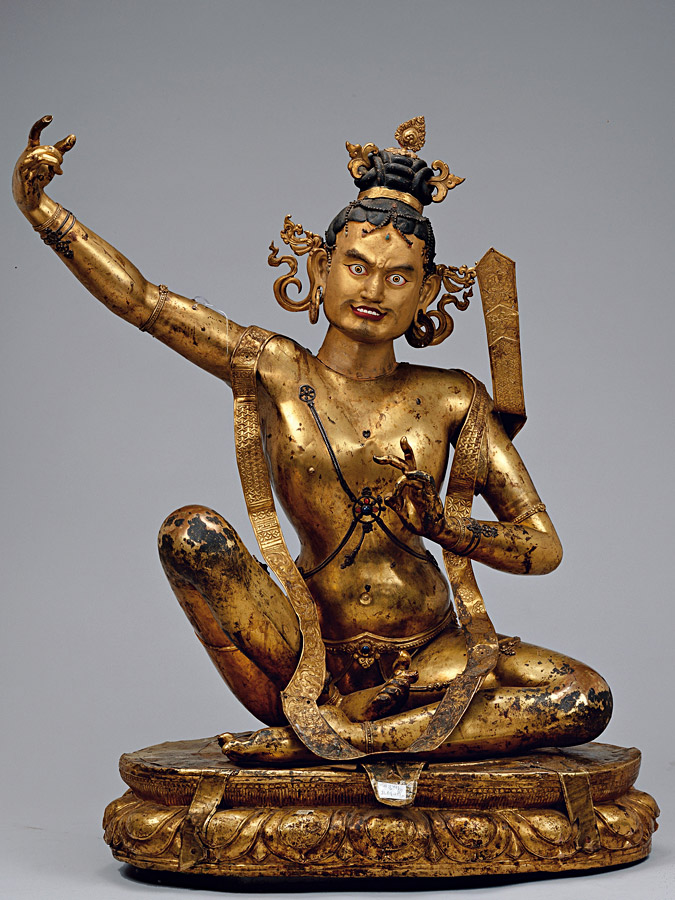
Mahasiddha Damarupa, Tibetan bronze.
Many of the Mahasiddhas such as Kanhupa, Luipa, Sabaripa, Bhusukupa, Birupa composed Charyapadas in Lalitagiri Mahavihara, Jajpur. One of the fascinating aspects is the mystic language that Buddhist teachers employed. An inscription collected from Ratnagiri has lines of Buddhist hymns that go – “Dhara dhara. Hara hara. Prahara hara. Mahabodhi chitta dhare. Chulu Chulu…” This baffling language was intended to convey its actual message to only the true recipient, that is, one who has trained in the correct method under a proper Guru and has learnt enough to be able to decode the metaphorical statements. A point to note is that the metaphors are not random; quite often they are like a codebook, following standard metaphors for specific concepts. The metaphors would be from daily life, like a musician playing the vina or perhaps a weaver at work. The songs were relatable hence popular.
The poets have designated ragas such as Gabuda, Malasri Gabuda, Baradi, Gujjari, etc. for their creations, and their songs continue to be sung in traditional ragas of Odissi music. Some of these 8th-century lines continue to be popular in Odisha and are sung during Lord Jagannatha’s Ratha Jatra by the Dahuka. The Charyas such as ‘Alie Kalie Bata Rundhela’ (Kanhupa), ‘Ucha Ucha Pabat Tahin’ (Sarahapa), ‘Apane Rachi Rachi’ (Sarahapa), ‘Kaa Tarubara Pancha Bi Daala’ (Luipa) are almost entirely comprehensible, for they appear to be very close to present-day Odia. It is also worth noting that many of the Ragas of the Charjyapada are only found in Odissi music, and do not exist elsewhere.
Sarahapa was one of the prominent Mahasiddhas. It is widely believed that he was one of the earliest poets who wrote in Odia. He was born in Odisha. The story goes that Sarahapa followed his work as a Brahmin during the day and fulfilled his Buddhist rituals once it was dark. Since he drank too much, his fellow Brahmins complained to the king. So the king arranged a private meeting and gently requested Saraha to avoid drinking too much, an accusation which Saraha simply denied. To prove his point he dipped his hand in boiling oil and drank molten copper without any harm. Seeing this, the others bowed down.
The Mahasiddha Jalandharipa described in the previous story is also known as Hadipa, the name by which he is popular in Odisha. The iconic ballad sung by the Natha ascetics of Odisha, bowing their kendera instrument, narrates how the king Gobinda Chandra left his riches and went to be the disciple of this very Hadipa. One story Odia grandmothers fondly recount is how Hadipa orders a coconut tree to bow down and the tree does so out of respect. Mahasiddhas such as Hadipa and Kanhupa might have been forgotten by most, but their vivid tales are still found in the oral tradition of Odisha. I remember listening to this story as a child, imagining these wonderful, magical characters. Stories about the Mahasiddhas are often full of colourful miracles – they make for interesting reading.
Another Mahasiddha who is well-known in Odisha even today is Luipa. Traditional accounts narrate that he too was born in Odisha. He met Sabaripa, a disciple of Sarahapa and learned from him. Then he went northwards and sat near a river. Luipa was initially disgusted by the food, but finally started eating fish gut piles along the riverbank. This led him to enlightenment. The message conveyed by the above tales is that as long as the mind sticks to notions of purity & impurity, love & disgust— one cannot attain single-mindedness, one of the goals of the penance. The vision is to stop breaking the world into good & bad, avoid dichotomy and see the world for what it is, bereft of judgement. The tales are quite taboo and go to shocking lengths to drive home this point.
Mahasiddha Kanhupa is also well-known in Odisha. One legend that is popular in Odisha says that when he walked, seven umbrellas and seven dambaru drums hovered above in his respect. Proud of his achievements, Kanhupa decided to go to Sri Lanka with his disciples. When he reached the sea, he simply walked on the water. And so delighted by his own miracle, he thought “Even my Guru does not have such power!” The moment he thought this, he fell into the depths of the sea, powerless. Dejected, he returned and apologised to his teacher Jalandharipa. His guru sent him to another Mahasiddha by the name of Tantipa. Kanhupa would have to follow whatever Tantipa said. Tantipa asks him to eat a corpse and even feces, and Kanhupa is utterly shocked. Disgusted, he endures and obliges to his best, but ultimately decides to leave and everything ends in a mess. Kanhupa’s is a cautionary tale, but his songs are also the most famous, perhaps arising from the experience in the words.
Lakshminkara was the sister of Indrabhuti of Sambhala (Sambalpur) – one of the only four women in the list of eighty four Mahasiddhas. She was the founder of a new school called Sahajayana in Buddhism, a thought that deeply influenced the entire Eastern India. Even today Odia people knowingly or unknowingly believe in some of its tenets. Sahajayana deeply affected the society in Odisha back then, and some things have become embedded in the rituals, stories and beliefs of the state. And that was a short glimpse into the history of Tantra in the popular belief of Odisha.
The grand temple at Simhachalam in Andhra Pradesh is dedicated to Narasimha. Narasimha, or Nrusingha, as is more common in Odia, is Vishnu’s fourth avatara. Prahallada is a young kid devoted to Vishnu but his father Hiranyakasyapa does not approve. This results in a struggle between the duo in which the asura father goes to great heights to destroy his own son, who is saved miraculously each time. The tale ends when Hiranya challenges Prahallada to show Vishnu to him. “Where is he?” asks Hiranya. Unperturbed, Prahallada answers “Everywhere”. “Show him in this pillar then!” commands the father. Prahallada humbly prays and moments later Vishnu appears in the man-lion form to kill the asura.
To the uninitiated, the temple in its present state appears to be a regular South Indian shrine. However, the history of this sacred site is affiliated with multiple dynasties and kings— few know that the early history of this temple is intimately associated with the Eastern Ganga dynasty.
The worship of Nrusingha has been central in Odia belief for thousands of years. In most of the crucial junctures in the legend of Jagannatha, such as the origin of the deity and the pratistha rituals, there is a mention of Nrusingha. Likewise, during the Nabakalebara rituals, he is invoked to oversee the proceedings. It is not surprising to see the connection— with his big circular eyes and wide red mouth, Jagannatha can evoke the image of a boyish Krishna, a smile waving across his lips or that of terrifying man-lion Nrusingha, his eyes and mouth wide open, seething with rage. It is but the devotee’s belief that determines who the deity is to them— the multiplicity and abstractness that is so characteristic of Jagannatha worship.
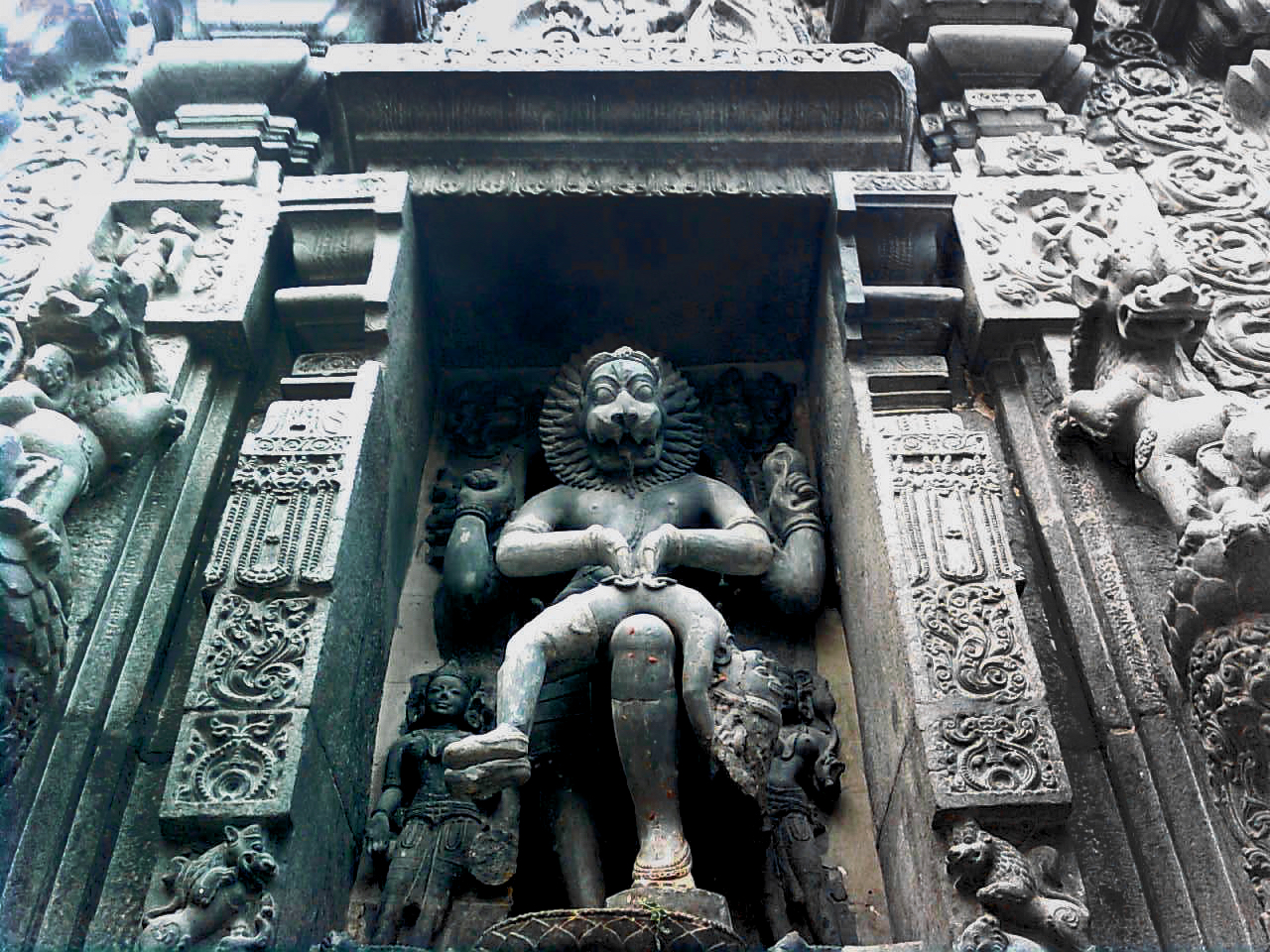
Narasingha in parswadebatā niche, 13th-century Kalinga sculpture, Simanchalam temple.
Early copperplate grants and other evidences mention Simhachalam as a part of Kalinga near unequivocally. Even until the 19th century, the Srikakulam and Vishakhapatnam regions were considered part of undivided Ganjam. However in modern times these Odia-speaking regions have been merged into Andhra Pradesh.
Performing art traditions of Odisha also accrue prime importance to Nrusingha. The Sahi Jata of Puri has elaborate medhas of the deity, centuries old. The Prahallada Nataka of Ganjam narrates the popular tale in an extravaganza of traditional Odissi music, dance and literature. Masks of the lion god are dotted across Odisha, many of them several centuries old. And in the lakhs of temples he is everywhere— even in Shaiva shrines such as Bali Singhanatha. The most important shrine to Nrusingha was the Singhachala, meaning “Lion’s hill”. Gradually the word has condensed to ‘Simanchala’.
The main temple is built in the Kalingan style of architecture and carving— that is because it was made by Langula Narasingha Deba, the same ruler who built the Sun Temple of Konarka. Narasingha Deba is depicted in a sculpture in the temple. Words like ‘bada’ and ‘bhogamandapa’, clearly from Kalinga silpa parlance, continue to be used. Under the leadership of the great Kalinga ruler, the scholar Narahari Tirtha established mathas and converted the region into an educational centre of repute. He used to be a minister for the Gangas before his life as a saint. Inscriptions talk about the involvement of Gajapati Kapilendra Deba, Prataparudra Deba and Purusottama Deba.
Simhachalam is also a virtual treasure trove of inscriptions, several in Odia. These inscriptions shed a lot of fascinating insights into life in ancient Odisha. An officer named Kalinga Pariksha used to supervise over the functioning. Quintessential delicacies like Podapitha, Kakara, Arisa, Karpura Kanti, Dahi Pakhala were offered. Narasingha Deba appointed a hundred women musicians at the shrine. Musicians were appointed quite frequently to sing and play for the deity— the inscriptions mention that musicians had to sing specifically in the tradition of Odia sampradaya, which is Odissi classical music.
In ancient Odisha, Simanchala was one of the major Vaishnava centres, second to only Jagannatha Puri. The shrines are referred to as twins in folk belief: Nilachala-Simanchala and Niladri-Simadri, the blue hill (Puri) and the lion hill respectively. The frequency of the names Simanchala, Simadri, Apanna, etc. in the southern districts of Odisha stands testament to the historical Odia link of this great shrine.
The Veena is one of the oldest instruments known in India for millennia. It is considered the mother of the stringed instrument family.
In ancient times the term ‘Veena’ was used in a generic sense for any plucked stringed instrument. Hence ekatantri was a Veena with a single string; in other words, one could liken it to what is known in Odisha and in many other parts of the country as the ektara. This ektara is used by the Jogis of Odisha to sing songs about yogic philosophies, sarira-bheda bhajana. Similarly we have the dotara with two strings.
The Veena as an instrument at its core is a string stretched to the desired pitch. Other elements such as a fretboard or gourd-amplifiers were obvious evolutions of the skeletal design. In Odisha’s ancient temples, we find hundreds of depictions of the Veena being played by divinities, celestial musicians (gandharvas), alluring maidens (nayikas) and mysterious creatures including yakshas. The traditional dances of Odisha all have a pose for the Veena.
The 6th-century Asanapat inscription from Keonjhar depicts a dancing Shiva playing on a Veena. This is one of the earliest depictions of Nataraja Shiva in India. Goddess Sarada of Jhankada, one of the most important Shakta shrines of Odisha holds a Veena prominently. Her pitha is easily around two thousand years old. Palm leaf manuscripts and Pattachitra murals across the state mention fabulous designs. A study of these designs reveals a huge variety. Elaborate descriptions are found in Odissi musical treatises such as Sangita Narayana.
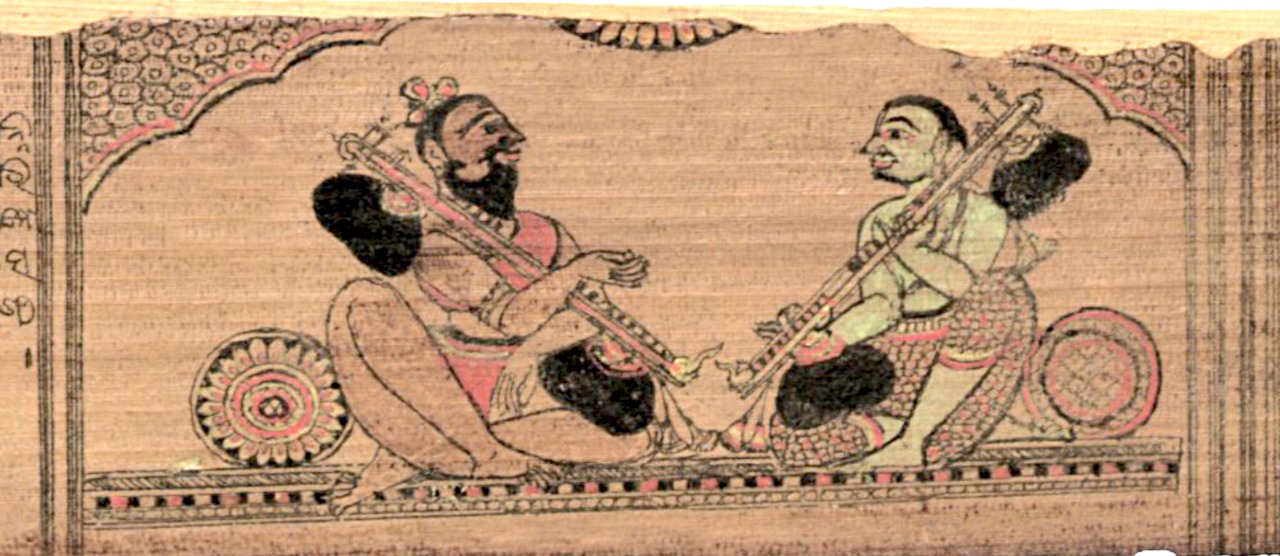
Chitrapothi or palm leaf illustration of Binākāras or Veena players, Odisha, 17th century.
The Veena was one of the mandatory sevas at the Jagannatha Temple of Puri. Musicians used to be appointed in the temple to sing and play traditional Odissi classical songs. Odissi music being a separate stream of classical music with its own history and stylistic features, the technique of Veena playing has also been markedly different, emphasising the contours of Odissi singing nuances. The instrumental repertoire included the Mardala, the traditional percussion instrument of Odisha, the Veena, the Venu or flute among others. The Madala Panji mentions the ‘Binākāra Seva’ quite prominently. Unfortunately, these sevas went extinct during the 1940s in Puri, and it is not easy to restart an extinct seva in the Jagannatha temple due to some beliefs. In the latter half of the 20th century the Veena was frequently used in Odissi dances, mostly due to the insistence of Adiguru Pankaj Charan Das, however, over time that has receded as well. It would not be out of place to mention that the term Binākāra is unique to Odia and Odisha, and is found in traditional performing arts such as Danda Nata.
The Veena in the Odissi music tradition however survived in South Odisha. In the mathas of South Odisha iconic Odissi musicians of the time would sing every evening in honour of their chosen deity. Many of the mahantas were themselves reputed Odissi musicians— singers and instrumentalists. For example, in Paralakhemundi there was the great Sangitacharya Mahanta Adwaita Guru, who lived in the last part of the nineteenth century. Royal courts often had court musicians. Again in the court of Paralakhemundi the raja-sangitagya was Apanna Panigrahi, possibly the greatest Odissi Binakara of his time. Apanna was a favourite of Maharaja Krushna Chandra Gajapati Narayana Deva, and it is on the latter’s insistence that he agreed to record his voice on gramophone. Hailed as ‘Utkala Ra Suradasa’ as he was blind, his records were an instant hit all over Odisha. He had several worthy disciples.
In the twentieth century, the Odissi Veena was kept alive thanks to the efforts of Acharya Tarini Charan Patra of Boirani, Ganjam. An ardent devotee of Kabisurjya Baladeba Ratha, writer of the iconic Champu, Tarini Charan Patra established a musical university of sorts in the 1940s, one of the earliest such efforts in Odisha. He trained students in Odissi vocal music with special focus on the Veena. His Veena playing was broadcast almost every other morning over All India Radio Cuttack. Now, it is his disciples who carry forward the instrument, keeping it alive against all odds. Pt. Ramarao Patra, now in his 70s, was one of the Acharya’s favourite students, and is perhaps the last upholder of this critically endangered tradition. It is a miracle indeed that the Odissi Veena has survived despite all odds.
Today, the mention of the word ‘Veena’ makes most people think about either Saraswati Veena in the South or the Rudra Veena of the North. Odisha, as usual, is overlooked without thought. It is about time that we learn to appreciate the sheer variety of traditions in the country, abstaining from simplistic binaries.
One festival that has been the very identity of Odisha is the Ratha Jatra of Puri. However, the concept of a festival built around a Ratha or chariot is not limited to Puri. Three other significant Ratha Jatras exist – those of Goddess Biraja (Jajpur), Surya or Mahabhaskara (Konarka) and Shiva or Lingaraja (Bhubaneswar). This quartet of chariot festivals spans the deities Vishnu, Shiva, Shakti and Surya; important deities with significant following in ancient and medieval Odisha. It is no coincidence that the festivals are centered at what are known as the four great ‘kshetra’s of Odisha.
Bhubaneswar, known variously as Ekamra Kshetra and Chakra Kshetra, has been a seat of Shaivism for centuries. The grandest of Bhubaneswar’s temples is the Lingaraja temple, viewed as the culmination of harmony in Odia sculpture by many scholars, who date back the worship of Lingaraja to at least 1500 years ago. The Ratha Jatra of Lingaraja is hence a very ancient ritual in its own right— with its fair share of curiosities.
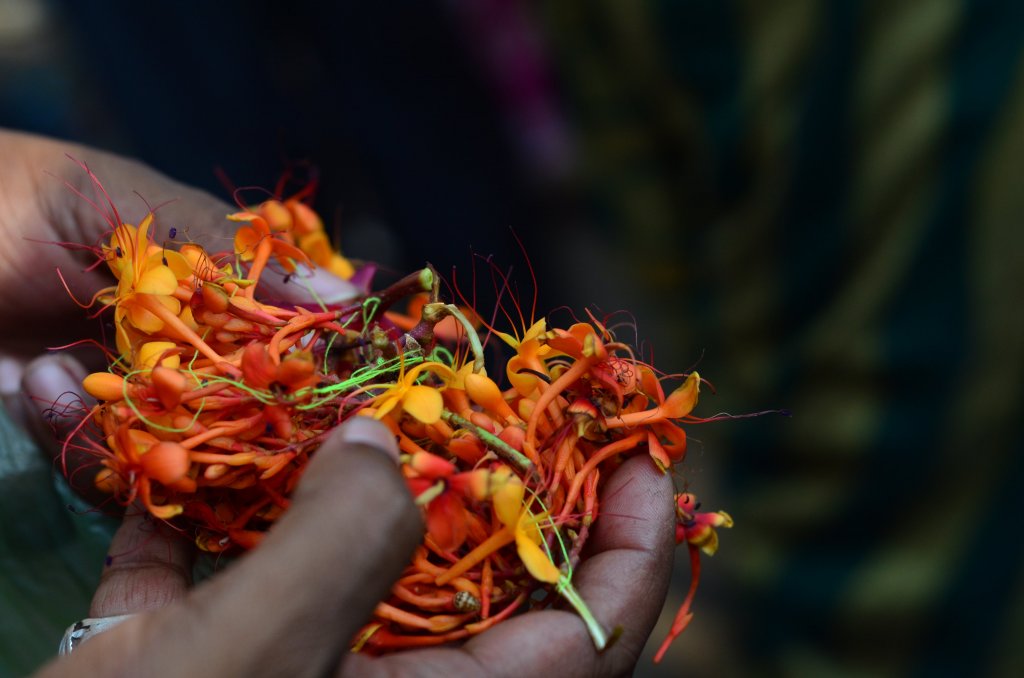
On the day of Ashokastami every year, Shiva is worshipped with flowers of the Ashoka tree, also the state flower of Odisha. The tale goes that Hanuman was captured by Ravana’s son Indrajita, who employed the naga-pasha (snake-coil) weapon. Trapped in the Ashoka Vatika, Sita worshipped Shiva with eight buds of the Ashoka flower. In remembrance, Odia womenfolk celebrate the ritual Ashokastami Brata. The word ‘a-shoka’ means ‘without shoka (grief)’— for it is believed that consuming the Ashoka flower robs one of all grief, perhaps a reference to the medicinal properties of the flower. The Ashoka tree is also one of the five flower-arrows of Kamadeva, a symbol of love and life. The connection with the ruler Ashoka is compelling of course, but somewhat conjectural.
Shiva’s Ratha is rather curiously known as Rukuna Ratha. ‘Rukuna’ is a colloquialism of ‘Rukmini’, Krishna’s wife. Lingaraja travels along with Ananta Basudeba and Rukmini — neatly forming a triad of deities. This triad of Shiva-Lingaraja, Shakti-Rukmini, Vishnu-Basudeba can be likened to Balabhadra-Subhadra-Jagannatha. Just like at Puri, the Ratha Jatra of Lingaraja also ends with a divine tussle between Parvati and Shiva, where Parvati rebukes her beloved for forsaking her in his grand journey.
Even more curious is that the Ratha’s destination is the Rameswara temple, locally called ‘Mausi Maa’ temple. It is said that Rama has to atone for the sin of killing Ravana, a brahmin, by worshipping Lingaraja. The site of his worship comes to be known as Rameswara. And so Lingaraja returns to his friend every year and is received by the four brothers Rama, Lakshmana, Bharata & Shatrughna – in the four temples named after them, one of the oldest temple clusters in Bhubaneswar.
Another interesting fact is that the Rukuna Ratha is never turned around. The Rathas at Puri are turned around for the return journey, a massive exercise considering their size and weight. However, the Rukuna Ratha is ritually never turned around. Rather the front and back are interchanged. This is the source for the Odia proverb ‘Rukuna Ratha Analeuta’, ‘the Rukuna Ratha never turns around’ — likening the chariot to someone who never breaks his word, or to something that never changes.
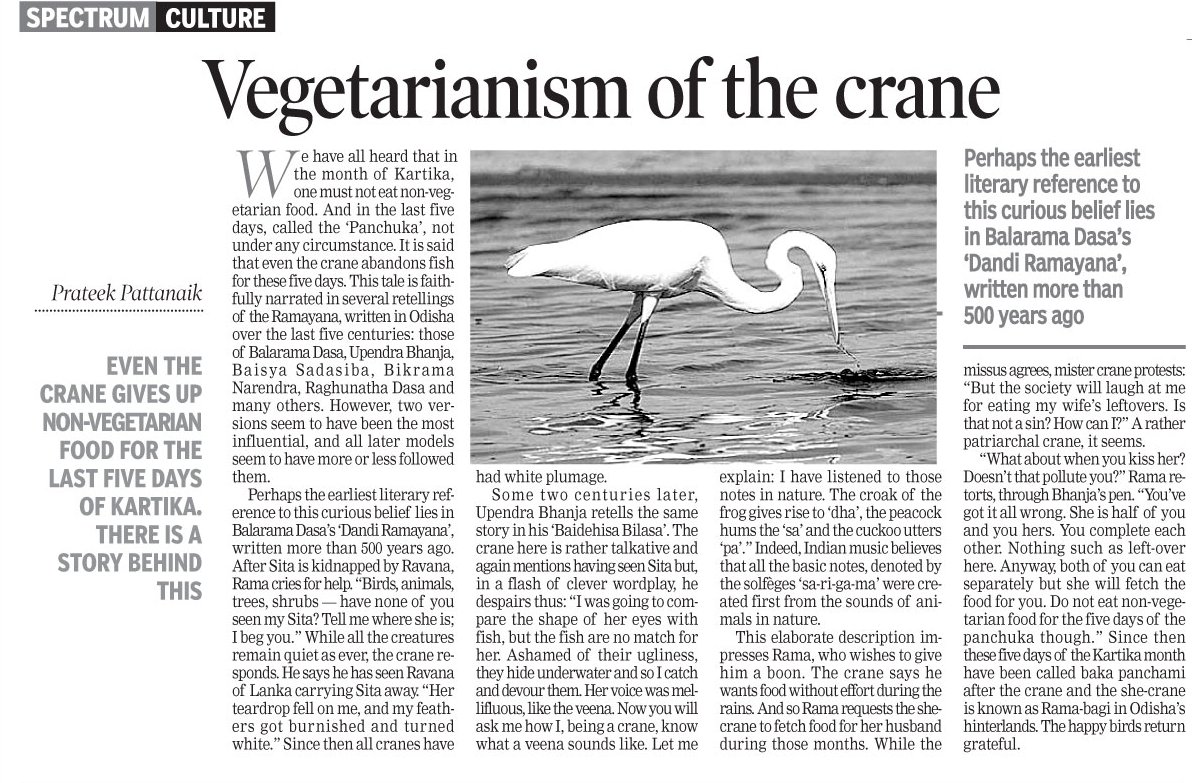
We have all heard that in the month of Kartika, one must not eat non-vegetarian food. And in the last five days, called the ‘Panchuka’, not under any circumstances. It is said that even the crane abandons fish for these five days. This tale is faithfully narrated in several retellings of the Ramayana, written in Odisha over the last five centuries : those of Balarama Dasa, Upendra Bhanja, Baisya Sadasiba, Bikrama Narendra, Raghunatha Dasa and many others. However, two versions seem to have been the most influential, and all later models seem to have more or less followed them.
Perhaps the earliest literary reference to this curious belief lies in Balarama Dasa’s Dandi Ramayana written more than 500 years ago. After Sita’s kidnap, Rama cries for help. “Birds, animals, trees, shrubs – have none of you seen my Sita? Tell me where she is; I beg you.” While all the creatures remain quiet as ever, the crane responds. He says he has seen Ravana of Lanka carrying Sita away. “Her teardrop fell on me, burnishing my feather and turning it white.” Since then all cranes have been fair.
Some two centuries later Upendra Bhanja retells the same story in his Baidehisa Bilasa. The crane here is rather talkative and again mentions having seen Sita but in a flash of clever wordplay he despairs thus “I was going to compare the shape of her eyes to a fish, but the fish is no match for her. Ashamed of its ugliness it hides underwater and so I catch & devour it. Her voice was mellifluous like the veena. Now you will ask me how I, being a crane, know what a veena sounds like. Let me explain : I have listened to those notes in nature. The croak of the frog gives rise to dha, the peacock hums the sa and the cuckoo utters pa.” Indeed, Indian music believes that all the basic notes, denoted by the solfèges sa-ri-ga-ma were created first from the sounds of animals in nature.
This elaborate description impresses Rama, who wishes to give him a boon. The crane says he wants food without effort during the rains. And so Rama requests the she-crane to fetch food for her husband during those months. While the missus agrees, mister crane protests “But the society will laugh at me for eating my wife’s leftovers. Is that not a sin? How can I?”
A rather patriarchal crane, it seems.
“What about when you kiss her? Doesn’t that pollute you?” Rama retorts, through Bhanja’s pen. “You’ve got it all wrong. She is half of you and you hers. You complete each other. Nothing such as left-over here. Anyway, both of you can eat separately but she will fetch the food for you. Do not eat non-vegetarian food for the five days of the panchuka though.”
Since then these five days of the kartika month have been called baka panchami after the crane and the she-crane is known as rama-bagi in Odisha’s hinterlands. The happy birds return grateful.
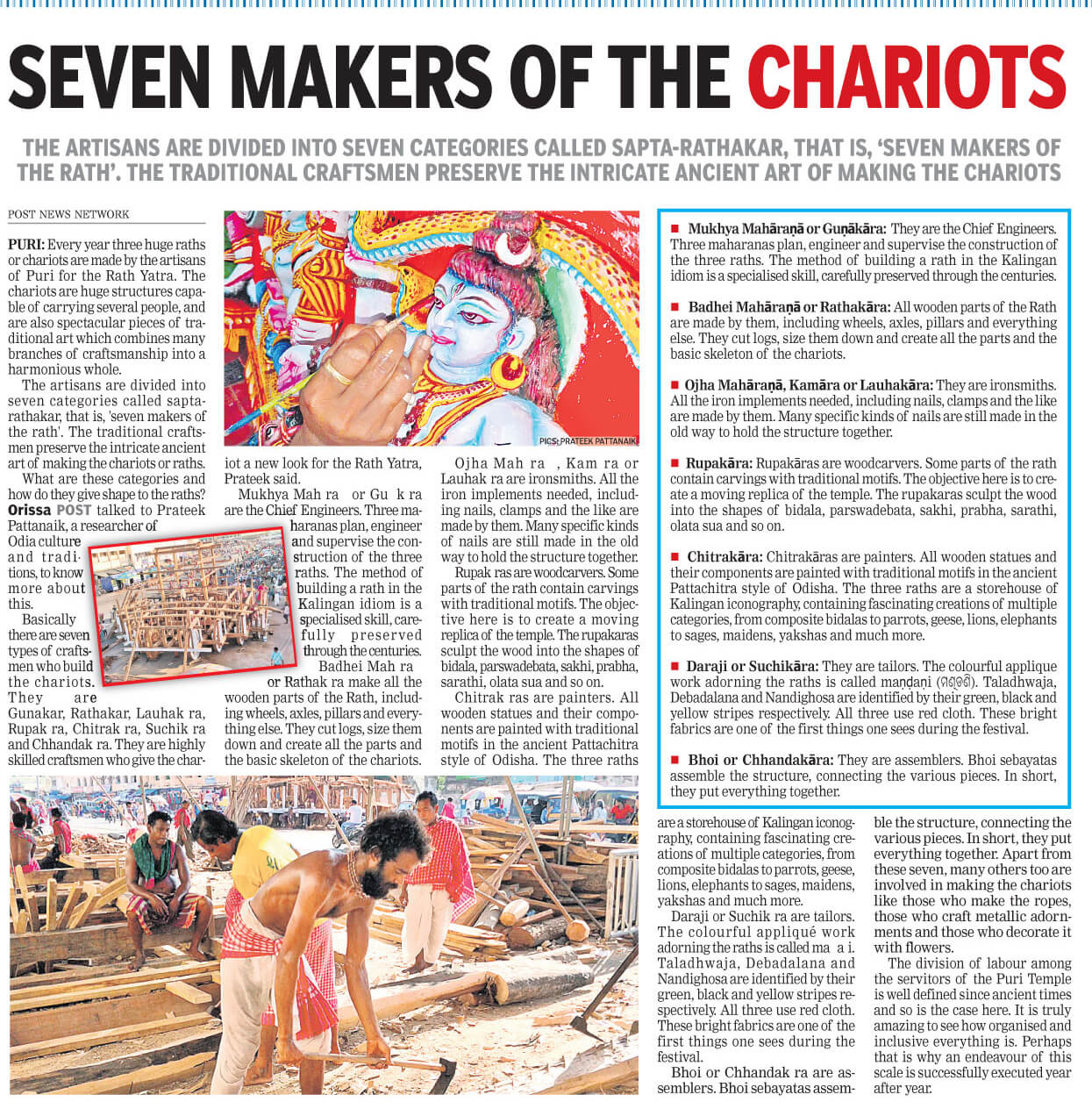
Every year for the Ratha Jatra, three huge rathas or chariots are made by artisans in Puri. While being huge structures that must be capable of supporting several people at once, the rathas are also spectacular pieces of traditional art, combining multiple branches of craftsmanship into a harmonious whole.
Traditionally the artisans are divided into seven categories called sapta-rathakāras, ‘seven makers of the ratha’. These traditional craftsmen hence preserve the intricate ancient art of making rathas. What are these categories and how do they work separately yet together to build the rathas?
1. Mukhya Mahāraṇā or Guṇākāra (ମୁଖ୍ୟ ମହାରଣା ବା ଗୁଣାକାର) : Chief engineers, so to say. Three maharanas plan, engineer and supervise the construction of the three rathas respectively. The method of building a ratha in the Kalingan idiom is a very specialised skill, carefully preserved for centuries.
2. Badhei Mahāraṇā or Rathakāra (ବଢ଼େଇ ମହାରଣା ବା ରଥକାର) : All the wooden parts of the Ratha are made by them, including the wheels, axles, pillars and everything else. They cut up logs, size them down and form all parts, creating the basic skeleton.
3. Ojha Mahāraṇā, Kamāra or Lauhakāra (ଓଝା ମହାରଣା, କମାର ବା ଲୌହକାର) : Ironsmiths. Iron implements needed, including nails, clamps and the like are all made by them. Several specific kinds of nails are still made in the old way to hold the structure together.
4. Rupakāra (ରୂପକାର) : Woodcarvers. Various parts of the ratha contain carvings of traditional motifs, the aim being to create a moving replica of the temple. The rupakaras sculpt the wood in the shape of bidala, parswadebata, sakhi, prabha, sarathi, olata sua and so on.
5. Chitrakāra (ଚିତ୍ରକାର) : Painters. All wooden statues and components are painted with traditional motifs in the ancient Pattachitra style of Odisha. The three rathas are a storehouse of Kalingan iconography, containing fascinating creatures of multiple categories, from composite bidalas to parrots, geese, lions, elephants to sages, maidens, yakshas and much more.
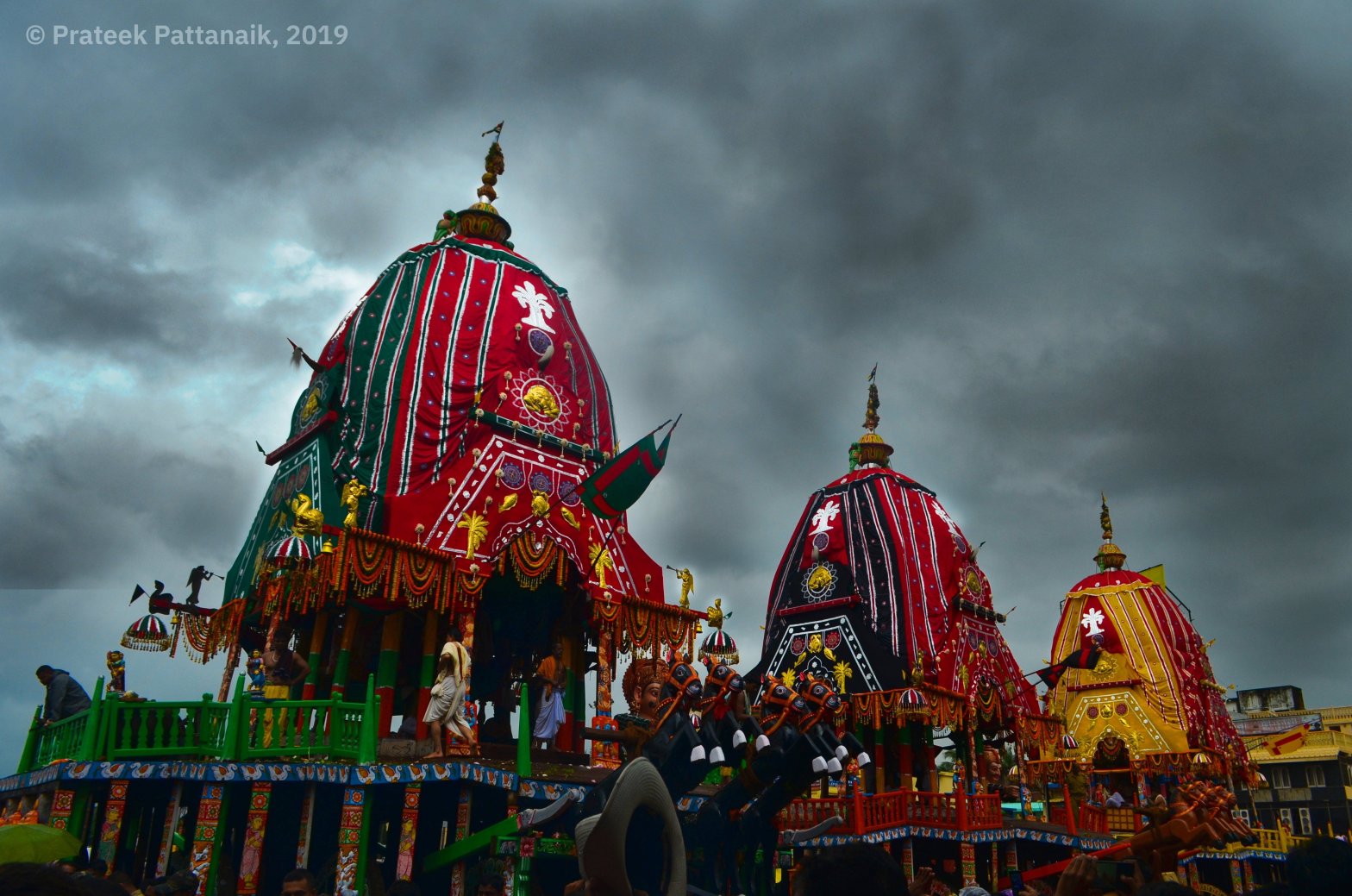
6. Daraji or Suchikāra (ଦରଜୀ ବା ସୂଚୀକାର) : Tailors. The colourful applique work adorning the rathas is known by the name maṇḍaṇi (ମଣ୍ଡଣି). Taladhwaja, Debadalana and Nandighosa are identified by their green, black and yellow stripes respectively. All three use the red cloth. These bright fabrics are one of the first things one sees during the festival.
7. Bhoi or Chhandakāra (ଭୋଇ ବା ଛନ୍ଦକାର) : Assemblers. The group of bhoi sebayatas assemble the structure, connecting pieces and putting it all together.
Besides these seven, many others are also engaged : including those who make the ropes, those who craft metallic adornments and those who decorate it with flowers. The division of labour among the servitors of the Puri temple is very well-defined since ancient times and so also is the case here. It is truly amazing to see how organised and inclusive the activity is— perhaps that is why an endeavour of this scale can be successfully accomplished, year after year.
The writer researches and documents vulnerable aspects of Odisha’s culture using technology. e-Mail: pattaprateek@gmail.com
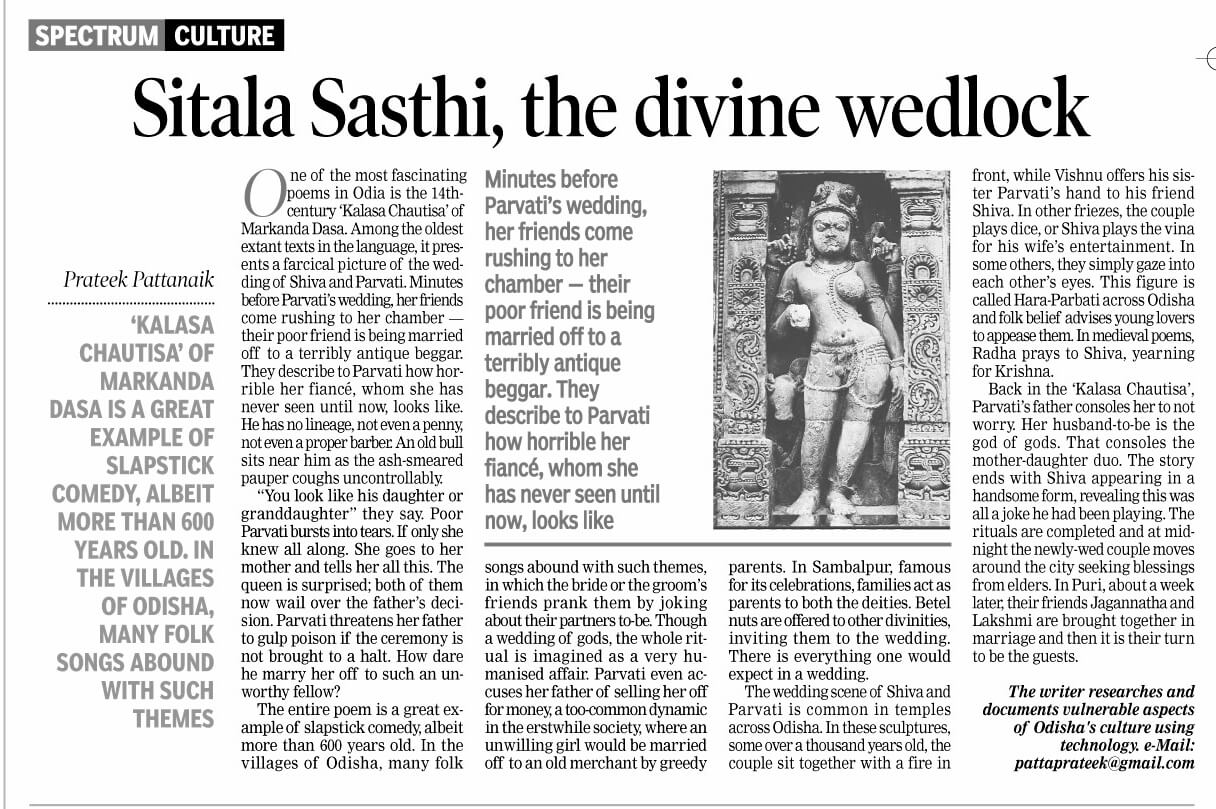
One of the most fascinating poems in Odia is the 14th-century ‘Kalasa Chautisa’ of Bachha Dasa. Among the oldest extant texts in the language, it presents a farcical picture of the wedding of Shiva and Parvati. Minutes before Parvati’s wedding, her friends come rushing to her chamber — their poor friend is being married off to a terribly antique beggar. They describe to Parvati how horrible her fiancé, whom she has never seen until now, looks like. He has no lineage, not even a penny, not even a proper barber. An old bull sits near him as the ash-smeared pauper coughs uncontrollably.
“You look like his daughter or granddaughter” they say. Poor Parvati bursts into tears. If only she knew all along. She goes to her mother and tells her all this. The queen is surprised; both of them now wail over the father’s decision. Parvati threatens her father to gulp poison if the ceremony is not brought to a halt. How dare he marry her off to such an unworthy fellow?
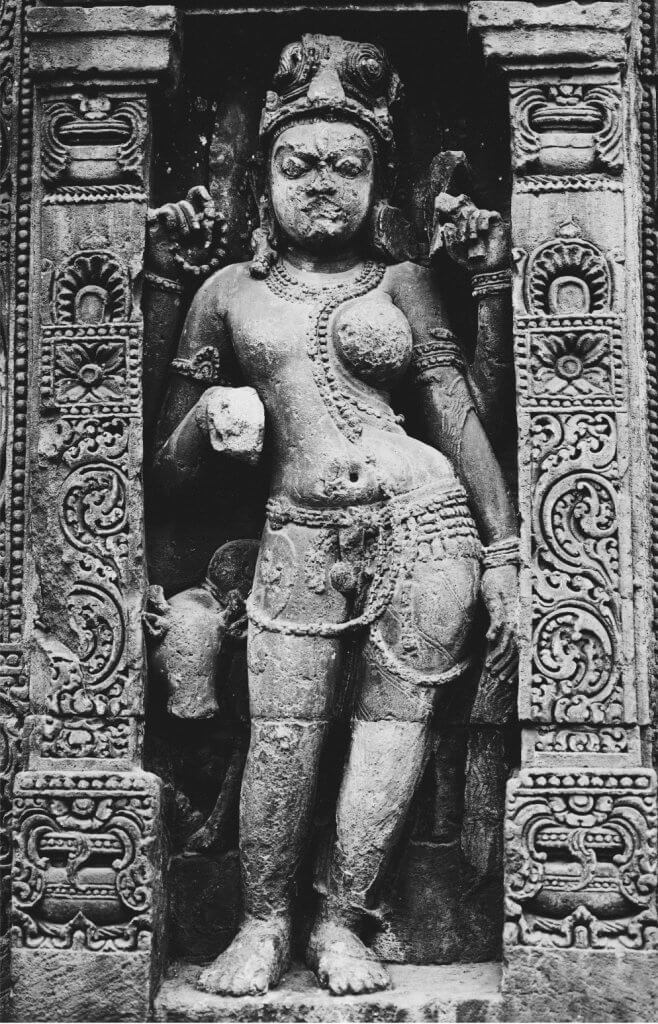
Ardhanariswara, 9th-century Baitala Deula
The entire poem is a great example of slapstick comedy, albeit more than 600 years old. In the villages of Odisha, many folk songs abound with such themes, in which the bride or the groom’s friends prank them by joking about their partners to-be. Though a wedding of gods, the whole ritual is imagined as a very humanised affair. Parvati even accuses her father of selling her off for money, a too-common dynamic in the erstwhile society, where an unwilling girl would be married off to an old merchant by greedy parents. In Sambalpur, famous for its celebrations, families act as parents to both the deities. Betel nuts are offered to other divinities, inviting them to the wedding. There is everything one would expect in a wedding.
Minutes before Parvati’s wedding, her friends come rushing to her chamber — their poor friend is being married off to a terribly antique beggar. They describe to Parvati how horrible her fiancé, whom she has never seen until now, looks like
The wedding scene of Shiva and Parvati is common in temples across Odisha. In these sculptures, some over a thousand years old, the couple sit together with a fire in front, while Vishnu offers his sister Parvati’s hand to his friend Shiva. In other friezes, the couple plays dice, or Shiva plays the vina for his wife’s entertainment. In some others, they simply gaze into each other’s eyes. This figure is called Hara-Parbati across Odisha and folk belief advises young lovers to appease them. In medieval poems, Radha prays to Shiva, yearning for Krishna.
Back in the ‘Kalasa Chautisa’, Parvati’s father consoles her to not worry. Her husband-to-be is the god of gods. That consoles the mother-daughter duo. The story ends with Shiva appearing in a handsome form, revealing this was all a joke he had been playing. The rituals are completed and at midnight the newly-wed couple moves around the city seeking blessings from elders. In Puri, about a week later, their friends Jagannatha and Lakshmi are brought together in marriage and then it is their turn to be the guests.
The writer researches and documents vulnerable aspects of Odisha’s culture using technology. e-Mail: pattaprateek@gmail.com
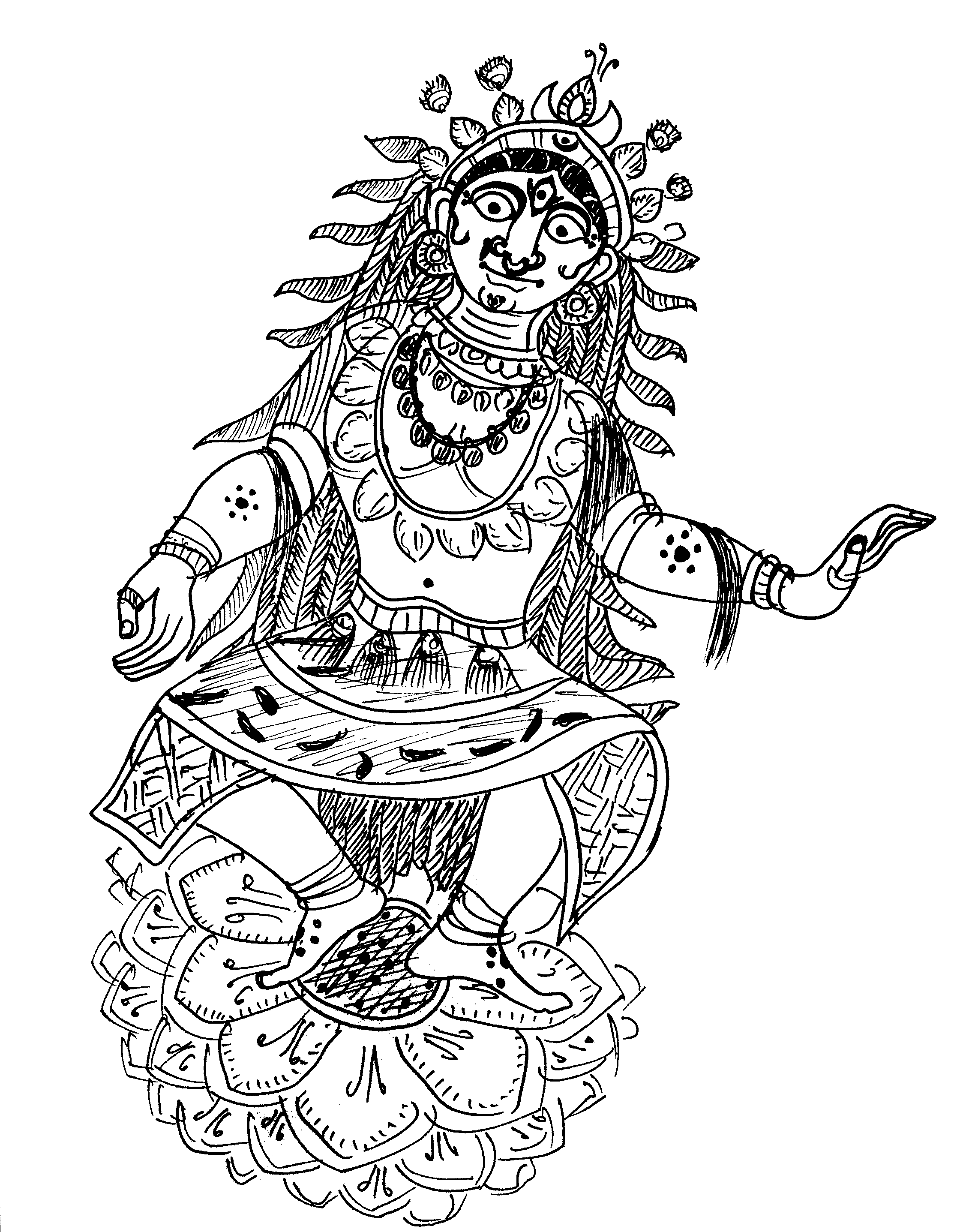
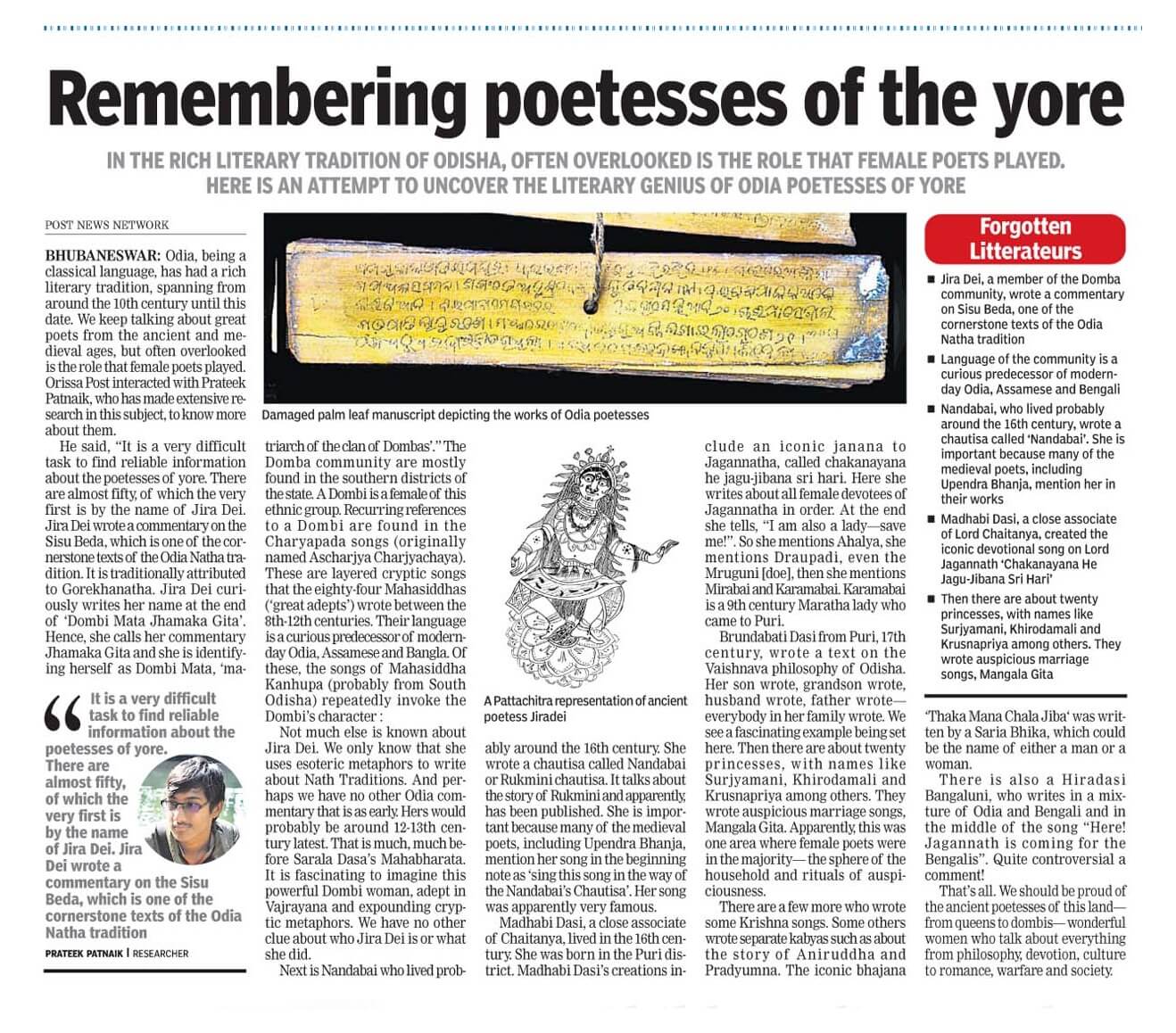
There are almost 50, of which the very first is by the name of Jira Dei. Jira Dei writes a commentary on the Sisu Beda, which is one of the cornerstone texts of the Odia Natha tradition. It is traditionally attributed to Gorekhanatha. Jira Dei curiously writes her name at the end ‘ବୋଲଇ ଜୀରାଦେଈ ୟେ ବିଷମ ସନ୍ଧ’ (which means— ‘this is a difficult nut to crack’) and ‘Dombi Mata Jhamaka Gita’. So she is calling her commentary Jhamaka Gita and she is identifying herself as Dombi Mata, ‘matriarch of the clan of Dombas’.
Jiradei, creative interpretation based on literature. Illustrated in the Jayapur style of Pattachitra by author.
The Domba community are mostly found in the southern districts of the state. A Dombi is a female of this ethnic group. Recurring references to a Dombi are found in the Charyapada songs (originally named Ascharjya Charjyachaya). These are layered cryptic songs that the eighty-four Mahasiddhas (‘great adepts’) wrote between the 8th-12th centuries. Their language is a curious predecessor of modern-day Odia, Assamese and Bangla. Of these, the songs of Mahasiddha Kanhupa (probably from South Odisha) repeatedly invoke the Dombi’s character :
You are a Dombi, and I am a Kapali— for your sake have I put on this garland of bones.
About Jira Dei nothing else we know. We only know that she uses esoteric metaphors to write about Nath Traditions— that’s all we know. And perhaps we have no other Odia commentary that is as early. Hers would probably be around 12-13th century latest. That is much, much before Sarala Dasa’s Mahabharata. It is fascinating to imagine this powerful Dombi woman, adept in Vajrayana and expounding cryptic metaphors. We have no other clue about who Jira Dei is or what she did.
Next is Nandabai who lived probably around the 16th century. She wrote a chautisa called Nandabai or Rukmini chautisa. It talks about the story of Rukmini and apparently, has been published. She is important because many of the medieval poets, including Upendra Bhanja, mention her song in the beginning note as ‘sing this song in the way of the Nandabai’s Chautisa’. Her song was apparently very famous.
Then comes Madhabi Dasi, a close associate of Chaitanya, 16th century, born around Puri. Madhabi Dasi’s only creation [update: I found more] is a single janana to Jagannatha, called chakanayana he jagu-jibana sri hari. Interestingly she writes about all female devotees of Jagannatha in order. At the end she tells, “I am also a lady—save me!”. So she mentions Ahalya, she mentions Draupadi, even the Mruguni [doe], then she mentions Mirabai and Karamabai. Karamabai is a 9th century Maratha lady who came to Puri.
Brundabati Dasi from Puri, 17th century, wrote a text on the Vaishnava philosophy of Odisha. Her son wrote, grandson wrote, husband wrote, father wrote— everybody in her family wrote. We see a fascinating example being set here.
Then there are about two dozen princesses Surjyamani, Khirodamali, Krusnapriya, et cetera. They wrote auspicious marriage songs, Mangala Gita. Apparently, this was one area where female poets were in the majority— the sphere of the household and rituals of auspiciousness.
There are a few more of them who wrote some Krishna songs. Some others wrote separate kabyas such as about the story of Aniruddha and Pradyumna. The iconic bhajana ‘Thaka Mana Chala Jiba‘ was written by a Saria Bhika, which could be the name of either a man or a woman.
There is also a Hiradasi Bangaluni, who writes in a mixture of Odia and Bengali and in the middle of the song “Here! Jagannath is coming for the Bengalis”. Quite controversial a comment!
That’s all. We should be proud of the ancient poetesses of this land— from queens to dombis— wonderful women who talk about everything from philosophy, devotion, culture to romance, warfare, society.
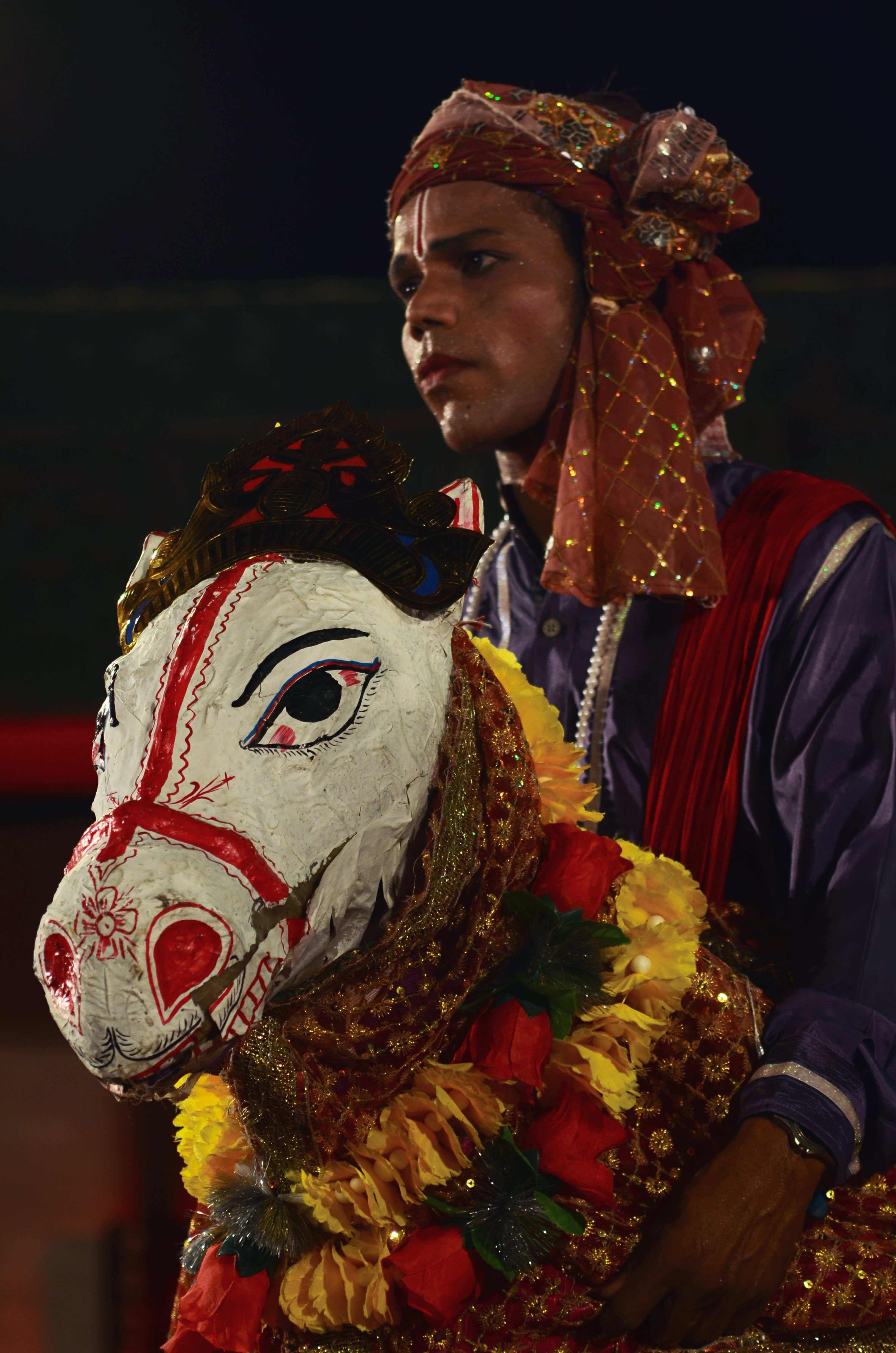
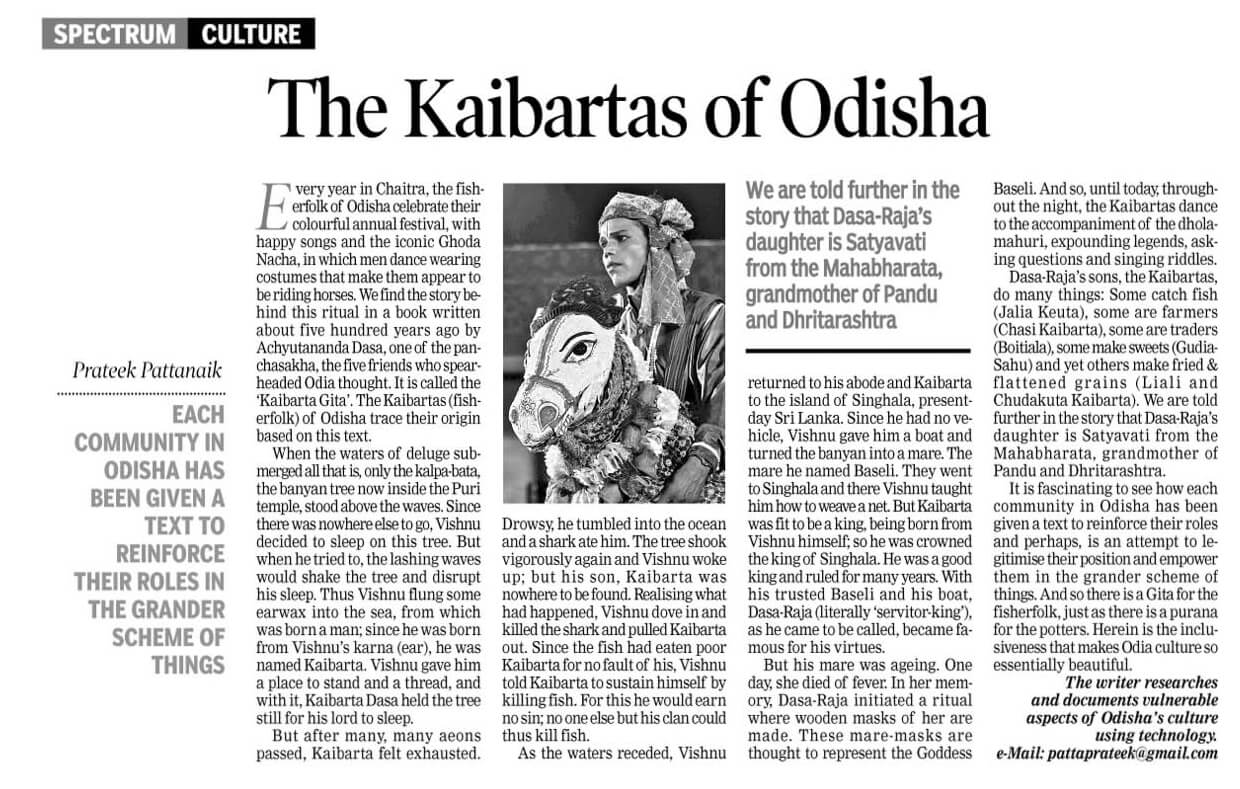
Every year in the month of Chaitra, the fisherfolk of Odisha celebrate their colourful annual festival, with happy songs and the iconic Ghoda Nacha, in which men dance wearing costumes that make them appear to be riding horses. We find the story behind this ritual in a book written about five hundred years ago by Achyutananda Dasa, one of the panchasakha, the five friends who spearheaded Odia thought. It is called the ‘Kaibarta Gita’. The Kaibartas (fisherfolk) of Odisha trace their origin based on this text.
Ghoda Nacha
When the waters of deluge submerged all that is, only the kalpa-bata, the banyan tree now inside the Puri temple, stood above the waves. Since there was nowhere else to go, Vishnu decided to sleep on this tree. But when he tried to, the lashing waves would shake the tree and disrupt his sleep. Thus Vishnu flung some earwax into the sea, from which was born a man; since he was born from Vishnu’s karna (ear), he was named Kaibarta. Vishnu gave him a place to stand and a thread, and with it, Kaibarta Dasa held the tree still for his lord to sleep.
We are told further in the story that Dasa-Raja’s daughter is Satyavati from the Mahabharata, grandmother of Pandu and Dhritarashtra
But after many, many aeons passed, Kaibarta felt exhausted. Drowsy, he tumbled into the ocean and a shark ate him. The tree shook vigorously again and Vishnu woke up; but his son, Kaibarta was nowhere to be found. Realising what had happened, Vishnu dove in and killed the shark and pulled Kaibarta out. Since the fish had eaten poor Kaibarta for no fault of his, Vishnu told Kaibarta to sustain himself by killing fish. For this he would earn no sin; no one else but his clan could thus kill fish.
As the waters receded, Vishnu returned to his abode and Kaibarta to the island of Singhala, present-day Sri Lanka. Since he had no vehicle, Vishnu gave him a boat and turned the banyan into a mare. The mare he named Baseli. They went to Singhala and there Vishnu taught him how to weave a net. But Kaibarta was fit to be a king, being born from Vishnu himself; so he was crowned the king of Singhala. He was a good king and ruled for many years. With his trusted Baseli and his boat, Dāsa-Rājā (literally ‘servitor-king’), as he came to be called, became famous for his virtues.
But his mare was ageing. One day, she died of fever. In her memory, Dasa-Raja initiated a ritual where wooden masks of her are made. These mare-masks are thought to represent the Goddess Baseli. And so, until today, throughout the night, the Kaibartas dance to the accompaniment of the dhola-mahuri, expounding legends, asking questions and singing riddles.
Dasa-Raja’s sons, the Kaibartas, do many things: Some catch fish (Jalia Keuta), some are farmers (Chasi Kaibarta), some are traders (Boitiala), some make sweets (Gudia-Sahu) and yet others make fried & flattened grains (Liali and Chudakuta Kaibarta). We are told further in the story that Dasa-Raja’s daughter is Satyavati from the Mahabharata, grandmother of Pandu and Dhritarashtra.
It is fascinating to see how each community in Odisha has been given a text to reinforce their roles and perhaps, is an attempt to legitimise their position and empower them in the grander scheme of things. And so there is a Gita for the fisherfolk, just as there is a purana for the potters. Herein is the inclusiveness that makes Odia culture so essentially beautiful.
The writer researches and documents vulnerable aspects of Odisha’s culture using technology. e-Mail: pattaprateek@gmail.com
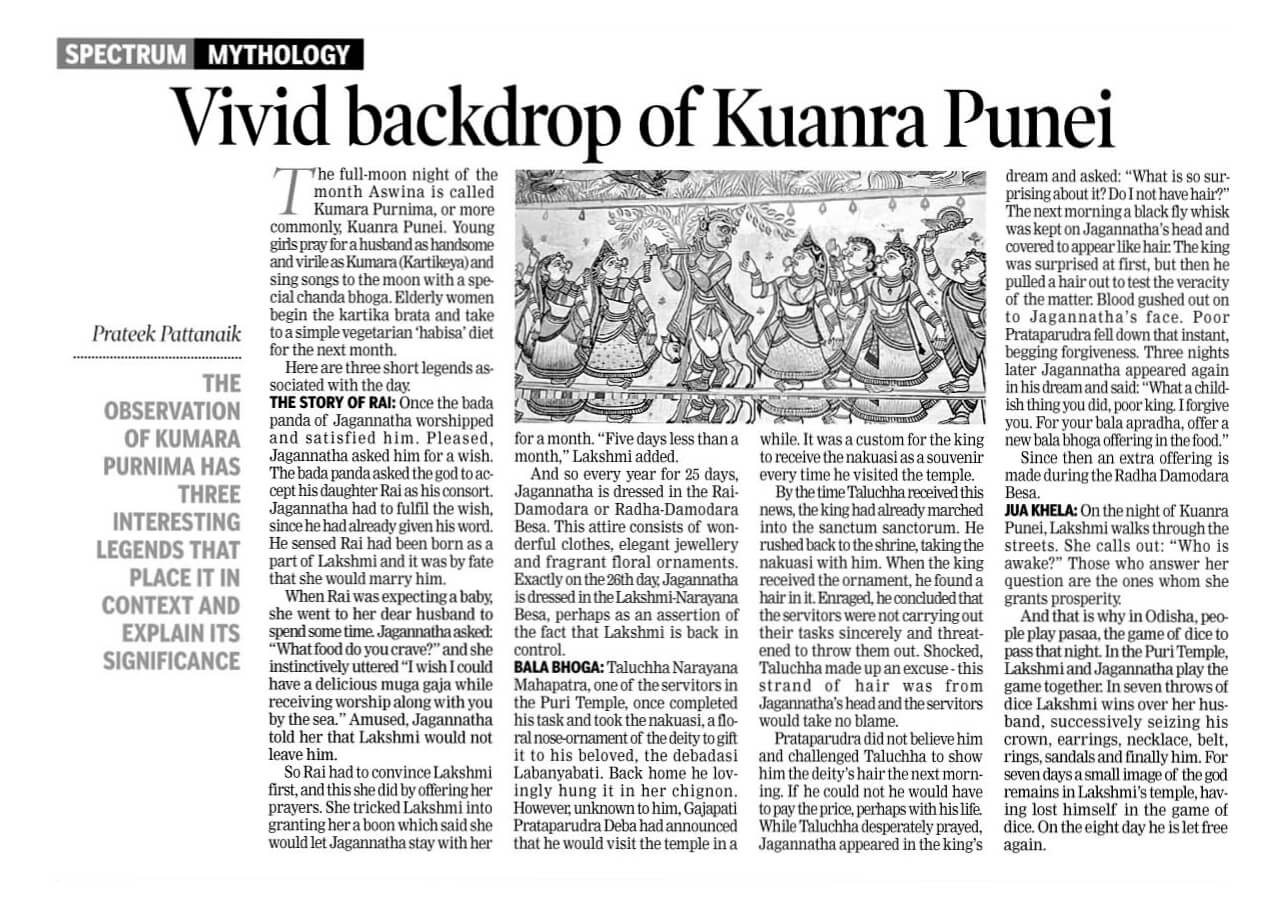
The full-moon day of the month of Aswina is called Kumara Purnima, or more commonly, Kuanra Punei. Young girls pray for a husband as handsome and virile as Kumara (Kartikeya) and sing songs to the moon with a special chanda bhoga. Elderly women begin the kartika brata and take to a simple vegetarian ‘habisa’ diet for the next month.
Here are three short legends on the day.
Kartikeya from 13th-century Buddhanatha temple, Garedipanchana.
1. The story of Rai
Once the bada panda of Jagannatha worshipped and satisfied him. Pleased, Jagannatha asked him for a wish. The bada panda asked the god to accept his daughter Rai as his consort. Jagannatha had to fulfil the wish, since he had already given his word. He sensed Rai had been born as a part of Lakshmi and it was by fate that she would marry him.
When Rai was expecting a baby, she went to her dear husband to spend some time. Jagannatha asked “What food do you crave?” and she instinctively uttered “I wish I could have a delicious muga gaja while receiving worship along with you by the sea.” Amused, Jagannatha told her that Lakshmi wouldn’t leave him.
So Rai had to convince Lakshmi first, and this she did by offering her prayers. She tricked Lakshmi into granting her a boon which said she would let Jagannatha stay with her for a month. “Five days less than a month”, Lakshmi added.
And so every year for 25 days, Jagannatha is dressed in the Rai-Damodara or Radha-Damodara Besa. This attire consists of wonderful clothes, elegant jewellery and fragrant floral ornaments. Exactly on the 26th day, Jagannatha is dressed in the Lakshmi-Narayana Besa, perhaps as an assertion of the fact that Lakshmi is back in control.
2. Bala Bhoga
Taluchha Narayana Mahapatra, one of the servitors in the Puri Temple once completed his task and took the nakuasi, a floral nose-ornament of the deity to gift it to his beloved, the debadasi Labanyabati. Back home he lovingly hung it in her chignon. However, unknown to him, Gajapati Prataparudra Deba had announced that he would visit the temple in a while. It was a custom for the king to receive the nakuasi as a souvenir every time he visited the temple.
By the time Taluchha received this news, the king had already marched into the sanctum sanctorum. He rushed back to the shrine, taking the nakuasi with him. When the king received the ornament, he found a hair in it. Enraged, he concluded that the servitors weren’t carrying out their tasks sincerely and threatened to throw them out. Shocked, Taluchha made up an excuse – this strand of hair was from Jagannatha’s head and the servitors would take no blame.
Prataparudra did not believe him and challenged Taluchha to show him the deity’s hair the next morning. If he could not he would have to pay the price, perhaps with his life. While Taluchha desperately prayed, Jagannatha appeared in the king’s dream “What is so surprising about it? Do I not have hair?”. The next morning a black fly whisk was kept on Jagannatha’s head and covered to appear like hair. The king was surprised at first, but then he pulled a hair out to test the veracity of the matter. Blood gushed out onto Jagannatha’s face. Poor Prataparudra fell down that instant, begging forgiveness. Three nights later Jagannatha told in his dream “What a childish thing you did, poor king! I forgive you. For your bala apradha, offer a new bala bhoga offering in the food.”
Since then an extra offering is made during the Radha Damodara Besa.
3. Jua Khela
On the night of Kuanra Punei, Lakshmi walks through the streets. She calls out “Who is awake?”. Those who answer her question are the ones whom she grants prosperity.
And that is why in Odisha, people play pasaa, the game of dice to pass that night. In the Puri Temple, Lakshmi and Jagannatha play the game together. In seven throws of dice Lakshmi wins over her husband, successively seizing his crown, earrings, necklace, belt, rings, sandals and finally him. For seven days a small image of the god remains in Lakshmi’s temple, having lost himself in the game of dice. On the eight day he is left free again.
In Hindu folklore, Krishna is born in the dark fortnight of Bhadraba on the day of Janmastami. Most Vishnu temples across the country celebrate the occasion with much pomp. Most people also identify Jagannatha with Krishna. But in the Puri Temple, a curious ritual takes place the previous night, something that might be rather shocking to a few.
Jagannatha suffers from labour pain on the night before Janmastami. Not only that, he is offered an extra alati, called the Garbhodaka Bandapana. Odia folk songs of the S(u)adakhia category often describe the cravings of a pregnant lady. In line with them, Jagannatha is also given a special medicinal preparation called the Jeuda Bhoga (ଜେଉଡ଼ ଭୋଗ). Jeuda is a rather unknown concoction whose primary purpose is to alleviate labour pain. It is named after a fruit called Jeuta, which forms the major ingredient. Somewhat like the mangosteen, it is this fruit that lends the concoction its strange sweet-sour-bitter taste. And this is what Jagannatha craves at the time, because the next night he shall give birth to Krishna.
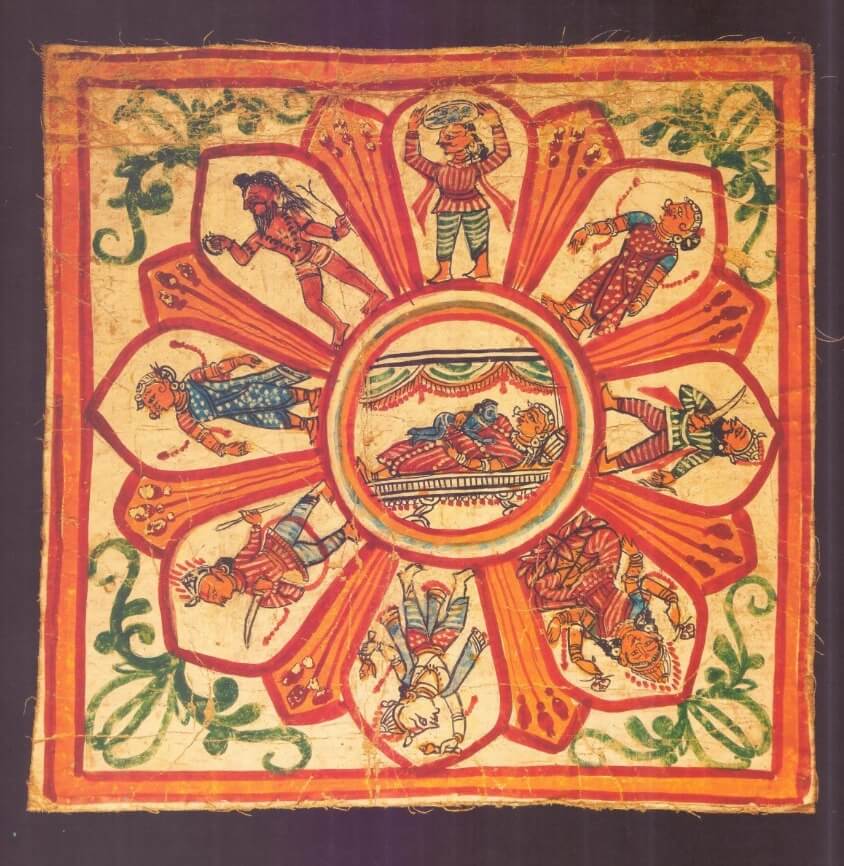
Krishna Janma Pati of the Puri temple.
The next night, Krishna is born; and now all of a sudden, the mother is the son. Jagannatha’s portable representative deity, Madanamohana is placed in the centre of the Krishna Janma Pati, a special Pattachitra painting in the shape of a lotus with eight characters in its eight petals. Soon after, he is ritually born. His umbilical cord is cut and countless rituals follow as they have for centuries. On the day after Janmastami, Madanamohana is placed on a swing with Rama and Krishna, two other metallic images. In the central position, now Madanamohana plays the mother’s role. In the next week, Jagannatha is dressed as Krishna for four consecutive days. I can hear you say; it is all very confusing! And so indeed, the people of Puri have a saying that goes “Mother today; son tomorrow; mother the next day. Who can decode the mystery of our dark lord?”
These mystic rituals are interpreted in various ways. We can only try.
First of all, Jagannatha defies gender logic during rituals such as these. How can a masculine god be in labour? Subtle traditions cleverly remind us that divinity is not restricted by gender notions and here we get a clear indication of how gender fluidity has been not just been accepted, but rejoiced in Odia thought since time immemorial. And that is also why he(or she?) proudly wears a saree and a nose-ring; like Krishna, unafraid of any possibility.
Secondly, the Jeuda ritual resonates with the idea of god creating himself, the cyclical notion of infinity. Like it is said, infinity is born out of infinity and goes back into it; so does Jagannatha give birth to himself. She is the mother, he is the son and both are identical. It is obvious that each codified ritual also has a firm base in deep philosophy.
And while ancient intricately weaved complexities baffle us, forcing us to ponder; Jagannatha smiles. Perhaps that is what they are meant to do; make us think, introspect and grow.
St.Peter’s Basilica, one of the most iconic monuments of the Christian world had to be cleaned from the multiple layers of grime that had gathered on its facade. However, found beneath the layers were pigments of various colors from the 1600s, when the colours were actually designed by the Baroque master Maderno. Took by surprise, further inspections were carried out to find whether the structure had initially been coloured and if so, what the original hues were. Research revealed that it had been so indeed, and detailed analytical studies helped reconstruct the exact shades. Soon, the facade had been repainted with the same shades in a meticulous attempt to reproduce or rather restore the original beauty of the structure. There it lay in its 300-year old form. This was in 1999.
Compare that to one of the most significant structures of the Hindus, the Jagannatha Temple of Puri. More importantly, this was the grandest shrine of Kalingan architecture and the greatest storehouse of Odia culture. A much older monument, it was constructed in the 13th-century by the legendary Chodaganga Deba of the Ganga dynasty. Over the next 800 years the temple was coated with numerous thick layers of lime plaster by the latter kings to protect it from the harsh salty sea breeze. The kings, irrespective of their personal religious beliefs used to look after the maintenance of the temple’s structural integrity from time to time. All this is written in the temple’s ancient book of chronicles, the Madala Panji.
Since the 1960s, incidents of stones falling off from various parts of the temple had increased. There was a looming risk of death if these pieces landed on a visitor or a servitor. In 1975, the prestigious Archaeological Survey of India took over the temple’s conservation. The ancient temple was announced a Centrally Protected Monument (CPM) in February. Amid numerous debates and cases, the ASI decided to remove the lime plaster. From 1975 to 1996, the enormously thick plaster was removed from the temple. Chemical treatment was used to treat the structure. Beneath the plaster was found splendidly carved stonework, a trademark of ancient Odia temples. However, something was amiss.
The White Pagoda, Bonnie G. MacDougall, sometime between 1940-70
This thick layer of lime plaster that covered the temple was not just a plain coat. The kings that had painstakingly taken care of the great temple weren’t ones who would leave it that way; they embedded numerous stucco figures of various deities embedded in it. So beautiful was the white tower that sailors called it the ‘white pagoda’, contrasted with the ‘black pagoda’ Konark. When the plaster was removed, these centuries-old figures were also removed; where they went nobody knows. Surely these were relics worthy of storing in a museum? I can’t seem to find them in any museum. The Niladri Vihar museum built inside the temple complex is itself in shambles. The last time I went there, the area had been razed with no sign of anything. More than two decades have passed. If not in the temple museum, where did it all go? Acquaintances and researchers tell me that they were ‘stolen’. Is it? Is it not? Why do we have no answer?
Aesthetics much?
There have been a lot of apprehensions about the ASI’s role. Was it right to doubt ancient methods of preservation? Was it not? Even today, some people still are of the opinion that the deplastering led to the temple’s weakening.
I am not going to talk about that, nor am I bothered with it. I ask these questions purely as an Odia, as a culturally aware individual who finds these answers have turned out to be elusive for no reason. To put it very mildly, this disconcerts me. The numerous ‘bibhrata’s that I have not seen I shall not speak about; but all of the following I have seen first-hand. The hundreds of unknown Odia temples that I have seen crumbling this is not; this is the temple of Jagannatha, literally the definition of what being Odia means. Is the ‘conservation’ carried out really befitting to a temple that means so, so much? Are we doing our best?
Here’s one very specific example for you to analyse yourself. The chitrakara seba or the painter service is laid out in the Madala Panji as one among the dozens of other servitors. Of the many duties of the chitrakara is to paint the Narendra Sarobara, the boathouse of the deities during the Chandana Jatra, their summertime boatrides. Each year the chitrakarawould wash it over with white plaster and paint it with natural colours, depicting amazing scenes of divine battles and fabulous episodes. This has been photographed way back in 1978 and the pictures make it look like a wonderhouse of traditional art. Now when I go to the same Narendra, I see a very different picture; it has all been painted in a bland baby pink hue. Same with the Bagha Duara, where all the old murals have faded out, never to be repainted again. In the Bada Odia matha and Gangamata matha of Puri, walls full of intricate murals are on the verge of extinction. While Pattachitra workshops are organised every other day in the state capital to sensitise the youth and while city walls along the roads are painted in the Pattachitra style to display our culture, I find it all rather hollow considering the art isn’t being given so much as a chance in the very place where it first emerged.
Another example is of the ceremonial beshas or attires of Madanamohana, Jagannatha’s representative image during the Chandana Jatra. Curious artistic attachments are made in the traditional solapitha craft of Odisha and used to adorn the idols. This year I saw that the artist had used cheap plastic flowers from the market in the work. To me it seemed like an insult to the rest of the thing.
It doesn’t end there. Recently, the repair work of the jagamohana of the Puri temple was completed. When I went to the place after that, I saw a false ceiling made of wooden tiles. These were mass-produced tiles of polished shiny wood with a generic carving on each of them. In that dark chamber designed specifically to draw attention to nothing but the sanctum sanctorum, these gaudy tiles were the worst detractors. Moreover, somebody had donated a new gem-studded golden crown to Mahalakshmi, the presiding goddess. The problem was that this crown was made in the north Indian style and hence wouldn’t fit in the Odia way in which the entire thing had been made. I find it sad that nobody around who had any power would speak about it; had they no aesthetic sense? Couldn’t they follow the ways of Odia jewellery, of which ample examples existed around them?
Some would presume I am being too puritanical. Bear with me for some more lines. The ancient cultural institution that the Puri temple is, it has been a storehouse designed to retain elements of Odia culture that fit in harmoniously like a grand jigsaw puzzle. The point I have to make is that this is like a round peg in a square hole; it simply doesn’t belong there. Naturally, such things throw the delicate, cohesive balance into disarray.
The starkest example I could give you is of the Singhadwara, the main entry gate of the Jagannatha temple. Millions of people enter into the temple through this gate each day. Guarded by two stone lions and the doorkeepers of Vishnu, Jaya and Bijaya, this gate has existed for a much longer time than most of the other parts of the complex. Here’s a photo of the gate from 1868 and beside it, a photo from an year ago :
Singhadwara : 1868 vs 2017 Left : William Henry Cornish, 1868 Right : Prachites Subham Das, 2017
Can you see any changes? The strip of idols showing the ten abataras of Vishnu have been removed. This had been done back in 2012-13 because the panel had become weak. Also, the sakhi idols on top are no longer to be found. Perhaps they had become weak too. On even closer inspection, one shall find another set of idols behind the present idols of the doorkeepers Jaya and Bijaya. These are the original half-relief black-stone sculptures, part of the gate from the beginning. We see them in British era paintings and woodcuts and photographs from 1844 to 1869. Where have these gone? Again, we have no answer. It has been five years, but the priceless idols aren’t to be found in any museum.
Who is to monitor all of this? Does conservation mean keeping things the way they are or mercilessly inflicting unnecessary change? Why don’t do away with then in that case? Why introduce these out-of-place dilutions? Does a single person in the huge institution not possess the aesthetic sense required to understand the irony?
At the end, it is just easier to blame it all on the kali yuga and sleep. It seems like everyone is doing the same. The king and the artists who made this harmonious balance of food, music, art, craft, sculpture, performance, literature and ritual would surely have thought about all these miniscule details. If only one could expect a slice of that conscience in the modern world.
Perhaps all of us being aware of this can bring a change. Let’s see.
Jagannatha might be the ideal deity for millions of his devotees around the globe, but his one wife is not too impressed. Just within a fortnight of their wedding, he bathes too much and falls ill for 15 days. Immediately after, he goes out on a vacation with his siblings, not bothering to even ask her if she would like to come along. How insensitive! As one would expect, Lakshmi is not too happy.
Nandighosa, Jagannatha’s Ratha.
Sad, she goes to her friend Bimala. In Balarama Dasa’s Jagamohana Chhanda, Lakshmi is depicted as doleful and crying. Newly-married Lakshmi being very simple bursts out into tears. Bimala, on the other hand, is a clever goddess; she tells Lakshmi that she has all the power and Jagannath is in fact, afraid of her. Convincing her so, Bimala herself goes and spies on Jagannath. He spots her and before she can reply, apologises and admits his fault. Craftily he also convinces her not to speak too much about all this. He asks Bimala how Lakshmi is feeling back at home and Bimala presents a sad picture- “To distract herself she is learning how to play the veena from Saraswati. Even then she strikes all the wrong notes out of grief. She’ll be coming here any moment. Go and placate her before sorrow turns to anger.”
On the day of Hera Panchami, all of this gets out of hand. Lakshmi marches to the Gundicha Temple secretly and breaks Jagannath’s chariot in her fury. She scurries back through hidden ways again. Even then he won’t budge.
About a week later he finally returns. On the day of Niladri Bije, the triad returns to the sanctum sanctorum from the Rathas. Balabhadra enters, Subhadra enters but when it is Jagannath’s turn, the door is shut. This is how Lakshmi decides to repay the unjust treatment doled out to her. And here starts the divine squabble between Lakshmi and Jagannath; wife and husband. This is known as the Lakshmi Narayana Bachanika or the Lakshmi Narayana Kali, ‘Kali’ in Odia referring to a verbal fight.
This is not the only kali that exists in Odia culture. There are the kela-keluni kali (snakecharmer and his wife) and sabara-sabaruni kali (tribal couple) in the ancient Danda Nacha of Odisha. Even Parbati has a squabble with Lingaraja after the Rukuna Ratha Jatra, perhaps an emulation of the Puri model. This is the Hara-Parbati Kali. Our folk stories even have a Lakshmi-Parbati Kali song where both goddesses slyly tease the other’s consort and their eccentricities. In the Puri temple tradition, Lakshmi also keeps nagging poor Saraswati. This is a peculiar humanisation of divinity and everyone derives a lot of enjoyment from the unlikely scenario.
The Lakshmi Narayan Kali itself has various retellings. Balarama Dasa, Jagannath Dasa, Gauracharana Dasa, Pindika Srichandana, Bipra Maheswara and many other poets have written their own versions of this squabble. That just goes on to explain how popular the storyline used to be. It still is.
In Gauracharana Dasa’s version, Jagannath decides to keep his cool and stay quiet when Lakshmi scolds him in anger. Lakshmi does not hold back; she scolds him for being with the gopis and takes a dig at Subhadra, who she calls ‘her majesty, a milkman’s daughter.’ Jagannath laughs all the while, chuckling at her complaints but when she scolds the gopis a bit too much, he points out her excessive pride and how her father, the Mahodadhi sea keeps ‘roaring’ all the time.
Atibadi Jagannath Dasa was the creator of the magnum opus Bhagabata in Odia. He lived in the 15th century. In his retelling, Lakshmi calls out Balabhadra for being too laconic and afraid to confront the reality. That is why, in her opinion, he gets away first in his Ratha, unconcerned that his young brother is ignoring his wife. When he returns, Lakshmi conspires with Indra, telling him to ‘throw hailstones on earth’. Poor Jagannath is all exhausted and wet. He almost catches a cold and his lips shiver. Lakshmi tells him ‘be there like you left me!’ and leaves the scene. Jagannath meanwhile bribes the servitors and enters inside.
He finds Lakshmi sitting in a corner, angry and unwilling to talk. Here comes the placating: he shows her the kalameghi saree he has brought for her from the market; the various types of ornaments kanaka dudura, banka daunria, padakamala and suabasa nakachana. But she is not amazed by the shimmer. They enter into another argument until Balabhadra interferes.
Balabhadra shouts “What are you doing Jagannath? You speak so many harsh things to Lakshmi. What do you think you do? She cooks all the food while I bring all the things to run the house. All you do is dress yourself with those silks while sitting like a king. Stop this matter right now or I’ll have to take action.”
Afraid, both of them now become quiet. Jagannath himself adorns Lakshmi with all the ornaments and asks her to forgive his faults. Lakshmi also joins her palms in a gesture of humility.
Quite notably, Jagannath offers her a sweet rasagola to pacify her further. Mentioned in 15th-century Odia texts like the Dandi Ramayana, the Rasagola has its origin in this ancient ritual of the Jagannath Temple of Puri. Sweet tale, isn’t it?
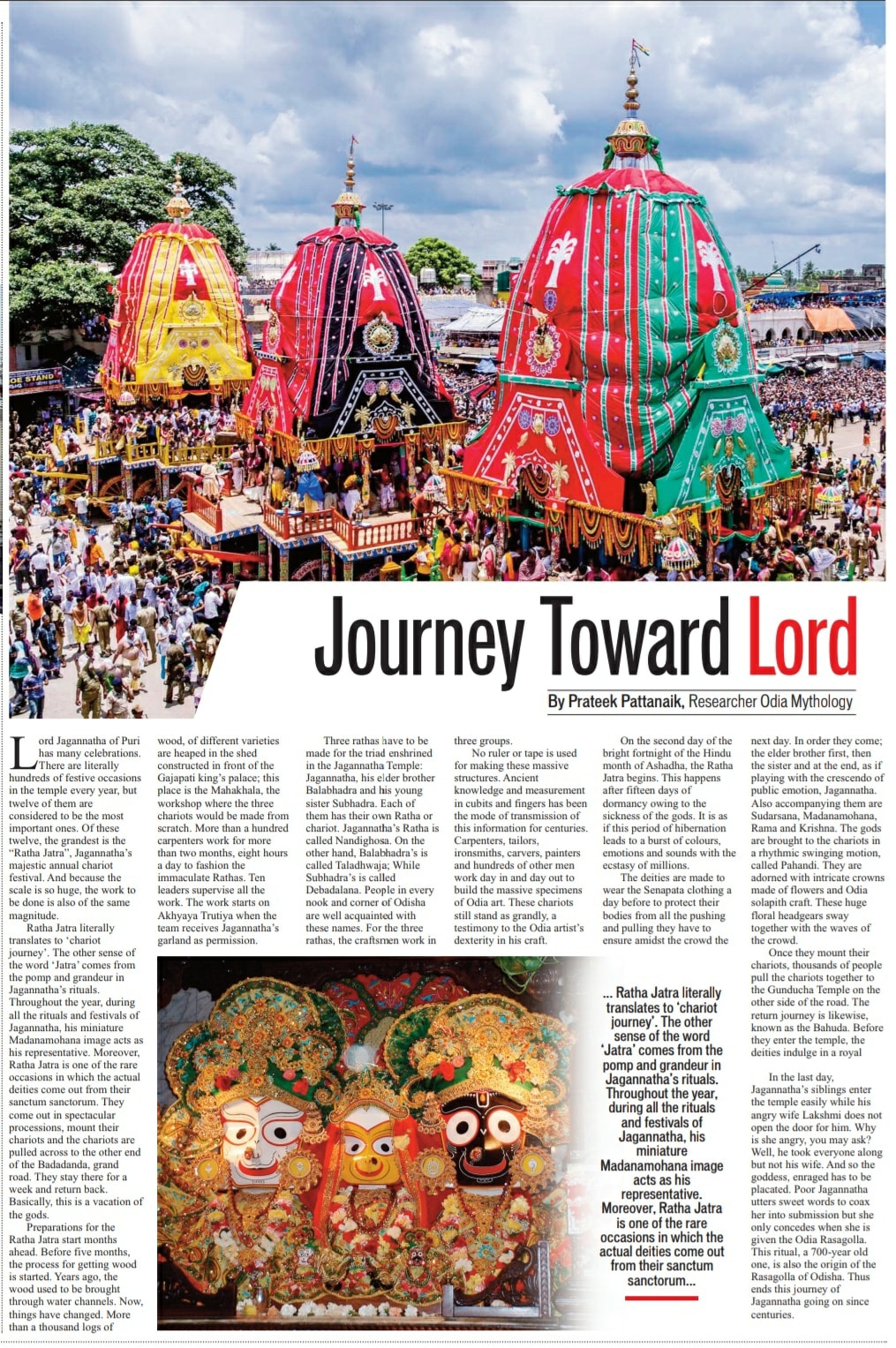
Lord Jagannatha of Puri has many celebrations. There are literally hundreds of festive occasions in the temple every year, but twelve of them are considered to be the most important ones. Of these twelve, the grandest is the Ratha Jatra, Jagannatha’s majestic annual chariot festival. And because the scale is so huge, the work to be done is also of the same magnitude.
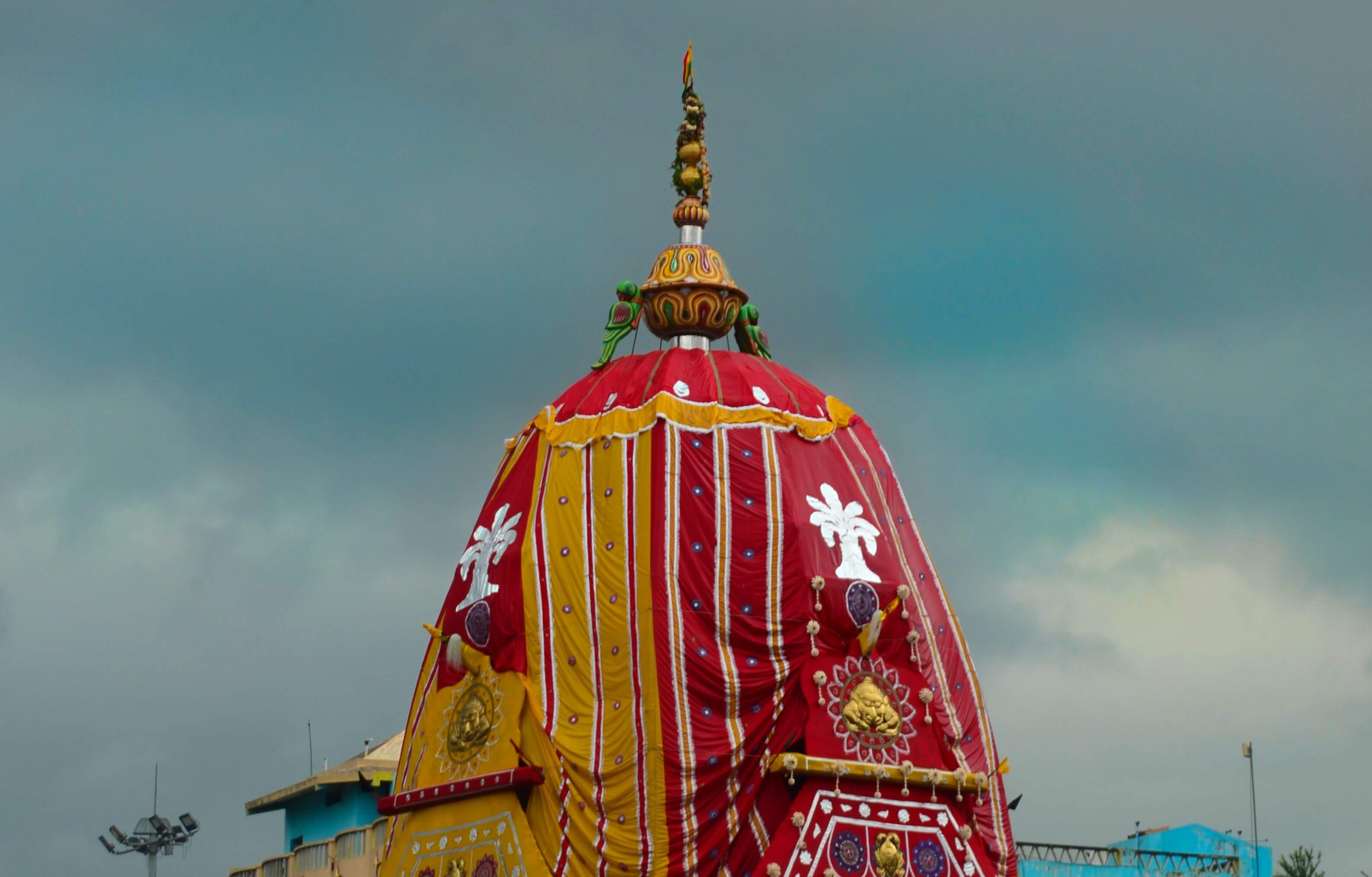
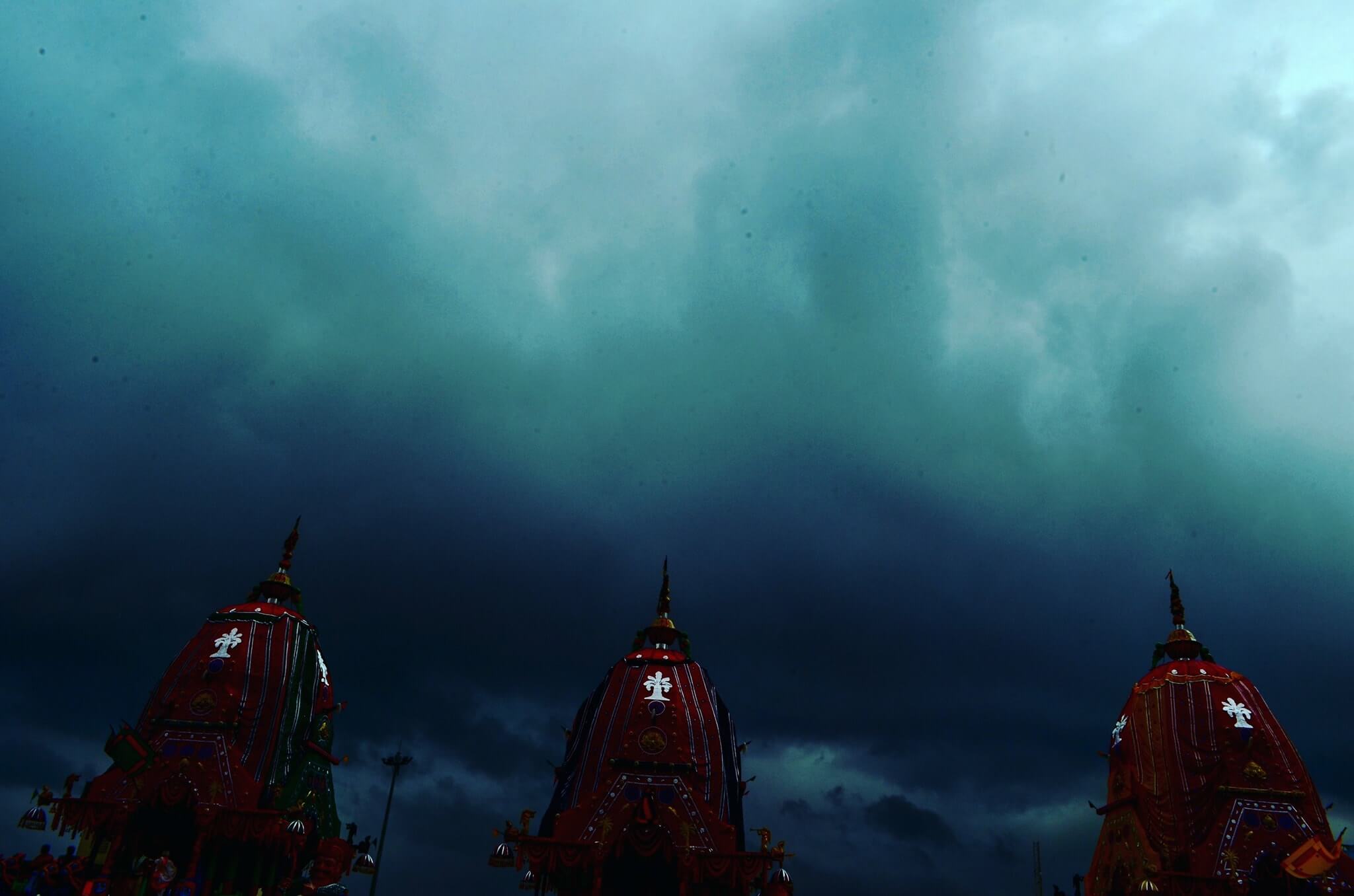
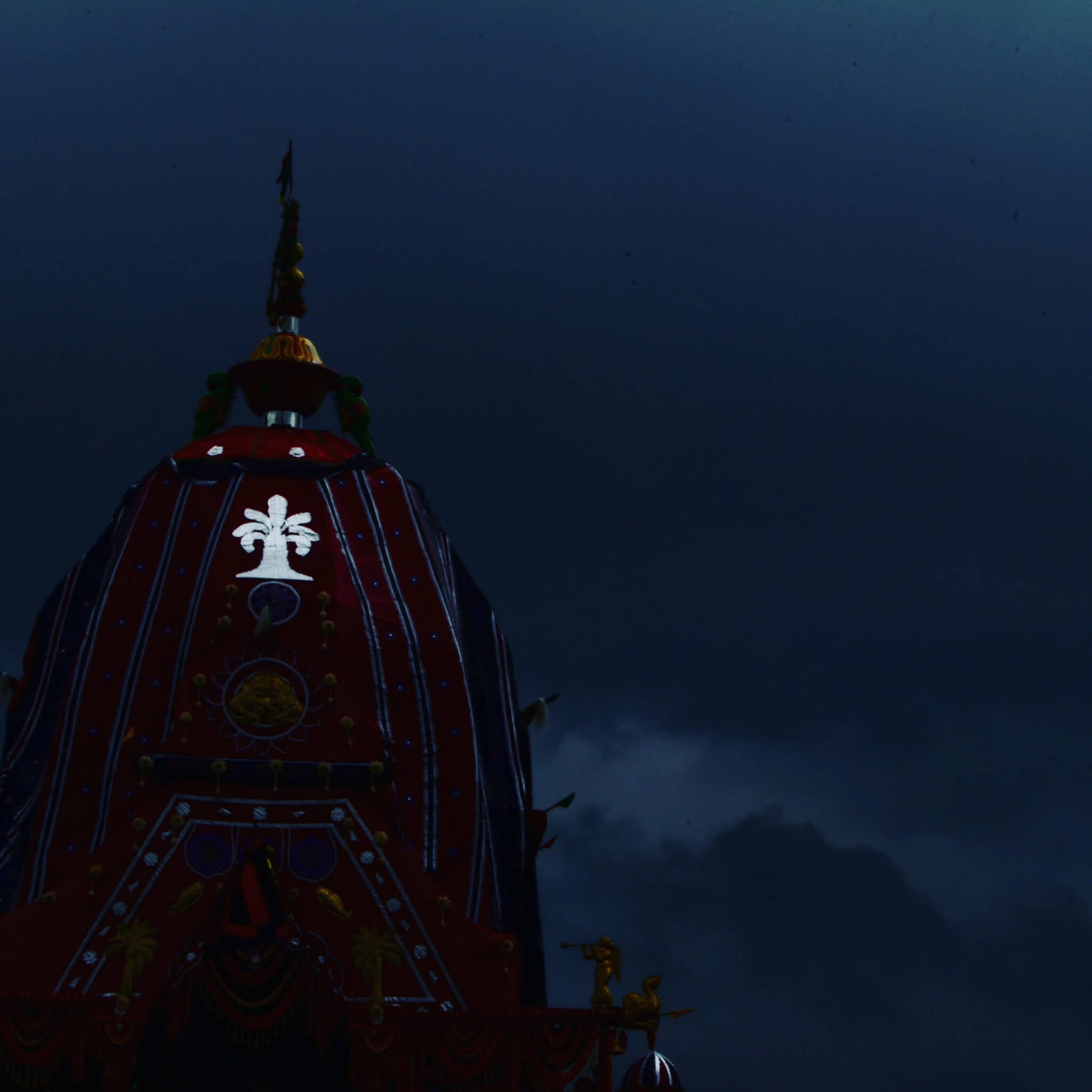
A stunning blue hue encompasses the sky at Puri. Prateek Pattanaik, 2018.
Ratha Jatra literally translates to ‘chariot journey’. The other sense of the word ‘Jatra’ comes from the pomp and grandeur in Jagannatha’s rituals. Throughout the year, during all the rituals and festivals of Jagannatha, his miniature Madanamohana image acts as his representative. Ratha Jatra is one of the rare occasions in which the actual deities come out from their sanctum sanctorum. They come out in spectacular processions, mount their chariots and the chariots are pulled across to the other end of the Badadanda, grand road. They stay there for a week and return back. Basically, this is a vacation of the gods.
Preparations for the Ratha Jatra start months ahead. Before five months, the process for getting wood is started. Years ago, the wood used to be brought through water channels. Now, things have changed. More than a thousand logs of wood, of different varieties are heaped in the shed constructed in front of the Gajapati king’s palace; this place is the Mahakhala, the workshop where the three chariots would be made from scratch. More than a hundred carpenters work for more than two months, eight hours a day to fashion the immaculate Rathas. Ten leaders supervise all the work. The work starts on Akhyaya Trutiya when the team receives Jagannatha’s garland as permission.
Three rathas have to be made for the triad enshrined in the Jagannatha Temple : Jagannatha, his elder brother Balabhadra and his young sister Subhadra. Each of them has their own Ratha or chariot. Jagannatha’s Ratha is called Nandighosa. Balabhadra’s is called Taladhwaja. Subhadra’s is called Debadalana. People in every nook and corner of Odisha are well acquainted with these names. For the three rathas, the craftsmen work in three groups.
No ruler or tape is used for making these massive structures. Ancient knowledge and measurement in cubits and fingers has been the mode of transmission of this information for centuries. Carpenters, tailors, ironsmiths, carvers, painters and hundreds of other men work day in and day out to build the massive specimens of Odia art. These chariots still stand as grandly, a testimony to the Odia artist’s dexterity in his craft.
On the second day of the bright fortnight of the Hindu month of Ashadha, the Ratha Jatra begins. This happens after fifteen days of dormancy owing to the sickness of the gods. It is as if this period of hibernation leads to a burst of colors, emotions and sounds with the ecstasy of millions.
The deities are made to wear the Senapata clothing a day before to protect their bodies from all the pushing and pulling they have to ensure amidst the crowd the next day. In order they come; the elder brother first, then the sister and at the end, as if playing with the crescendo of public emotion, Jagannatha. Also accompanying them are Sudarsana, Madanamohana, Rama and Krusna. The gods are brought to the chariots in a rhythmic swinging motion, called Pahandi. They are adorned with intricate crowns made of flowers and Odia solapith craft. These huge floral headgears sway together with the waves of the crowd.
Once they mount their chariots, thousands of people pull the chariots together to the Gundicha Temple on the other side of the road. The return journey is likewise, known as the Bahuda.
Before they enter the temple, the deities indulge in a royal display. They are dressed in the magnificent Suna Besa or golden attire. As the king of Odisha, this is a proud moment for everyone around.
In the last day, Jagannatha’s siblings enter the temple easily while his angry wife Lakshmi does not open the door for him. Why is she angry, you ask? Well, he took everyone along but not his wife. And so the goddess, enraged has to be placated. Poor Jagannatha utters sweet words to coax her into submission but she only concedes when she is given the Odia Rasagola. This ritual, a 700-year old one, is also the origin of the Rasagola of Odisha.
Thus ends this journey of Jagannatha going on since centuries.
Every year, the deities of the Jagannatha Temple are carried to the Gundicha Temple on the other side of the road on grand chariots, in the world famous Ratha Jatra. During this time, the huge temple remains empty, bereft of its presiding deities. People throng to the other temple where the deities reside during the time. But what happens inside the lonely chambers of the Jagannatha Temple? Out of the hundreds of stories surrounding the Puri shrine, this is one of the lesser-known, unusual ones.
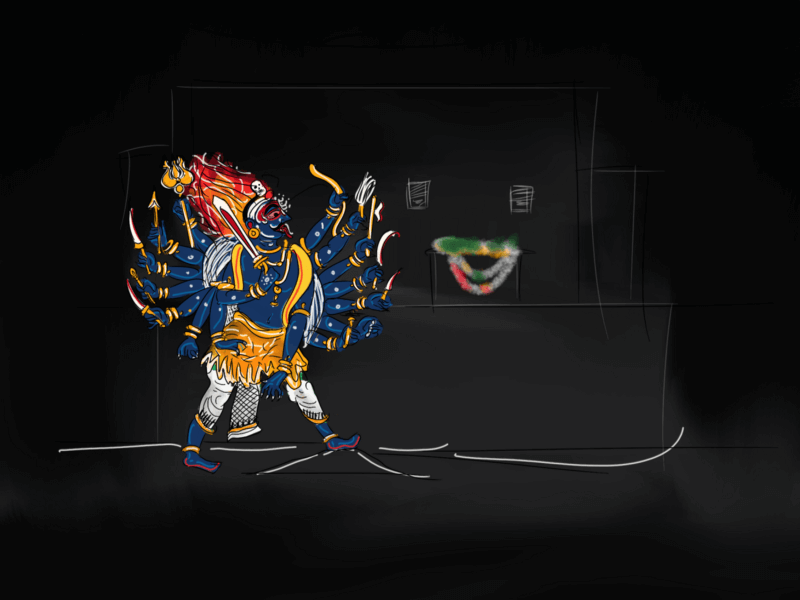
Illustration by Author
The Story
The sight was spectacular – huge idols of Balabhadra, Subhadra and Jagannatha being taken out of their main sanctum sanctorum. A huge flower-crown called a Tahia adorned their heads, and they danced as they came, the crown swaying with them. Ecstasy everywhere- people were going crazy- the thunderous clang of thousands of gongs filled the air, spreading the contagious enthusiasm. Jagannatha would refuse to move for a second, and the Pandas would be struggling to move him an inch- another moment, they would carry him like a feather. But one among the crowd was not impressed. The sensory overload was not enough to affect him, for he had learnt how to withdraw from the material world.
He watched like a prying predator, while the sea of people around him rose and fell. Soon, the Gajapati King arrived and did his traditional ritual. The horses were tied. The charioteer held the ropes. He called out, “Start, people!” The elephants dragged the chariot with men and the huge wheels started rolling.
The man now began laughing like one who is mad. It was nothing less than funny to watch a group of people put God in a chariot and drag him away, believing him to have left. What fools! Jagannatha can never leave this temple, his eternal abode. They may take away a wooden idol, but God can’t leave the temple. He must have left the idol. Yes, that was it!
Not even looking back at the chariots, the man left. Indraswami, he was. Skilled in the yogic arts, he had undergone years of penance. Nothing could lure him, nothing could frighten him. He had gained unconcern for the world. A great adept, he went back to his humble cottage and sat down for his yoga session. He tried to focus his mind on the Lord, but he failed to have a glance. He tried again and failed once more. Unable to have a mental vision, he proceeded towards the Jagannatha temple. People said that Jagannatha had left, but for him, he hadn’t. He was still at the Srimandir. And so, while people thronged at the Gundicha Temple on one side of the road, he proceeded to the other side.
He entered through the huge gates, finally leading to the inner sanctum. There, the Ratnasinghasana, the bejewelled pedestal was empty. No one sat on it. The temple was empty. So was the throne. He was alone in this void. So much had he seen in his life, yet, not a speck of fear had touched him. But now, he felt alone. The silence chilled his bones. He experienced horror in that dark stony chamber.
Indraswami tried to suppress his fear and marched on towards the throne. He was just near the throne when a horrible figure emerged from nowhere. He had fiery hair, sharp fangs and multiple hands. His ashy robes sharply contrasted with his dark hue. He flared out his tongue. Indraswami was shocked. He had never seen something more frightening in his life. He remembered Jagannatha to calm his mind. Re-energised, he stabilised his shaky voice to ask the person, “Who are you? Why do you stop me from circumambulating my worshipped?” The man laughed. So horrible and loud was his laugh that Indraswami had to shut his ears with his palms. The man spoke, “I am Bhairava. I am the Kshetrapala, protector of this holy land. When Jagannatha is away, no one but me has the right to come anywhere near his throne. Go away, go to the Gundicha Temple if you wish to see the Lord. He is not here.”
The name reminded Indraswami of another incident. Just a few days back, when Jagannatha was recovering from his fever, Indraswami had tried to roam around the temple during midnight. He came across a ferocious figure. Dark as the midnight, she held a scimitar in one hand. In a thunderous voice, she had asked him, “Who are you? Why do you come?” Indraswami had responded by saying that he wished to see the Lords. That woman had then told him, “You cannot see the deities. They are in their sickness, neither asleep nor awake. During this terrible time, I have been given the duty of protecting the temple. When the world sleeps and even God is asleep, I am awake. When no one was in this land, I was.”
The next day, Indraswami had narrated his sight to the priests. They said that she was none other than Bedhakali — Goddess Kali, who protected the temple.
Thinking of his visions, Indraswami realised that this was a land where the deities danced together in their terrible dance. He was reminded of the legendary Tandava, the dance of destruction. He went back to his hermitage and lied down, tired.
That night, Indraswami had a vision. Jagannatha himself appeared to him in his dream and told him that he was indeed in the Gundicha Temple. Indraswami woke up, astounded, and rushed towards the other side of the road, where the Lord waited for his devotee.
When you think about the Indian conception of God, most Gods live either alone or with their consorts. Jagannatha lives with his elder brother and sister in his huge home at Puri. Quite a departure from the usual norm; it doesn’t end there too. Not only does he have more members in this wonderful ‘divine’ family, the members are spread all across the state. Each of these deities has a very well-formed popular understanding of their characters. At times, it is just fascinating to study these beliefs and how anything or the else in Odisha invariably leads to Jagannatha.
Madhabananda Jiu of Niali
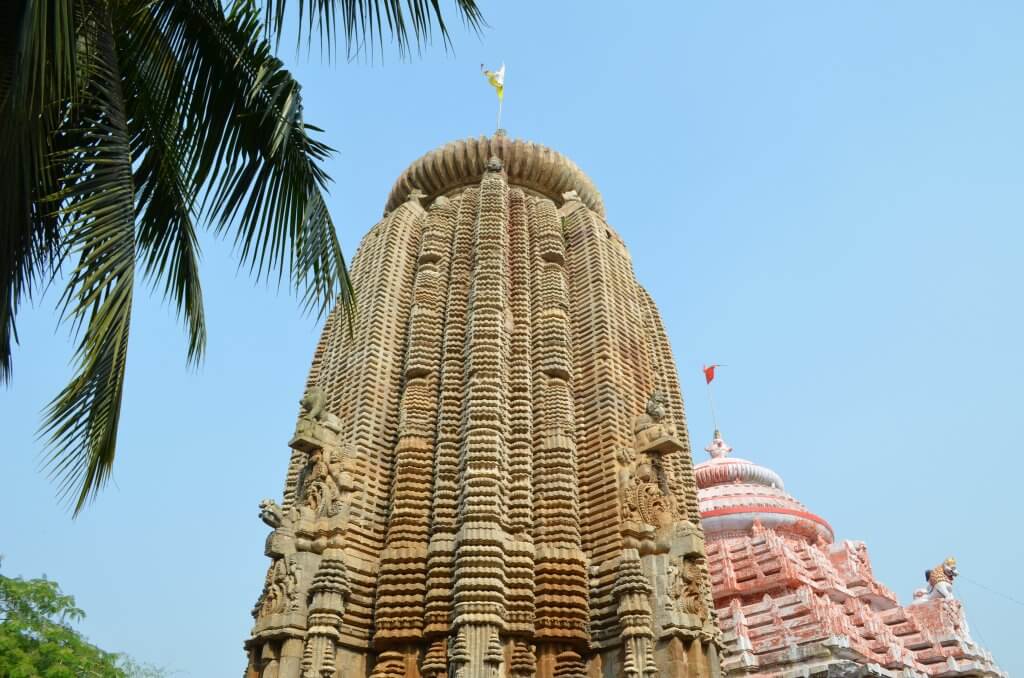
Let us look inside the grand temple of Puri first. This is the Badadeula, quite literally the ‘big temple’. Of the twenty four styles of homes this is considered to be Vishnu’s favourite and Jagannatha was accepted to be a primarily Vaishnavite deity when this temple (the third one) was constructed. He does not live only with his family though; he lives with his relatives, acquaintances and in a complex socio-cultural web, the entire society of Puri operates like a family for this deity to whom the Gajapatis of Odisha voluntarily acceded subservience.
Inside the sanctum sanctorum on the huge singhasana his elder brother Balabhadra sits to the left and Jagannatha himself sits to the right; their sister Subhadra is in between her brothers.
Balabhadra is white and his eyes are slightly reddish, intoxicated by the kadambari wine, which is considered to be his favourite. Canopying his head is the seven-headed white snake and he holds a huge pestle and plough in his hands. Being the elder brother, he is revered and obeyed without question.
Besides, everybody knows that he is easy-to-anger and easy-to-please and hence, no one messes with him. No one. Jagannatha on the other hand is everyone’s friend. They can talk to him as they are, without pretension, even hurling abuses and joking about his black face. To the young guys he’s the cool dude, to the elderly & the octogenarian priest he is a son and to the dancing Mahari servitor her husband.
Balabhadra is a bachelor while Jagannatha’s wives Bhudebi and Sridebi sit on both sides of him. Bhudebi is generally equated with Saraswati; calm, composed, artistic and knowledgeable. Sridebi or Lakshmi on the other hand is fickle, jealous and always looking for a fight. Lakshmi even dares to get into an argument with Jagannatha when he returns after the Ratha Jatra. One of the insults hurled is from Jagannatha who calls her squint-eyed. Going one step further he calls her father, the sea god Mahodadhi ‘salty’ and ’screaming’ and at the end, poor Jagannatha concedes and gives her a sweet Rasagola. He does his job of being a good son-in-law by regularly paying visits to his father-in-law though, so points for that.
The temple rituals acknowledge these ancient, nuanced behavioural analyses by the public. At one point Lakshmi and Saraswati get into a headless fight and poor Saraswati finds that nobody is by her side because all the other greedy demigods want some fast cash by siding with Lakshmi. Jagannatha is in an even pitiable state as the husband; he has to stop the banter and he calls the goddess Bimala for help in coaxing the womenfolk. She gets irritated and finds this squabble of no use, preferring to retire to seclusion with her music. The tantric goddess Bimala sits behind the towering badadeula in her own shrine. She is the mistress of the yoginis and the matrukas, possessing chants and adept in the mystic arts. Donning a classic black saree she tells Lakshmi to throw magic dust on her husband to bring him to his senses if he is too enamoured with his fantastic journey during the Ratha Jatra.
There are other members too. Natua Ganesha, for example, maintains records of the visitors. Agniswara Mahadeba inspects the food that comes out of the stove and Goddess Hingula of Talcher burns as the flame in the kitchen. Lakshmi herself is the head cook. Goddess Kuttama Chandi appears as a dog on the premises if there has been any pollution of the food before offering. Bhandara Lokanatha is the treasurer and the protector of the Ratnabhandara. Isaneswara Mahadeba towards the northern side is Jagannatha’s teacher. Hari Sahadeba tends the cattle and is in-charge of the dairy. Khetrapala Mahadeba maintains the security and the ferocious Bedhakali guards the inner complex. Each one has his or her duty in the grand scheme.
Perhaps the most well-known of all of Jagannatha’s relatives is Mausi Maa, his maternal aunt. Her actual name is Ardhashani and she looks a lot like Subhadra because they are from the same family. She lovingly cooks a podapitha each year when Jagannatha stops by at her humble home by the Badadanda each year during the Ratha Jatra. Bhubaneswar’s Lingaraja Shiva similarly stops by at his sister Kapalini’s house at the Baitala Deula and gives her a gift.
Within Puri, the five major Shivas are good friends of Jagannatha. He goes for his boating sessions with them during the Chandana Jatra. Lokanatha and Jagannatha have a hilarious conversation on the way. Jagannatha tells his pal about his wives always squabbling with each other, and Lokanatha breathes a deeper sigh because his condition is no better. Moreover, his vehicle is a bullock and his wife’s a lion. Their sons have a peacock and a rat. Fed up of all this worldly stuff both of them resign. Jagannatha turns to wood and Lokanatha to stone. And so the people of Puri have a saying “He is wood, he is stone; to whom can one turn to?”
A little far away, Niali’s Madhabananda is Jagannatha’s uncle. Madhaba lives with his sister Durga in that place. Before the Ratha Jatra, the siblings get permission from their uncle for their outing. The 15th-century philosopher-poet Balarama Dasa even mentions deities across the state who come to Puri to get a sight of Jagannatha night time Badasinghara attire.
We have talked about all kinds of relations, but who are the parents? Strange are the deities of Puri; they have not one but five pairs of parents. Each year they offer funeral oblations to Kasyapa-Aditi (for Vamana), Kausalya-Dasaratha (for Rama), Basudeba-Debaki and Nanda-Jasoda (for Krishna). At the end, they make offerings to Indradyumna and Gundicha, the legendary king and queen who erected the first temple and started it all. Indradyumna had asked Jagannatha to give him no offspring because then his children would have claimed the temple as a feat of their ancestors. Childless, the couple would have nobody to complete their funeral and so Jagannatha took that upon himself.
The dark God of Odisha surely knows how to pay gratitude.
Does the tradition of pulling a chariot exist elsewhere in Odisha? Yes it does! Many different shrines across Odisha have their own chariot-pulling festivals. Most of these are emulations of the iconic Ratha Jatra of Jagannatha. Bhubaneswar’s famous Lingaraja Temple and Jajpur’s Biraja Temple both have their own Ratha Jatras, albeit at different times of the year. Lingaraja’s chariot is called Rukuna Ratha and Biraja’s is called Bijaya Ratha.
Even the magnificent Sun Temple of Konark might have had its own chariot festival. Mentioned in the ancient book of accounts of the Sun Temple is the construction of a 24 cubit high Ratha which was made by a group of 40 carpenters. Eight painters from Puri went to paint the chariots. This chariot festival was done on Magha Saptami, said to be Surya’s birthday. Even today, hundreds of people gather near the Chandrabhaga as per tradition.
What are some of the unusual traditions associated with Ratha Jatras across Odisha? When the iconoclast Kalapahada attacked the Puri triad, the priests fled with the deities and concealed them in the deep pockets of Odisha. One such place was Marada in Ganjam, where the gods lived for almost two years. The temple was constructed atop a mountain and there was a huge canal surrounding the shrine hidden by dense forest cover. Due to this, conch shells were never blown or gongs beat for fear of drawing attention. To this day, the Marada temple has no Ratha Jatra. People still throng the empty singhasana with as much devotion though.
The Balarama Jiu Temple of Dhenkanal is presided by not Jagannatha, but his elder brother Balabhadra. And so it is the Ratha of Dhenkanal that moves first. Popular belief dictates that the younger brother waits for his elder to move first, and it is only after Dhenkanal that the Puri chariots can move.
We have innumerable such distinctions across the state. One can only list so much.
Everybody knows about Mausi Maa, Jagannatha’s aunt. Are there any other divine relatives? Yes! In fact, Jagannatha is so deeply ingrained in Odisha’s cultural fabric that one finds a very complex net of beliefs across the state. And so, there is an entire divine family.
Jagannatha lives with his brother Balabhadra and sister Subhadra in the Puri Temple. Lakshmi has her own temple just behind his, and Bimala & Lakshmi are believed to be good friends. His maternal aunt Mausi Maa lives a few kilometres away but within the boundaries of Puri. Madhabananda Jiu of Niali is believed to be Jagannatha’s uncle, whose permission he seeks before starting out on his Ratha. Madhaba himself lives with his sister Durga. Panchupandaba, the five Shivas of Puri are good friends of Jagannatha; he takes them along during his summer boatrides. Lokanatha is the protector of Jagannatha’s treasury, Isaneswara his teacher and Agniswara the fire of his kitchen. Hari Sahadeba tends to his cattle while Natua Ganesa keeps a record of the visitors. Khetrapala Mahadeba and Bedhakali guard the temple.
His father-in-law, the sea-god Baruna lives near the temple of Chakra Nrusingha. Every fortnight, Jagannatha goes in the form of Amabasya Narayana to meet his in-laws. One has got to maintain good relations with family after all!
Which servitors work to give life to the Ratha Jatra? Many classes of servitors. The Ratha Jatra forms a very good example of how the Jagannatha Temple binds the social structure of Puri and its surroundings. Carpenters work to make the wooden frame, woodcarvers carve the skeleton, ironsmiths prepare clamps, painters colour the chariots, tailors make the fabric covering. Milkmen provide dairy products for the Adhara Pana while potters make huge earthen pots. It is as if various occupational groups come together to make the event a success. Perhaps this is what has been driving this festival for hundreds of years.
Do we have accounts of the Ratha Jatras of the past? Yes we do. Numerous poets of Odisha give vivid accounts of the grandeur of these celebrations. One of the notable accounts is the tale of the marauder Kesho Das, who led a big army under the Mughal emperor Jahangir. Around 1610, Kesho Das attacked and ransacked the Puri Temple. Gajapati Purusottama Deba, on getting this news immediately started out with an army and surrounded the temple, inside which were the enemy. In a last attempt, Kesho Das did something unimaginable; he set fire to the three Rathas. Enraged, the Odia troops battled day and night but Kesho Das had a last trick up his sleeve; he sent word and got a backup army. According to some historians, the Gajapati was forced to accede to an agreement under which he had to offer his daughter to the Delhi king and his sister to Kesho Das. This was one of the worst days in Odisha’s history. But even with so many attacks, Ratha Jatra still continues today, with increased splendour.
Why are certain rituals of the Jagannatha Temple secret? Certain rituals like the Nabakalebara and Anasara are entirely out of public view. This is attributed to various reasons. The logical point of view is that the deities need to be painted afresh during Anasara and this isn’t possible in full view. The other side is that he is sick with fever and hence prefers isolation. We can only speculate; the secrecy surrounding these things is there for a reason.
A legend talks about Karnama Giri, a famous 12th-century tantric who was so proud of his occult powers that he decided to investigate the issue. He assured the king that this was a hoax and somehow managed to get him so that he could expose this great big lie that god could have a fever. He then turned into a bee and tried to fly inside but was overcome with a pungent scent and fled the place half-swooning. As a last attempt, he tried to turn invisible and follow a daitapati into the internal chamber. Karnama is said to have seen eight ladies sitting on an eight-petalled lotus. They chuckled at his stupidity. He could understand nothing and finally acknowledged his defeat. The dark Anasara chamber is still as mysterious.
Jagannatha brushes his teeth and chews a ‘paan’ daily, but he does not take a bath each day. Well he does, but it is a symbolic ritual. Every morning, he is dressed in barebones clothing; only two pieces of cloth known as tadapa and uttari. The tadapa is wound around his waist while the uttari is thrown across his shoulders. Three metal mirrors are placed in front of the three deities and angled such that their faces are reflected. These mirrors are then bathed with scented water. This elaborate arrangement acts as the daily bathing ritual of the gods.
Once in the year however, he comes out for an actual bath and when he does, the bath is with more than a hundred pitchers. That night he gets a fever and has to be cured for 15 days. This period is known as Anabasara, or the more colloquial Anasara. He is hidden from public view for this period and the people get to see three paintings in his place instead. These are the Anasara Pati paintings, humanised depictions of the beloved triad. Behind the partition however, the ailing deities need to be cured of their fever. And the only ones who have access to the secret chamber are the Daitapatis, believed to be descendants of the Sabara king Biswabasu who originally worshipped Nilamadhaba. The treatment inside is hence believed to be reflective of the Sabari tribal rituals. To everybody else, the secret of the Anasarachamber remains hidden.
Only a flickering earthen lamp provides light to the enormous temple during this period. No loud instruments are rung because that would disturb the deities, who only wear a single white cloth and pure white flowers. It is said that there must not be even a single coloured petal in the floral ornaments woven during Anasara. It has to be pure white to maintain the solemn mood. For a temple that is bursting with colours, sounds and festivity throughout the year, this period is a dramatic departure. Shrouded in these surroundings is the mystery of the Anasara chamber. These secrets have remained secret for centuries. We only know a little here and a little there, but nothing more.
Of the things that we do know are the few rituals that occur outside the temple. On the fifth day of Anasara, the Bada Odia Matha of Puri provides Phuluri Tela, a special kind of medicinal oil. Myriad scented flowers and barks combine with camphor, sandalwood and other ingredients to form this oil. The oil is actually kept underground for a year, then dug out and carried to the temple in earthen pots. This is said to provide relief to the ailing Gods. Also prepared is the Anasara Pana, a special drink made to cure. The Gods’ also have their very own doctors; the Baidya family. With their knowledge of ancient medicine, they prepare various medicinal concoctions, of which notable is the Dasamula Modaka or rounded pills of a special concoction whose ingredients are secret.
Most of the other details remain unknown. This secrecy, as one would expect, has often stimulated curiosity. Back in the 12th century, Karnama Giri, a tantric expert came to know that the deities were ill. When he was refused a sight, Karnama rebelled – how could God fall ill? He somehow convinced the king that this was all a hoax and declared that he would expose it all. He first flew in as a fly, but he saw a lotus and so pungent was its smell that he fainted. Somehow he struggled outside through the crevice in the door. The next time he turned invisible, but inside he saw eight maidens who chuckled at his stupidity. Bewildered he acceded defeat and left. Stories such as these still lurk around.
The practical point of view is that all the bathing washes off the colour, and the images have to be remade and repainted. This keeps the deities looking as new as ever. The last day is theNaba Joubana, when the completed deities are finally shown to the public. Before that the faces of the idols are painted. This work is done only by the Datta Mahapatra at Puri. The Datta Mahapatra family carefully keeps the Banaka Pothi in their home. This is their prized heirloom, and the only painting manual found in Odia palm leaf manuscripts. It mentions in detail how the three deities have to be painted. Like everything else concerned with Anasara, the contents of this manuscript too are a secret. After painting the eyes, eyebrows, eyelashes, mouth and nose, the eyeballs are filled with black at the very end. This concluding process of filling the eyes completes the images. A day later would be the magnificent Ratha Jatra, when the dormant temple would rise up again with the most splendid celebration of the entire year.